Make Texture a preferred source on Google to support us
Add Texture to GoogleIn May 1927, a man arrived at the port of Papeete whose vision would leave a lasting mark on the iconography of the South Pacific. Robert Lee Eskridge, an American painter and illustrator, was then beginning the first of his four stays in Tahiti, laying the groundwork for a monumental body of work now compiled in a reference book: *Robert Lee Eskridge: Affable Artist, Author, and Adventurer in Tahiti, Hawaii, Brazil, and Beyond*. Published by South Pacific Dreams Publishing, this volume is the fifth installment in the Artists of the South Pacific series, offering an exhaustive exploration of a body of work that captured the essence of Polynesia and Hawaii with a unique modernity.
From European Precision to the Light of the Gambier Islands
Eskridge’s journey is not merely the wanderings of a contemplative traveler. Born on November 22, 1891, in Pennsylvania—records vary between Philipsburg and Philadelphia regarding his exact birthplace—the artist honed his technique at the most prestigious institutions. From the University of Southern California to the Art Institute of Chicago, his academic education was complemented by a formative immersion in Paris. In the French capital, he became a student of André Lhote, a master of Cubism, and of the engraver George Senseney. This European influence, combined with a three-year journey through Europe and North Africa in the 1920s, shaped a style in which geometry and clear lines take precedence over Impressionist blur.
After arriving in Tahiti, Eskridge took his exploration even further. In 1929, he settled for eight months on the island of Mangareva, in the Gambier Archipelago. This immersion would give rise to one of his most notable works, *Manga Reva: The Forgotten Islands*, published in 1931. This period was pivotal: it marked his transition from a passing observer to an author and illustrator deeply rooted in the geographical and cultural reality of Oceania. Eskridge did more than just paint; he documented, wrote, and illustrated, later producing works such as *Umi, the Hawaiian Boy Who Became King* and *South Sea Playmates*.
An Art Deco Aesthetic in the Service of Polynesian Dignity
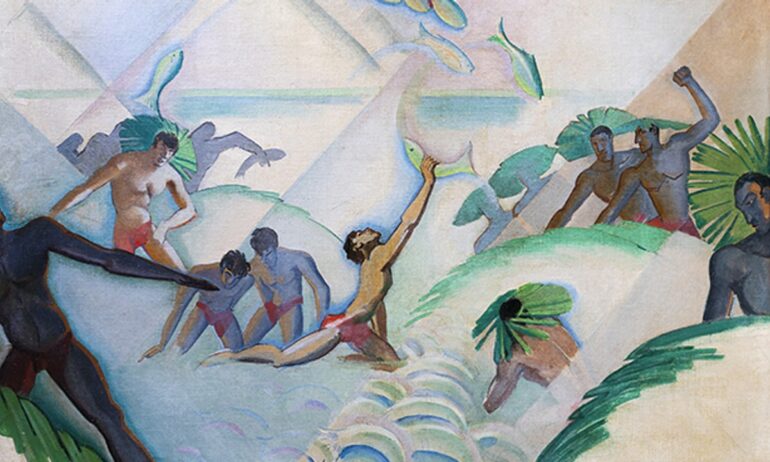
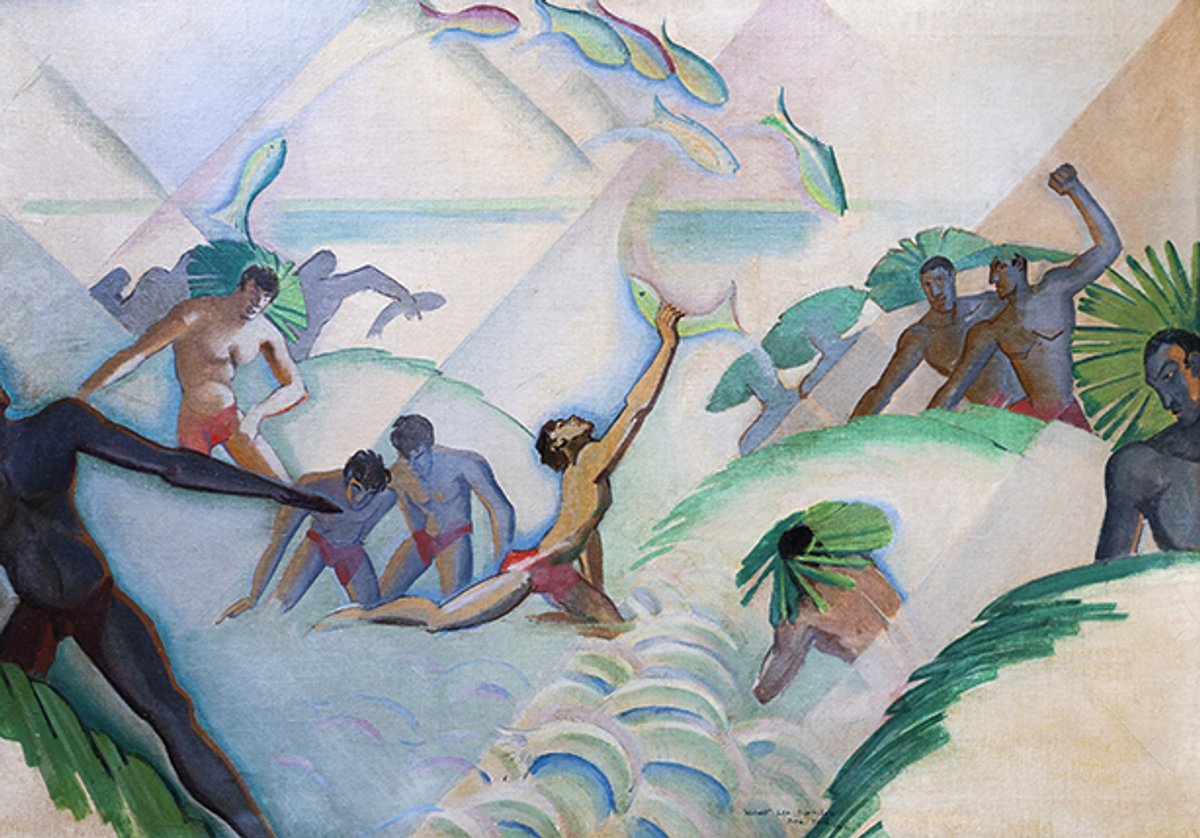
Eskridge’s body of work, comprising several hundred oil paintings and thousands of watercolors, is distinguished by an effective synthesis of Art Deco and figurative modernism. His use of dynamic blocks of color and bold geometric shapes lends his subjects an almost sculptural presence. His preferred themes reflect a desire to move away from colonial clichés or the static depictions for which his predecessors were often criticized. In Eskridge’s work, local people are depicted in action, embodying the dignity and vitality of their present lives.
His compositions celebrate daily life and ritual: scenes of traditional fishing, notably stone-fishing, appear alongside depictions of hula dancers, surfers, and paniolos—those iconic Hawaiian cowboys. His work *Hilo Wharf* perfectly illustrates this focus on harbor scenes, places where tradition meets modern economic activity. This documentary and artistic approach offers an alternative to Western fantasies, favoring the observation of active bodies and ceremonies rooted in tangible reality.
The Mural Legacy: From Chicago to Honolulu
Before settling permanently in Honolulu in 1932, Eskridge had already made a name for himself in the art of monumental murals. Between 1926 and 1927, he created four murals on the theme of Marco Polo for the lobby of the Palmer House Hotel in Chicago—works that were unfortunately painted over in 1966. His move to Hawaii, where he taught at the University of Hawaii, allowed him to return to this medium. Under the auspices of the Works Progress Administration (WPA) during the New Deal, he created two monumental murals dedicated to the Makahiki festival for the sports pavilion at Ala Moana Park in Honolulu.
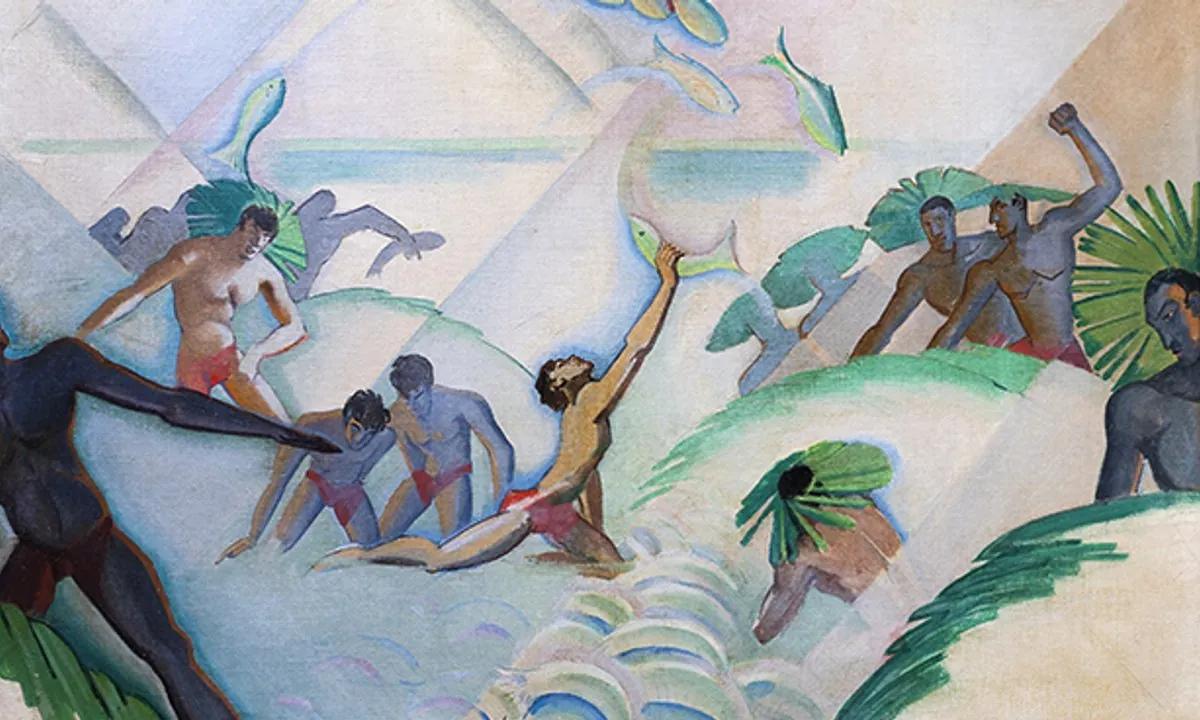
These public commissions attest to the institutional recognition the artist received during his lifetime. His work was not limited to the easel canvas but was integrated into urban architecture, making local folklore and traditions an essential component of modern public space. Robert Lee Eskridge passed away in Honolulu in April 1975—sources vary between April 14 and 16—leaving behind an unprecedented visual record of a rapidly changing Pacific.
A Work of Historical Rehabilitation
The book, written by C. J. Cook, a biographer and collector, is a cornerstone for understanding this period in art history. This 344-page hardcover book (some databases list 340 or 612 pages, but the publisher’s figure remains the standard) brings together 509 images, offering a comprehensive overview of Eskridge’s career. With a foreword by Michael Horikawa and Watters O. Martin, the volume allows for a reassessment of the artist’s significance in the dissemination of Art Deco within the Oceanic context.
Available since August 11, 2026, the book (ISBN 9798994826607) retails for $59.95 USD. It provides a solid documentary foundation for enthusiasts of design and cultural history, shedding light on a man who was at once a painter, author, and adventurer, and whose influence continues to fuel the imagination of the South Seas without ever succumbing to the easy appeal of the picturesque.