
Make Texture a preferred source on Google to support us
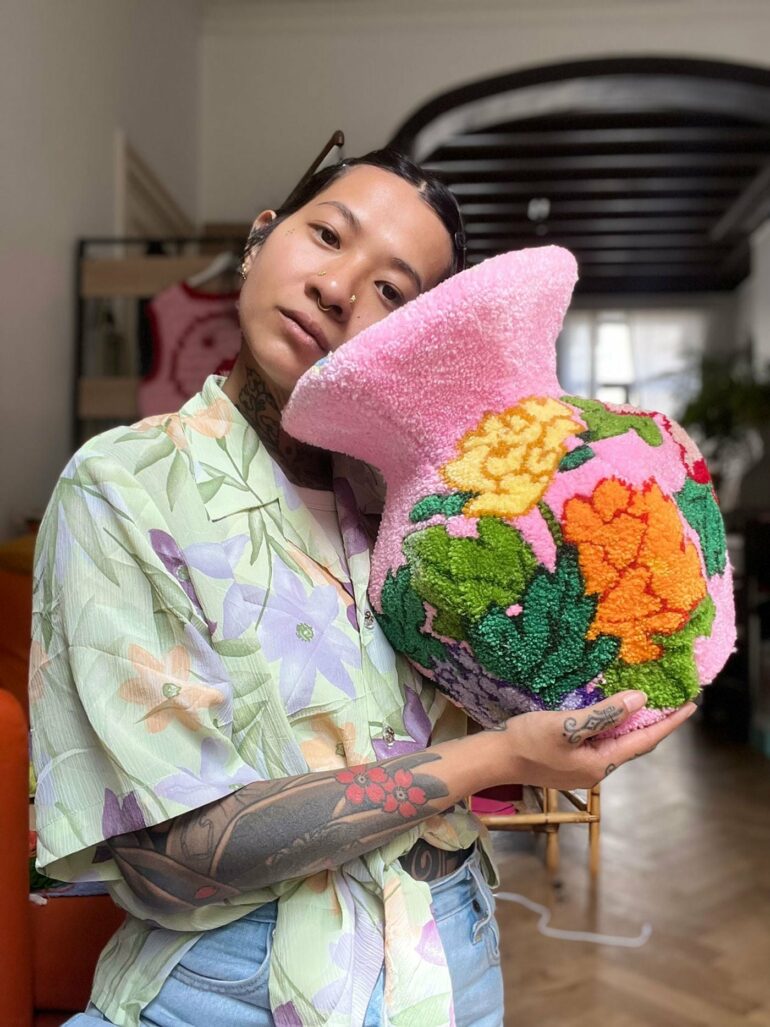
Add Texture to GoogleIn Brussels, amid the bustling Marolles neighborhood, an artist is redefining perceptions of traditional decorative objects by subverting the conventions of the medium. Shishi San, born in Vietnam in 1993 and adopted by a Belgian couple, has made textiles the vehicle for a quest for identity in which her Asian roots and her Western environment intertwine. In her studio, the cold, rigid forms of antique porcelain are transformed into warm, tactile volumes, turning classical heritage into a unique sensory experience. This approach, which rejects mass production in favor of the uniqueness of each piece, is rooted in an ongoing dialogue between personal memory and observation of the world.
From Embroidery to Three-Dimensional Form: Learning About Textiles
Shishi San’s journey is that of a self-taught artist whose sensibility has been refined through the mastery of various techniques. As a teenager, she began experimenting with textile customization and embroidery, before exploring the possibilities of crochet, knitting, and punch needle. It wasn’t until 2019 that she discovered tufting, a technique traditionally reserved for making wall hangings or rugs. Initially focused on two-dimensional creations, her practice took a decisive turn in 2022 when she decided to add depth to her work. By developing an internal structure capable of supporting the weight of the fibers, she managed to make her works stand upright, transforming them from tapestries into three-dimensional sculptures.
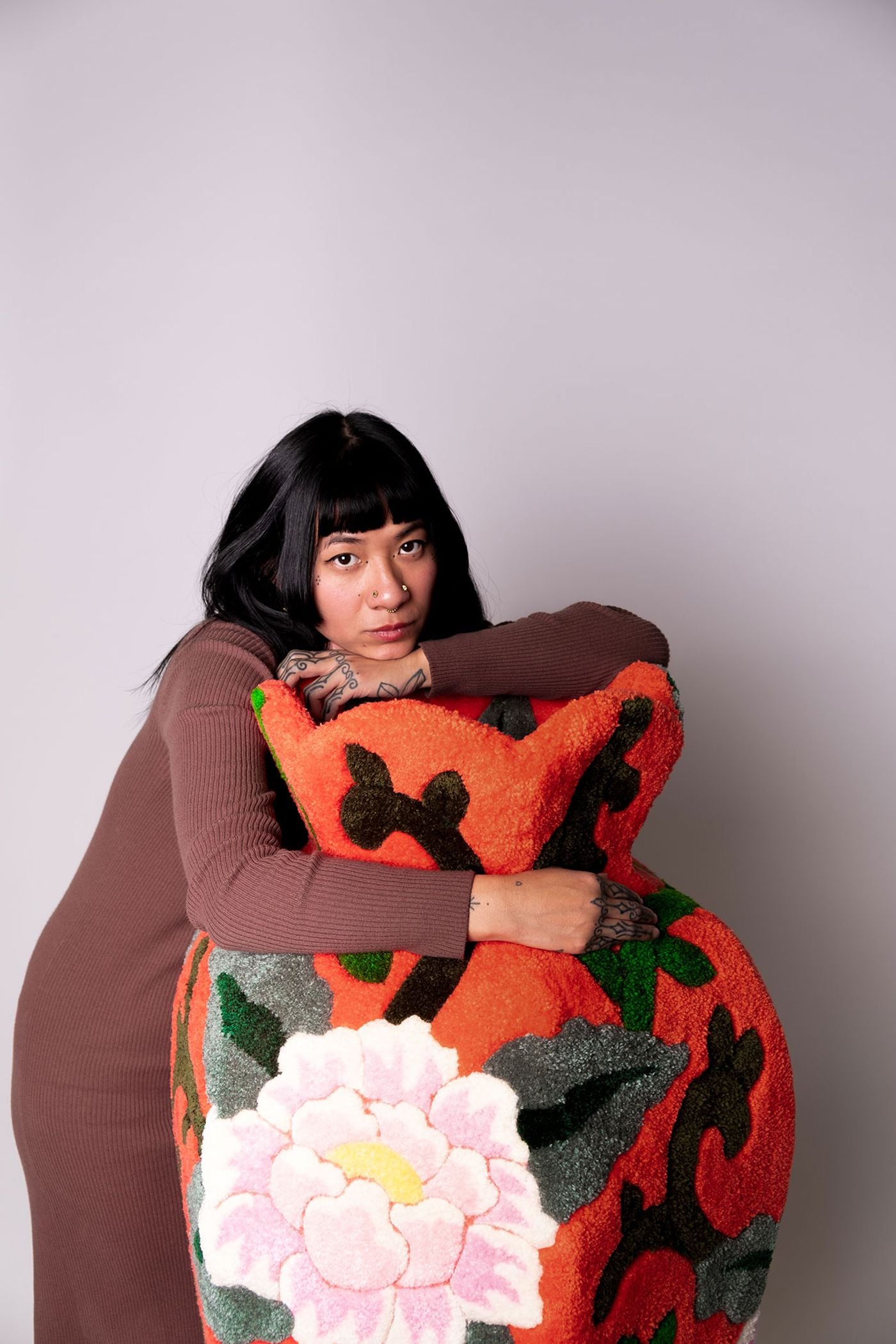
This transition to 3D marked the birth of the Fluffy Collection, an inaugural series of nine pieces inspired by Chinese vases. The concept is based on a reversal of materiality: whereas ceramics are hard, cold, and fragile, Shishi San’s sculptures are soft, supple, and padded. This striking contrast between the historical form and the textile rendering challenges our relationship with the precious object, which is stripped here of its utilitarian function to become an almost living physical presence in space.
An Aesthetic Bridging Brussels and East Asia
The artist’s work serves as a mirror of her dual cultural heritage. On one hand, it draws from the repertoire of ancient East Asian ceramics, borrowing the characteristic silhouettes and iconographic motifs of Japanese and Chinese vases. The flora, folklore, and mythologies of South and Southeast Asia fuel her imagination, filling her creations with reinterpreted symbols. On the other hand, her daily life in Brussels directly influences her compositions. Her strolls through the flea market at Place du Jeu de Balle and the antique shop windows in the Marolles neighborhood are a constant source of inspiration.
This fusion is particularly evident in works such as the *Stained Glass Vase*, where the botanical motifs of Brussels Art Nouveau meet the tufting technique. Shishi San does not merely reproduce forms; she reinvents them by imbuing them with texture. Each piece becomes a vessel for a narrative in which eras and geographies overlap, creating a unique aesthetic that has already caught the attention of institutions such as MAD Brussels (Center for Fashion and Design). It was in this context that she collaborated with photographer Mous Lamrabat on the exhibition A(R)MOUR, cementing her place at the intersection of design and contemporary art.
The Precision of the Gesture: Between Spray Gun and Scissors
The ethereal quality of Shishi San’s sculptures belies a highly precise technical process. Each work begins with the creation of an internal framework, made from recycled cardboard or rigid structures shaped to define the final silhouette. On a cotton canvas, the artist projects acrylic wool fibers using a tufting gun. Once the fiber is secured to the back with a layer of latex glue, the most meticulous stage begins: manual carving.
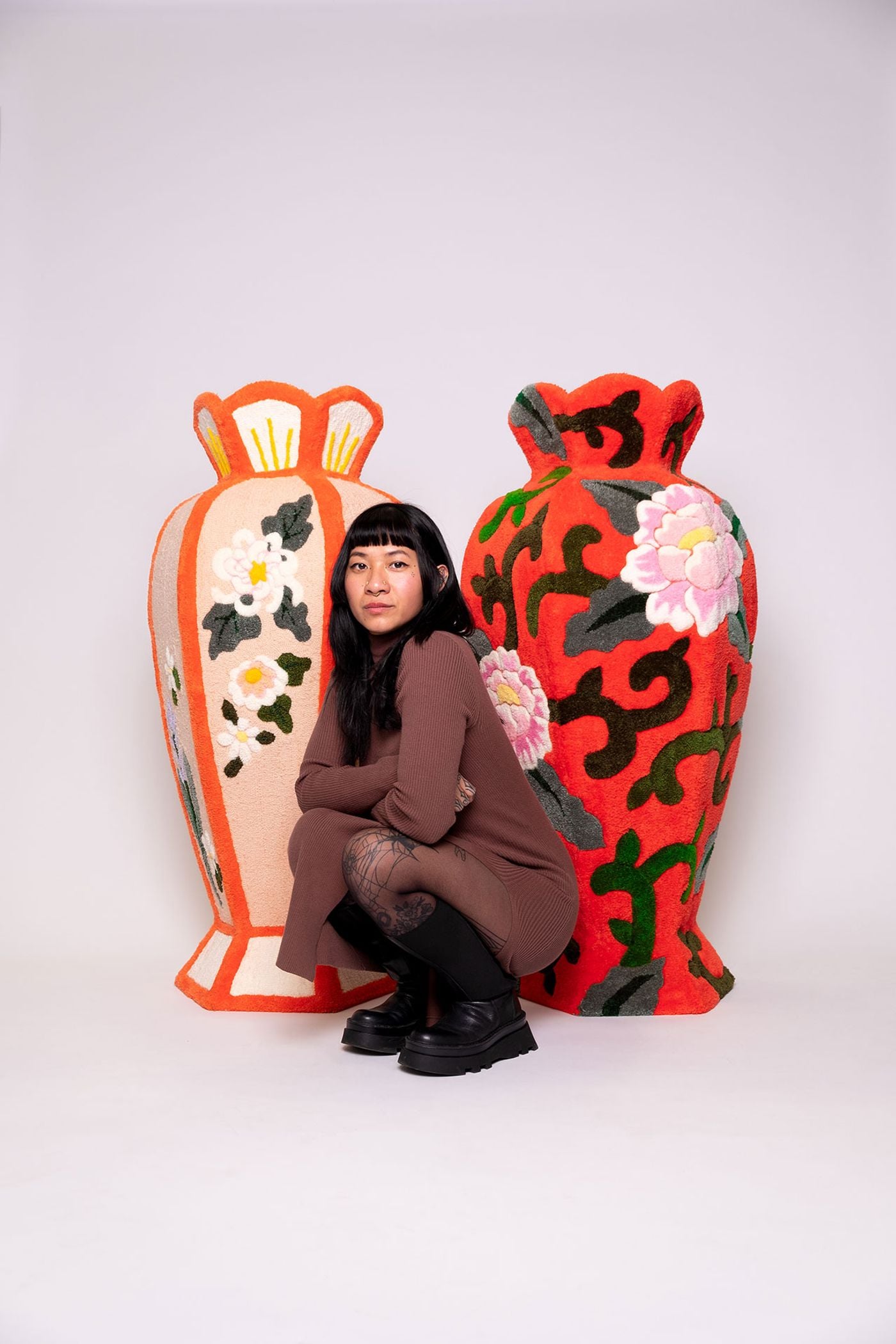
Armed with scissors, Shishi San literally carves the wool on the surface. This carving process creates sharp edges, highlights the contours, and generates plays of light and shadow that lend depth to the patterns. It is this final stage that gives the pieces their graphic appearance and sculptural definition, transforming a shaggy surface into a structured form. The occasional use of acrylic paint sometimes complements this work on textures and color nuances, reinforcing the pictorial quality of each vase.
Recognition and Prospects in the Art Market
Since her inaugural exhibition at the That’s What X Said gallery in Brussels between 2022 and 2023, the artist’s market value has been steadily rising. Her works, presented by EDJI Gallery at events such as The Rooms at Mix Brussels in May 2025, command prices that reflect their uniqueness and the complexity of their craftsmanship. For example, the Pink Flask (2025) sells for around €1,500, while larger pieces such as the Large White Flask (2025) fetch €2,500 in galleries.
The reach of her work now extends beyond Belgium’s borders. In 2025, Shishi San participated in the Ulsan International Art Fair (UIAF) and took part in residencies during Textile Craft Week in South Korea, reflecting a strong interest in her reinterpretation of Asian traditions through the lens of contemporary textile craftsmanship. Her collaboration with Hashimoto Contemporary, notably for an exhibition in Los Angeles and New York alongside Ella Emhoff, underscores the international appeal of this new generation of textile artists. Finally, her selection by the Homo Faber platform recognizes her technical expertise within the realm of high-end arts and crafts.
The year 2025 also marks a symbolic milestone in her career with the creation of a custom vase for the artist Stromae, a private commission that illustrates the resonance of her aesthetic with other major figures in the Belgian cultural scene. By continuing to explore the format of flasks and three-dimensional floral vases, Shishi San pursues a body of work in which the apparent softness of the material serves as a vehicle for a complex reflection on heritage and self-construction.