
Make Texture a preferred source on Google to support us
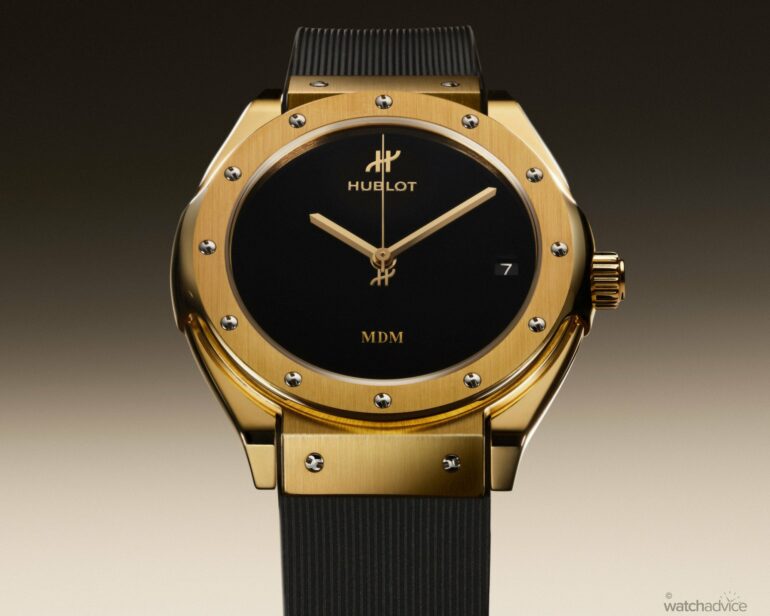
Add Texture to GoogleOn the dial of the Classic Fusion Tributo, there’s nothing to help you tell the time. Not a single hour marker, not a single numeral: just a date window at 3 o’clock and three discreet letters at 6 o’clock. To tell what time of day it is, you have to look up at the bezel, where twelve domed screws—fully functional—serve as hour markers. This design is by no means a recent whim. It dates back to a watch unveiled in 1980 at the Basel Fair—the first in watchmaking history to combine an 18-karat gold case with a natural black rubber strap. Forty-six years later, Hublot is bringing it back, and the watchmaker who originally launched it was there to witness its rebirth.
Basel, 1980: Gold Meets Rubber
The story begins under a different name. When Italian watchmaker Carlo Crocco unveiled his watch in Basel, he did so under the name MDM Genève, standing for Marie Danielle Montres. The watch defied convention: a precious metal, crafted with all due care, fastened to the wrist by a material that no one would have associated with gold. It was this clash that would later become, in the brand’s vocabulary, the “Art of Fusion”—a marketing concept that still gives its name to the entire Classic Fusion line.
The gamble paid off quickly. From the moment it was launched, the model found an audience among European royal families and numerous celebrities. A clientele accustomed to classic aesthetics thus embraced, without hesitation, a watch that challenged those conventions. That is precisely the challenge of the Tributo: to reimagine this provocation at a time when it has become the brand’s standard.
Milan, October 2026: The Founder’s Return
The new model was announced on October 15, 2026, in Milan. Carlo Crocco participated in the event as well as in the launch campaign, alongside Julien Tornare, CEO of Hublot. This gesture carries significant weight: it’s rare for a reissue to come with the endorsement of the designer who created the original.
This connection is, in fact, inscribed on the dial itself. The letters “MDM,” pad-printed at the 6 o’clock position, carry a double meaning. They refer to MDM Genève, the brand’s original structure, but also to “Main Dans la Main,” the charitable foundation created by Carlo Crocco in 1998. Three letters representing two legacies: one commercial, the other philanthropic.
Two millimeters larger, two different dials
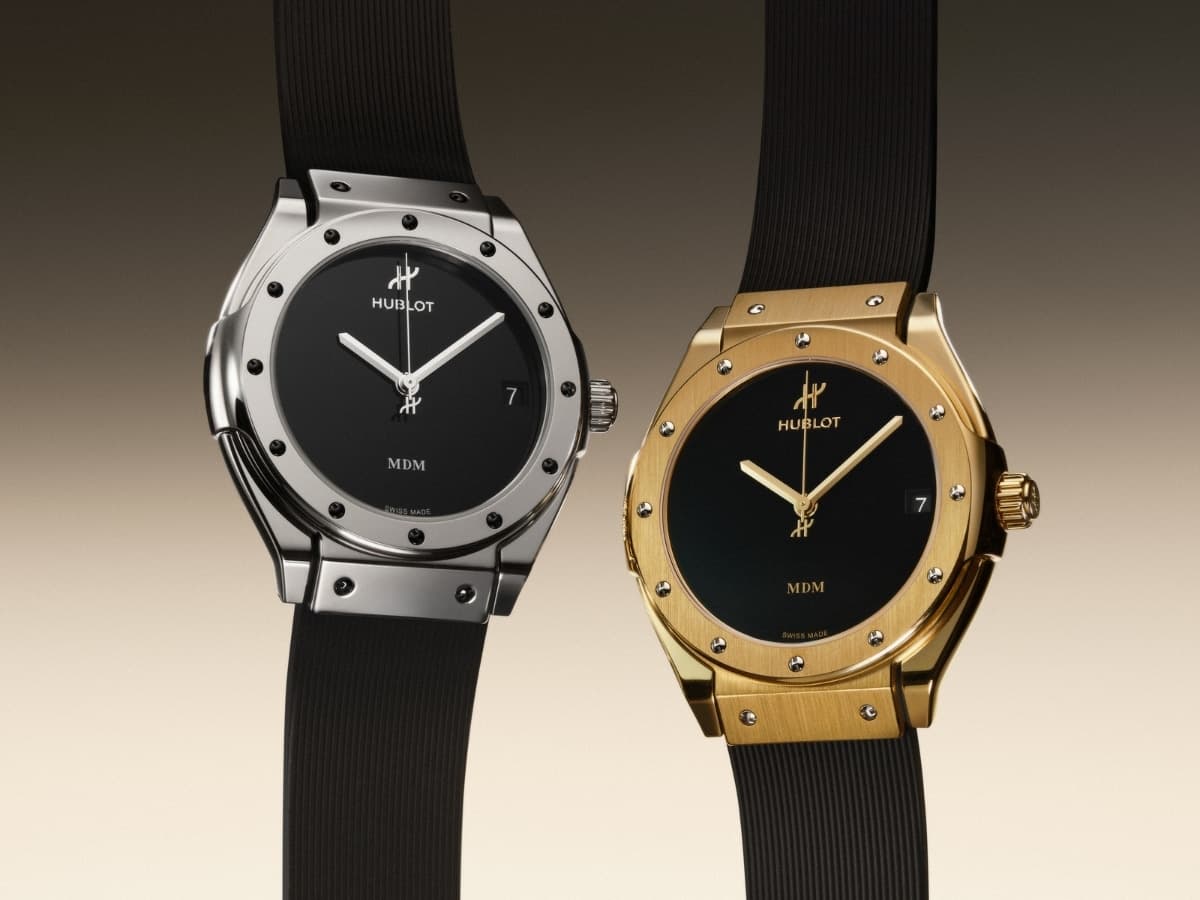
The first deviation from the original can be measured with a caliper. The Tributo has a diameter of 38 mm, while the 1980 model was 36 mm. Two millimeters may not seem like much on paper, yet it is the most visible concession made to contemporary tastes. The rest of the design remains faithful to the original: the bezel with its twelve screws, the unadorned dial, and the black rubber strap.
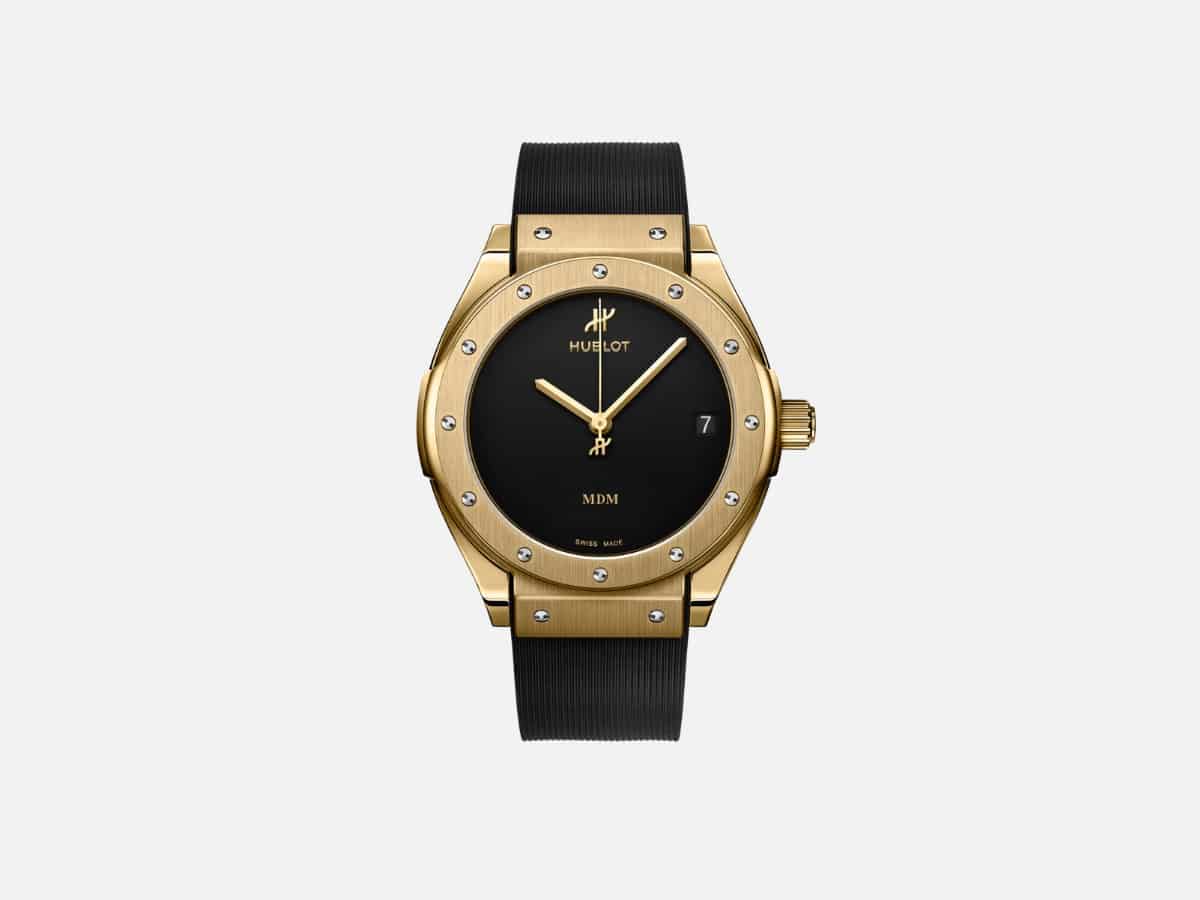
Two metal options are available, both in 18-karat gold with alternating polished and satin-finished surfaces. The yellow gold version (reference 262.VX.1130.RX.MDM) features gold screws and a matte black lacquered dial, accented with a subtle “charcoal” finish that breaks up the uniformity of the black without detracting from it. The white gold version features blackened screws and, most notably, a dial carved from polished natural black onyx. The choice between the two is therefore not solely a matter of case color: on one hand, a textured lacquer; on the other, a hard stone with its own depth and unique iridescence.
The brand embraces the absence of hour markers on the dial as a deliberate choice: everything is conveyed through the bezel. An anti-reflective sapphire crystal protects the entire watch, and the case back—also made of sapphire—is transparent. The watch is water-resistant to 100 meters (10 ATM), a rating that allows for everyday use without any special precautions.
From Quartz to Automatic Movement
It is beneath this transparent case back that the most profound change lies. The 1980 model was powered by a quartz caliber. The Tributo has abandoned this movement in favor of the HUB1711 automatic caliber, whose architecture is derived from the Zenith Elite. This connection comes as no surprise: Zenith and Hublot belong to the same watchmaking group, LVMH. The movement oscillates at 28,800 vibrations per hour, or 4 Hz.
Regarding the power reserve, the brand’s documentation is contradictory. The technical summary for the yellow gold version states approximately 50 hours, while the detailed description of the HUB1711 caliber mentions approximately 60 hours. In the absence of official clarification, the figure of 50 hours is listed in the technical description, but the discrepancy is worth noting for anyone planning to let their watch rest for an entire weekend.
The oscillating weight, visible through the case back, is skeletonized in the shape of an “H.” Here again, the two versions differ. On the yellow gold model, it is crafted from 22-karat yellow gold; on the white gold model, it is made of blackened tungsten, which extends the understated, dark aesthetic of the onyx dial and blackened screws to the case back.

This shift to a mechanical movement sums up the logic behind the design quite well. The Tributo retains its 1980s look but incorporates what the market now expects from a gold watch at this price point: a movement you can watch ticking.
The bracelet, without a quick-release system
Perhaps the most revealing detail of this approach lies in what Hublot chose not to include. The brand’s recent models feature the “One Click” quick-change system, which allows straps to be swapped without tools. On the Tributo, it has been deliberately omitted. The smooth, double-layered black rubber strap is mounted directly between exposed lugs, just like on the original watch. What is lost in versatility is gained in fidelity to the 1980 design, and the brand clearly deemed this trade-off worthwhile.
The folding clasp combines several materials: gold—yellow or white, depending on the model—paired with black-plated stainless steel and black-plated titanium. The precious metal of the case is thus carried through to the clasp.
Price and Terms
Both versions carry the same suggested retail price: $30,900, whether you choose yellow gold or white gold. Prices recorded in October 2026 were 30,200 euros, 25,000 Swiss francs, and 23,600 pounds sterling. These amounts are subject to regional tax rates and may fluctuate with exchange rates; in October 2026, the price in Switzerland was approximately 26,600 euros, which is significantly lower than the European price.
The Tributo is neither numbered nor marketed as a limited edition; it is presented as a model in the permanent collection. However, Hublot has not specified whether production will be capped annually or left open-ended.
The standard warranty covers five years. It can be extended to ten years under the “5+5” program, provided the watch is registered with the brand’s owner program, Hublotista.