
Make Texture a preferred source on Google to support us
Add Texture to GoogleIn Venice, logistics often border on the epic. Imagine a floating crane, gently rocking on the lagoon’s ripples, unloading bed frames, air conditioning ducts, and freshly reupholstered armchairs with metronomic precision through the pointed-arch windows of the Riva degli Schiavoni. This aquatic ballet, which lasted three years, epitomizes the titanic challenge posed by the Danieli’s transformation. In this city, where every square meter is inextricably linked to the movement of the tides, the renovation of an institution of this magnitude is not merely a matter of interior design, but of advanced naval engineering and the patience of a craftsman. Every piece of the puzzle—from the smallest Murano chandelier to the most massive piece of furniture—had to be transported via the canals, a reminder that while the palace itself is stationary, its soul and its very functioning depend entirely on water.
Light as the Guiding Thread
Pierre-Yves Rochon, the architect whose name is now inextricably linked to the most prestigious addresses in Florence, Paris, and Milan, approached this project from the top down. It was from the building’s panoramic terrace that he found his chromatic compass. Observing the transition from the deep blues of the Adriatic to the muted golds of the Venetian twilight, he decided to break away from a certain nostalgic imagery. The Danieli we once knew—often shrouded in baroque twilight and somewhat heavy burgundy velvets—has given way to a more ethereal interpretation of La Serenissima. The guiding principle was simple yet radical: to invite the lagoon inside the walls. This new visual language emphasizes clarity and fluidity, transforming once-dark spaces into volumes bathed in a diffuse, almost unreal light reminiscent of Canaletto’s paintings.
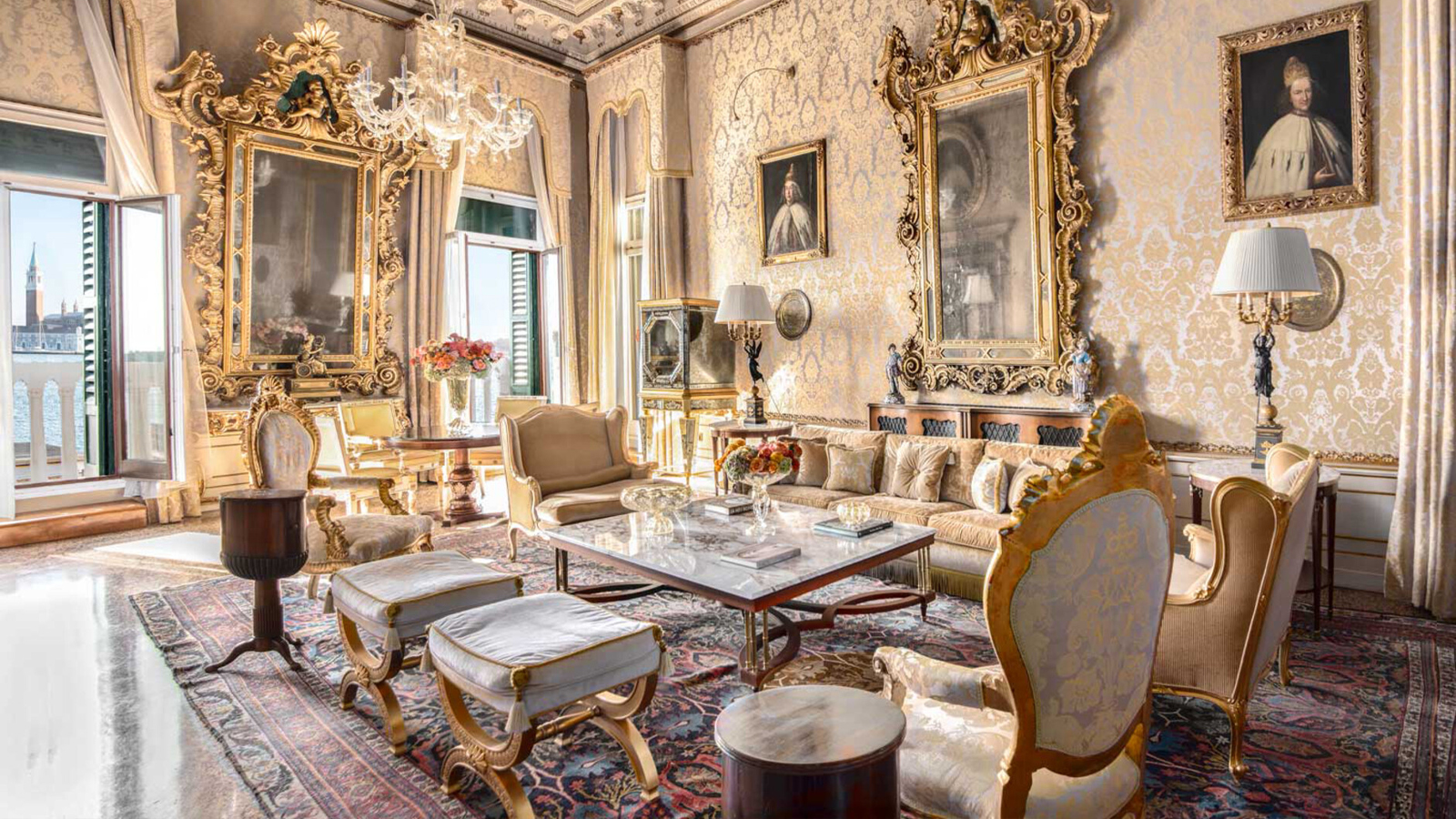
This approach in no way denies the classical heritage; rather, it breathes new life into it. In the guest rooms, the color palette has softened to reflect the shifting hues of the sky and water. Here, one finds pastel-toned satins, light wood finishes, and shades of aquatic blue that soothe the eye. The attention to detail relies on a network of local artisans whose expertise seems inexhaustible. To adorn the walls, the architect turned to Rubelli, a quintessentially Venetian institution, whose damasks—woven with time-honored precision—bring a texture and depth that only handcrafted work can offer. It is this ongoing dialogue between the site’s history and a contemporary aspiration for lightness that defines the establishment’s new look.
The Rebirth of a Doge’s Palace
The history of the Danieli is rooted in the Palazzo Dandolo, a Gothic marvel completed in the late 15th century for a family that produced several doges for the Republic. It wasn’t until 1822 that Giuseppe Dal Niel, a visionary entrepreneur, transformed this stately residence into what would become one of the city’s first grand hotels. The very name of the hotel is a local variation of his surname. Over time, the hotel expanded by incorporating two neighboring palaces dating from the 19th and 20th centuries, creating a complex architectural ensemble just a stone’s throw from the Doge’s Palace. Its guest book reads like a who’s who of European culture: Byron, Goethe, Proust, and later, Hollywood stars such as Greta Garbo and Grace Kelly all left their mark there. However, by the time management was entrusted to the Four Seasons group, the luster of this “grand dame” had begun to fade.
Breathing new life into this landmark without betraying its spirit required a total immersion in the Italian arts and crafts. Upon crossing the threshold today, guests are greeted by a dark-wood concierge desk flanked by a wall of brass keys—a nod to a traditional hospitality style that resists complete digitization. The lobby opens onto the Bar Dandolo, a majestic space where ceilings carved with gilded four-leaf clovers overlook Corinthian columns and colorful stained-glass windows. Here, light from the lagoon filters through the tinted glass, creating iridescent reflections on the terrazzo floor. You can still see gilders at work here, busy perfecting the final embellishments, while the old-fashioned engraved mirrors in the elevators receive their final polish.
Cuisine Inspired by Land and Lagoon
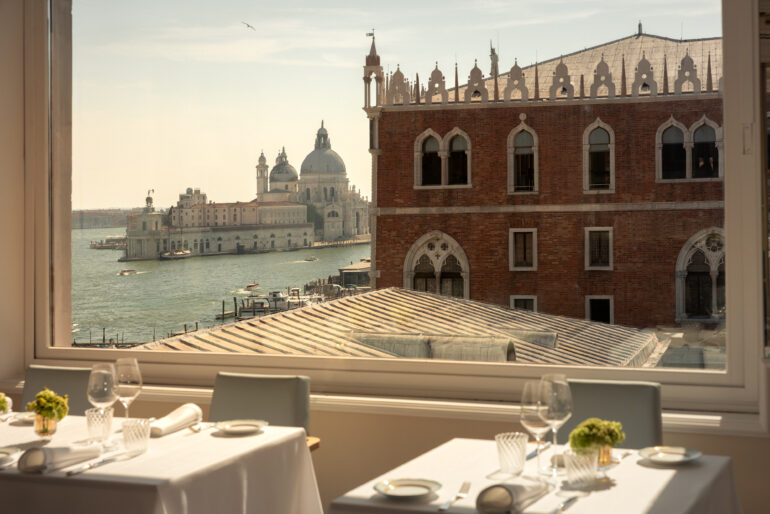
Perhaps the most spectacular transformation is on the fifth floor, within the Terrazza Danieli restaurant. Christian Zandonella, the general manager, wanted the dining room to literally merge with the horizon. Gone is the stuffy atmosphere of the past; the space is now punctuated by large mirrors and panoramic windows that frame St. Mark’s Square, the Church of San Giorgio Maggiore, and the Punta della Dogana. The view now extends far beyond the Grand Canal, taking in the Giudecca and the untamed expanse of the lagoon. It is against this breathtaking backdrop that Chef Adriano Rausa brings his culinary vision to life. A native of Rome who trained under Sicilian chef Ciccio Sultano, he infuses Venetian classics with a southern flair.
Rausa’s work is rooted in a quasi-ethnographic field study. To develop his menu, he scoured the trattorias frequented by locals, seeking to isolate authentic flavors before reinterpreting them. His cuisine is a meeting point between the historical influences of Venice—a crossroads of cultures—and the produce of the surrounding islands. The fish comes directly from the nets of lagoon fishermen, while the vegetables are sourced from the gardens on the island of Sant’Erasmo. Among the signature dishes are Venetian-style tuna belly, exquisitely delicate crab tortelli, and an Adriatic seafood stew that celebrates the bounty of the local waters.
Experiencing Venice Through Its Waters
The ambition of this new era extends beyond the physical boundaries of the building. For Christian Zandonella, staying at the Danieli should be an invitation to leave dry land behind. The hotel is currently developing its own fleet of vessels, including a restored “bragozzo” (traditional fishing boat), a houseboat, and an electric gondola. The goal is to take travelers on a journey to explore a more hidden side of Venice, far from the tourist crowds of St. Mark’s. The itineraries now include stops on the island of Pellestrina, that narrow strip of land separating the lagoon from the open sea, where you can still watch lace-makers at work in fishing villages that have retained their authentic character. Other excursions, led by ecologists, offer the chance to discover the richness of the “barene”—salt marshes that are home to a fragile ecosystem of birds and aquatic plants.
The Danieli’s revival is also part of a broader trend affecting the outlying islands. On Torcello, the legendary Locanda Cipriani has just reopened after a complete renovation of its rooms and restaurant, confirming the appeal of a more contemplative Venice. For its part, Giudecca continues to cultivate its residential and authentic identity, with restaurants like Altanella attracting a new generation of visitors in search of authenticity. For those who prefer a more active experience, learning “voga alla veneta” (standing rowing) with the Associazione Remiera Vogaepara on the island of Burano offers a hands-on immersion in the local culture.
The hotel complex’s development will continue through 2027 with the reopening of the Palazzo Excelsior, a 1950s-style building that will feature suites with gardens and bring the total capacity to 168 rooms. A full-service spa and an indoor pool—a rarity in the historic center—will round out the offerings. But beyond these luxurious amenities, it is the unbreakable connection to the lagoon that remains at the heart of the project. Whether through the flight of the falcons used to keep seagulls away from the terrace or the shifting reflections on the walls of the suites, the Danieli reminds us that Venice is never more beautiful than when it gazes at its own reflection in the water.