Make Texture a preferred source on Google to support us
Add Texture to Google2035: For the Italian leather goods industry, the horizon now extends beyond the next collection. This is the timeframe for Assopellettieri’s strategic study, which is intended to inform the discussions at the sixth edition of the sector’s “États généraux,” on Thursday, November 19, in Florence. The choice of this timeframe sets the tone. Beyond the brands and their products, the focus is on examining the future of the companies that make up the industry. Craftsmanship remains a central issue, but the discussion will also address the conditions necessary for it to maintain its position in international markets.
2035: A Horizon Rather Than a Promise
Conducted in collaboration with LIUC Business School, the study will not merely take stock of the current situation. It aims to link recent developments in the sector to the transformations likely to shift its balance. Consumer preferences are changing, new markets are opening up, and regulations and technologies are reshaping the competitive landscape. The value of this exercise lies in this cross-analysis: examining demand without losing sight of what is happening on the business side.
The focus will be on possible scenarios, not on a future presented as a foregone conclusion. This distinction is important. Projecting into 2035 allows us to move beyond mere commentary on current economic conditions and reflect on the directions that a wide variety of stakeholders might take. The study must therefore identify appropriate development trajectories, ranging from companies involved in the production chain to small and medium-sized businesses with their own brands.
This work will provide the basis for debate, though its results are not yet detailed in the program. It should therefore not be expected to predict a rebound or identify winning markets. Its ambition lies elsewhere: to give professionals a framework for evaluating their choices, taking into account both European developments and international prospects.
An industry is more than just its major players
Perhaps the most interesting aspect of this event lies in the composition of its audience. Major brands will rub shoulders with industry players and small and medium-sized enterprises (SMEs) that market their products under their own names. This coexistence makes it impossible to speak of “Italian leather goods” as a perfectly homogeneous whole. A strategy that works for one brand does not necessarily address the challenges faced by a company located elsewhere in the supply chain.
This is precisely what the study’s differentiated approach aims to examine. For an SME with its own brand, changing buyer preferences and access to new markets directly raise the question of its positioning. For other players in the sector, these same trends must be interpreted through the lens of their role in production. The trends are shared; their consequences, however, are not distributed equally.
Assopellettieri, however, aims to foster a shared vision. There is a productive tension here: preserving the diversity of business models while defining collective priorities. The association’s president, Claudia Sequi, emphasizes the need to strengthen companies and promote the sector’s expertise. The issue, therefore, is not merely to better defend Italy’s image, but to reflect on the strength of those who bring it to life.
Luxury: A Barometer of Demand
Luca Solca, managing director of luxury goods at Sanford C. Bernstein, will provide insights into the luxury market. His participation frames the event within a very concrete question: how can the outlook for leather goods be aligned with that of a market whose developments warrant specific analysis? The program distinguishes this session of expert analysis from the broader reflection on the sector as a whole.

This distinction prevents the conflation of two levels of analysis. On the one hand, the strategic study will focus on shifts in demand, the opening of new markets, and consumer preferences. On the other hand, Luca Solca’s presentation will offer an analysis focused on the luxury sector. Bringing these two perspectives together should help contextualize companies’ decisions without reducing the entire industry to just the major brands present in Florence.
The economic perspective will also be provided by Carlo Cottarelli, director of the Public Accounts Observatory at the Catholic University of Milan, and by Beatrice Lemucchi, managing director and partner at BCG. Both will speak at the opening of the event. Before addressing the sector’s responses, the event will take time to examine the framework within which these responses must be considered.
Competition also plays out beyond the product itself
In this discussion, the European dimension plays an explicit role. The study will analyze competitive dynamics while taking regulatory and technological factors into account. This shift in perspective is central to the event’s focus: competitiveness will not be considered solely through the lens of brand offerings, but also through the conditions under which companies operate.

Massimiliano Serati, dean of the LIUC Business School, and Alessandro De Biasio, CEO of Cefriel, are among the announced speakers. The program will thus bring together economic and technological expertise around a single theme. It does not specify which solutions will be advocated; however, it does indicate that the future of leather goods will be discussed beyond mere product or distribution issues.
The session on global competitiveness will expand on this broader perspective with Matteo Ferrando, Director of Technology & AI Innovation at WPP Media. Technology and artificial intelligence will thus be represented in the debate. Their inclusion does not prejudge any recommendations; rather, it highlights the areas of expertise that the organizers wish to bring into dialogue with leather industry professionals.
Working Collectively, Without Erasing Differences
How can these analyses be translated into the capacity for collective action? A discussion on how to work collectively is planned. The international session will feature Giovanni Bozzetti, President of Fondazione Fiera Milano, and Raffaele Scalese, Director of Business Development at Il Bisonte, alongside Matteo Ferrando. The ICE agency will also participate. The program thus brings together the experience of a brand with that of organizations whose scope of action extends beyond the individual company.
This diversity gives the event its scope, but also its challenge. Sharing an analysis is one thing; identifying useful guidelines for organizations of different sizes and models is another. The challenge will be to link market analysis to the specific trajectories that the study must propose, without diluting individual needs in a general discourse on competitiveness.
In Florence: From Analysis to Recommendations
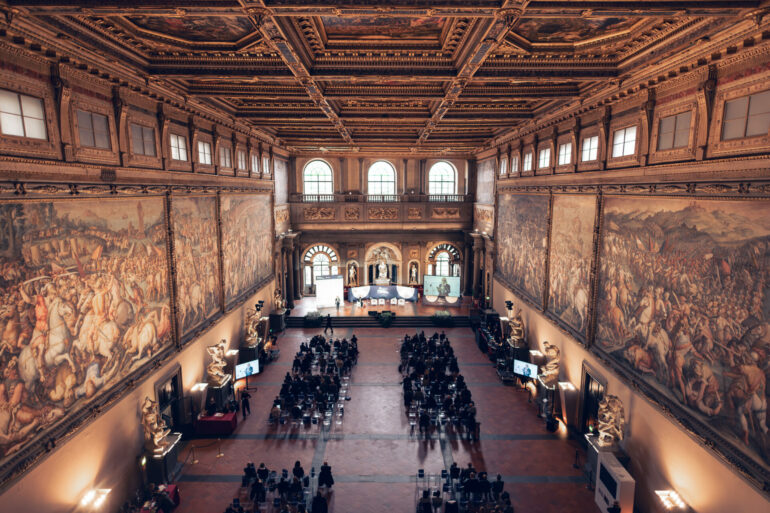
The event will take place in the Salone dei Cinquecento at the Palazzo Vecchio. Promoted by Assopellettieri, it is organized in collaboration with the City of Florence and held under the patronage of the Region of Tuscany. Mediaset journalist Stefania Cavallaro will moderate the event. Fondazione Fiera Milano supports the initiative; Intesa Sanpaolo remains the main sponsor, while Aon and D.B. Group have joined as partners for this edition.
The participation of institutional representatives will continue at the closing session. Claudia Sequi will present the sector’s recommendations to them, following economic analyses and discussions among professionals. This segment will bring the day to a close: translating the outlook through 2035 into proposals addressed to public officials. Their content, which has not yet been revealed, will provide a concrete measure of the priorities identified by the industry.