Make Texture a preferred source on Google to support us
Add Texture to GoogleSometimes all it takes is a simple rectangle of fabric to make people drop their masks. In the luxury industry, where romantic narratives and marketing all too often overshadow the reality of manufacturing, the scarf serves as a relentless truth serum. Once stripped of the allure of its logo and the fanfare of advertising campaigns, this piece of silk, wool, or cashmere cannot deceive. Its fiber, its texture, the finesse of its hems, and the chromatic depth of its pigments instantly reveal whether one is dealing with an authentic, traditional house or a mundane, overhyped stylistic exercise. Why should a connoisseur of the art of living today scrutinize the label of a shawl with the same uncompromising eye as a watch collector examining a mechanical movement? Because the scarf holds a unique place in the wardrobe: devoid of buttons, zippers, or size constraints, it is the pure expression of fabric. Beneath its apparent simplicity—capable of shaping a silhouette or warming up an outfit with a single fluid gesture—a silent battle rages between the true guardians of craftsmanship and the champions of the label.
Mastery of the craft: a prerequisite for excellence
It is by no means a coincidence that the 2026 study conducted by the influential Global Brands Magazine highlights a top trio of companies that rigorously control their production chains. By placing Hermès, Johnstons of Elgin, and Loro Piana at the top of its rankings, the analysis underscores a fundamental law of elegance: the price—often astronomical—only justifies an accessory if it is underpinned by vertically integrated craftsmanship.
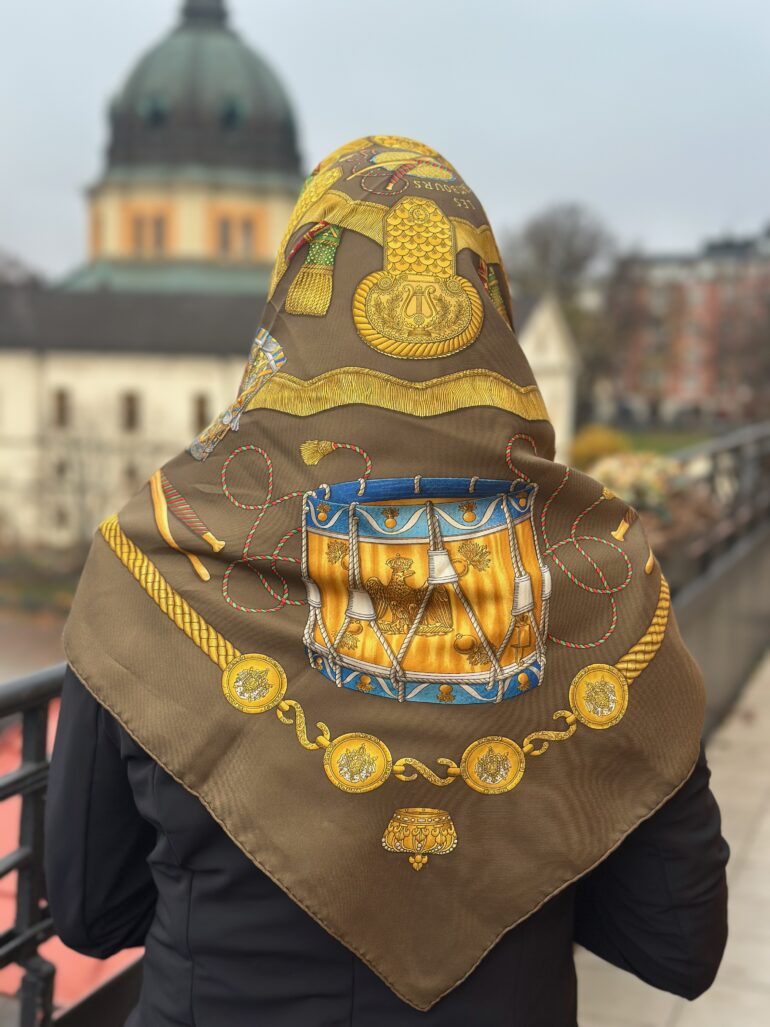
For the Parisian leather goods house, which dominates this global landscape, its dominance stems not from wistful nostalgia but from formidable industrial mastery. Since the historic launch in 1937 of the very first silk twill scarf, dubbed “Jeu des omnibus et dames blanches,” the institution on the Faubourg Saint-Honoré has elevated textile printing to an art form. With revenue nearing one billion euros for this division alone in 2025 (964 million euros reported in its registration documents), the brand is cementing its supremacy within a jealously guarded ecosystem in Lyon. In the workshops of the Hermès Textile Holding, located in Pierre-Bénite, the method known as “flat-frame printing” resembles a scientific ballet. On heated tables stretching 150 meters in length, artisans sometimes lay out as many as forty successive frames, scraping away layer after layer of color to bring the complexity of a single pattern to life. This demanding alchemy, crowned by the patient, hand-rolled edges, more than justifies the approximately 520 British pounds (about 660 U.S. dollars) charged for the iconic 90-centimeter size. It is no longer merely an accessory, but a distillation of the history of decorative arts.
The Scottish Paradox: Shadow Versus Light
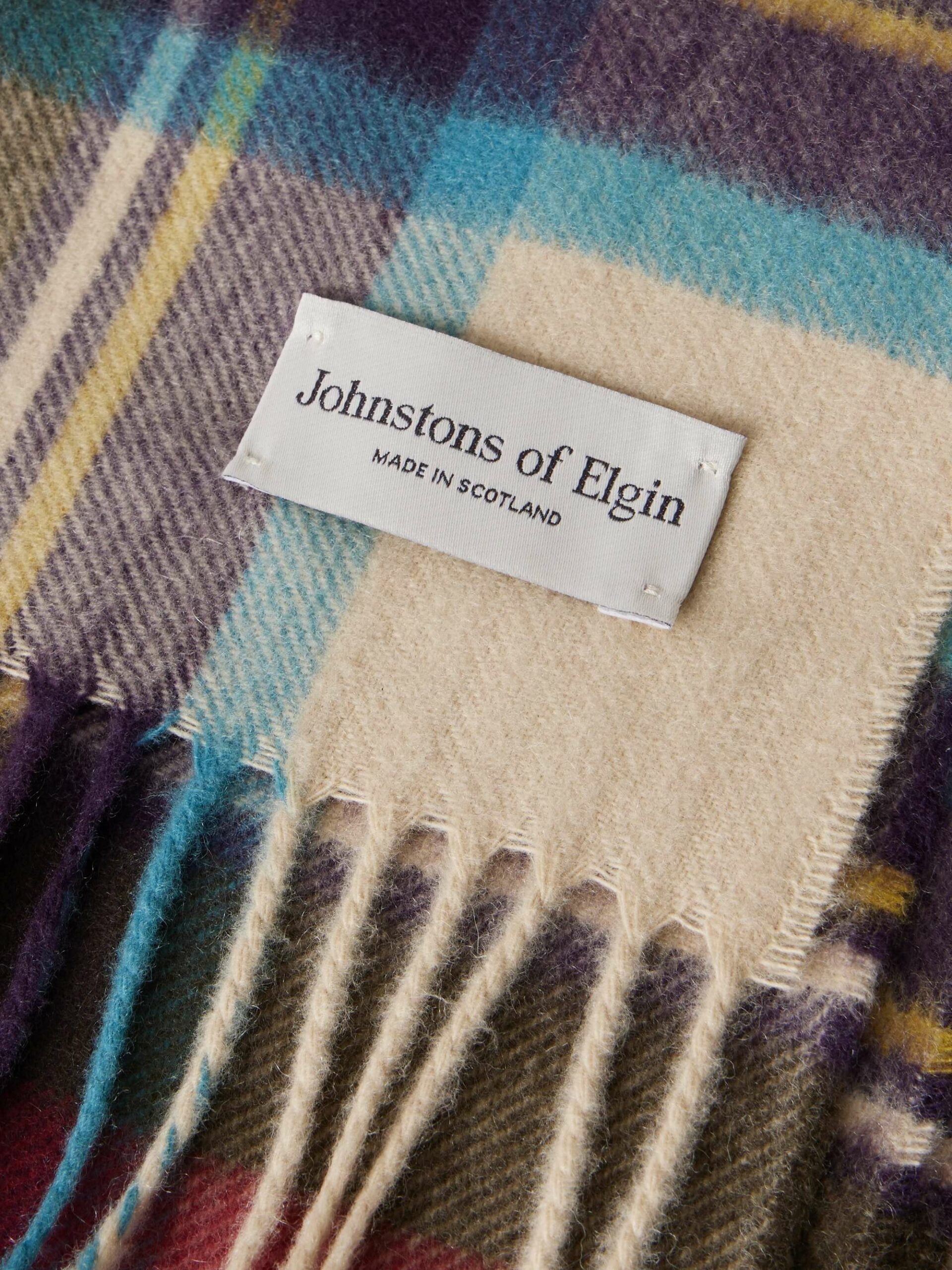
Cross the English Channel, head north toward the Highlands, and the aesthetic paradigm shifts radically. The delicacy of French silk gives way to coarse woolen fabrics designed to withstand the biting damp of the moors. Ranked second on the list, Johnstons of Elgin embodies the quintessential “shadow” manufacturer, a true pillar of the industry. Founded in 1797 on the banks of the River Lossie, this mill stands as Scotland’s last remaining spinning mill to master the entire production cycle, from imported raw fleece to the finished garment. It was, in fact, this textile stronghold that, as early as 1851, had the audacity to introduce cashmere weaving to Scotland.
What makes this company—now B Corp-certified—so fascinating to observers of the luxury sector is the dizzying level of self-reflexivity it offers in the face of marketing giants. Take Burberry’s world-famous checkered cashmere scarf. This iconic tartan, introduced in the 1920s to discreetly line the trench coats of the London-based house, now retails for around 450 pounds sterling. Yet, behind this global symbol of British chic—woven on traditional looms, purified with local mineral-rich spring water, and then brushed using a time-honored method with dried thistles to enhance its suppleness tenfold—lies the industrial machinery of Johnstons of Elgin. The study highlights that Johnstons’ own Bard cashmere model, produced in the exact same workshops, retails for just 175 pounds. This vast price difference starkly illustrates the premium paid for brand recognition compared to the intrinsic cost of production.
Other exceptional spinning mills carry on this Scottish tradition with their own distinct approaches. With industrial experience dating back to 1866 and its workshops in Ayr and Hawick, Begg & Co. moves away from rustic classicism to explore the absolute lightness of its fabrics. Their “Wispy” model, priced at 450 pounds, is aimed at purists seeking an airy texture, while the dramatic price fluctuations of the “Kishorn” line (reduced to 295 pounds at the time of this report, down from the usual 495) reflect the economic vagaries of strictly localized production. While the B Corp certification claimed by these two manufacturers guarantees sound ethical and environmental corporate governance, the discerning reader will not forget that no label can replace the tactile assessment of a fabric.
The Italian terroir and the quest for tactile ultra-luxury
The third major exploration of exceptional yarns inevitably takes us to Italy, where hedonism dictates its own definition of the accessory. Loro Piana exemplifies the Italian obsession with the absolute rarity of raw materials. From its strongholds in Piedmont, the brand has established itself since 1924 as the world’s most powerful buyer and processor of baby cashmere and vicuña. Its Grande Unita scarf boasts monumental proportions (175 by 43 centimeters) for a price set at 540 pounds or 750 dollars. The “Made in Italy” label goes beyond a mere customs claim here: it promises a drape and a softness that border on the unreal—the hallmark of this understated luxury prized by discreetly wealthy individuals.

On the peninsula, geography often dictates the perspective. Further south, in the hills of Umbria, the hamlet of Solomeo has been meticulously restored by Brunello Cucinelli, who has forged an identity there that is inseparable from heathered cashmere. The diagonally woven scarf, which has topped the best-seller lists, shatters price barriers: at $1,800 on the U.S. market, it deliberately embraces its status as a work of art reserved for a handful of connoisseurs, shifting the scarf from its strictly functional role to the realm of unlimited spending.
At the polar opposite of this mineral-like rigor, the tailoring spirit reinvents itself through the whimsy of color and unexpected combinations. Based in Prato—the historic epicenter of wool processing in Tuscany since 1949—the family that runs Faliero Sarti has been producing stoles of delightfully irreverent flair for two decades. Their Giulietta model ($420) embodies the poetry of a skillfully crumpled drape. We must not overlook the incomparable craftsmanship of the shores of Lake Como, the home of silk production. It is there that the British label Drake’s—a pioneer since 1977 in the art of subverting the classic London wardrobe—has its famous patterns printed. With its wool-silk blends priced between 245 and 275 pounds, the house offers an approach where exuberant design becomes a weapon of elegance in its own right.
Deciphering the Grammar of the Contemporary Market
To fully understand the structure of this industry, the observer must be willing to confront the incomparable. Scandinavian minimalism has thus managed to impose its own style. Since its founding in Stockholm in 1996, Acne Studios has transformed an oversized, fringed wool scarf—certified by the Responsible Wool Standard and made in Italy—into a symbol of urban identity. Priced between 160 and 200 pounds, it proves that a distinctive, well-thought-out, and widely photographed design is sometimes enough to create desire, regardless of the intrinsic quality of the yarns used.
In contrast, Uniqlo’s massive market presence serves as both a barometer and a benchmark. When the brand sells pure cashmere scarves for just under $70, or markets its formidable Heattech thermal technology (a blend of wool and acrylic) for less than $20, it holds up a mirror to the realities of global production. This stark contrast bluntly raises the question of value scales. What are we really paying for when the price tag is multiplied by ten, fifty, or a hundred?
We are undoubtedly paying for a stubborn refusal to compromise. We are supporting the survival of time-honored crafts, the upkeep of century-old workshops, the meticulous selection of the longest fibers from a fleece, and that indispensable slow pace of manufacturing that allows pigments to penetrate deep into the fabric. Navigating this vast array of offerings requires a shift in mindset on the part of the customer. The art of living no longer lies in the blind pursuit of a brand name shrouded in prestige. It lies in an aesthete’s ability to turn a scarf inside out to decipher its exact geographical origin, to weigh its density, and to examine its seams. Authentic luxury is not found in the lines of an awards list, but in the precision of a weave.