Make Texture a preferred source on Google to support us
Add Texture to GoogleThe straight line stands in stark contrast to the very idea of rest. When a seat rejects curves in favor of the rigidity of angles, it leaves the exclusive realm of functionality to venture into the realm of sculpture. It is precisely this geometric tension that captivates the viewer when encountering the Kubic. Unveiled at the Hôtel Particulier Louis Vuitton, in the heart of Rue de Martignac, during Paris Design Week from September 10 to 13, this chair breaks decisively with the indulgent contours of living room furniture. No inviting curves here, but rather a strict architecture—a manifesto of clean lines and sharp breaks. Behind this radical approach, however, lies not the provocation of a young contemporary studio, but the resurrection of a timeless design, created in 1923.
The arrogance of unapologetic geometry
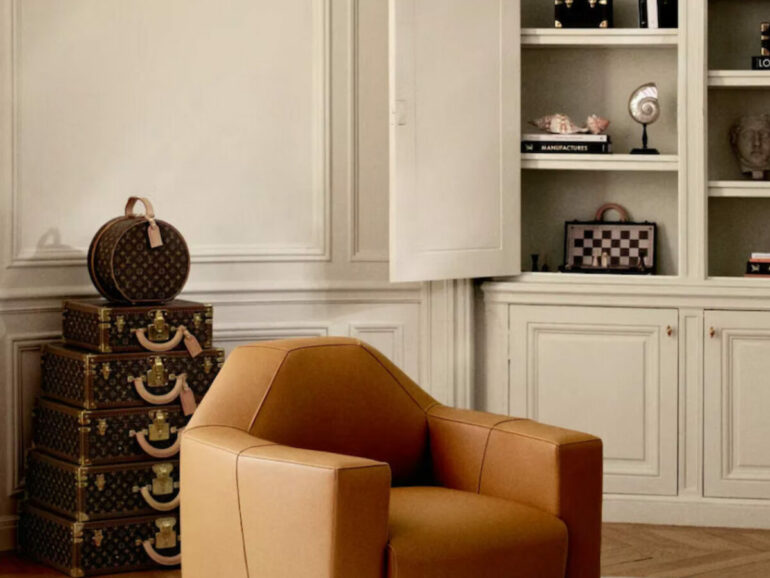
The eye is first drawn to the clash of materials before dissecting the form. The seat is upholstered in Nomade leather, a material whose inherent lightness and suppleness clash with the severity of a complex peripheral structure. On either side, wide rosewood panels frame the whole. This dense wood creates a stark contrast, both through its deep hue and its massive presence, radically altering the perception of the object. The design itself is both disconcerting and fascinating. The backrest rises in a unique trapezoidal shape, while the armrests unfold into faceted surfaces, catching the light with their sharp edges.
Lower down, the base further defies convention. The daily newspaper *Le Monde* notes an atypical silhouette, cut in a sawtooth pattern, which anchors the piece to the floor with rare visual precision. The LVMH Group, in its own publications, readily embraces this very distinct formal style to define the work’s presence. Comfort, however, remains an unresolved question in the face of such a sculptural display. Contemporary documents, while providing precise details on the materials used and the object’s dimensions, remain silent on its ergonomics, leaving doubt as to its primary function: is it meant to be sat in, or simply viewed?
A patron, a bookbinder, and a trunk maker
To understand the origins of this radicalism, we must delve back into the intellectual effervescence of the interwar period. In 1923, the vocabulary of Art Deco was just beginning to shape the Parisian aesthetic. The Kubic belongs to this formative period. It was not the result of a standard manufacturing commission, but rather a response to the demands of a leading figure of the avant-garde: the great fashion designer and collector Jacques Doucet. It was he who commissioned Pierre Legrain, an unclassifiable designer whose talent moved with ease between illustration, interior design, and bookbinding. This multidisciplinary approach allowed Legrain to tackle furniture design without the constraints of classical cabinetmaking traditions.
The Kubic thus unashamedly brings together the dazzling brilliance of the Cubist movement and the early stages of Art Deco. The piece never attempts to smooth over its influences or conceal its historical roots. On the contrary, it stands as a stark testament to an era of transition. The upcoming centennial of the 1925 International Exhibition of Modern Decorative and Industrial Arts provides an ideal commemorative setting for this tribute. While the Parisian event definitively cemented Art Deco in the history of design, Legrain’s armchair predates it by two years, serving as a trailblazer amid a creative ferment of which 1925 remains the defining moment.
From the Milanese exhibition design to the Parisian salons
Before making its debut in Paris’s 7th arrondissement, the model began its reintroduction onto the international stage during Milan Design Week 2026. The collection, simply titled “Homage to Pierre Legrain,” first took up residence in the grand spaces of the Palazzo Serbelloni. There, LVMH orchestrated a complex exhibition journey centered on furniture, tableware, and textiles. The curatorial concept drew directly from the designer’s bookbinding work and personal archives, weaving a unique network of visual connections.
The Italian exhibition drew its strength from the direct juxtaposition of different time periods. Historic creations shared the space with masterful figures of the twentieth century, such as Charlotte Perriand and the Futurist Fortunato Depero. This temporal network extended all the way to the very contemporary by incorporating works by the Brazilian studio Estudio Campana, the London-based duo Raw Edges, and designer Franck Genser.

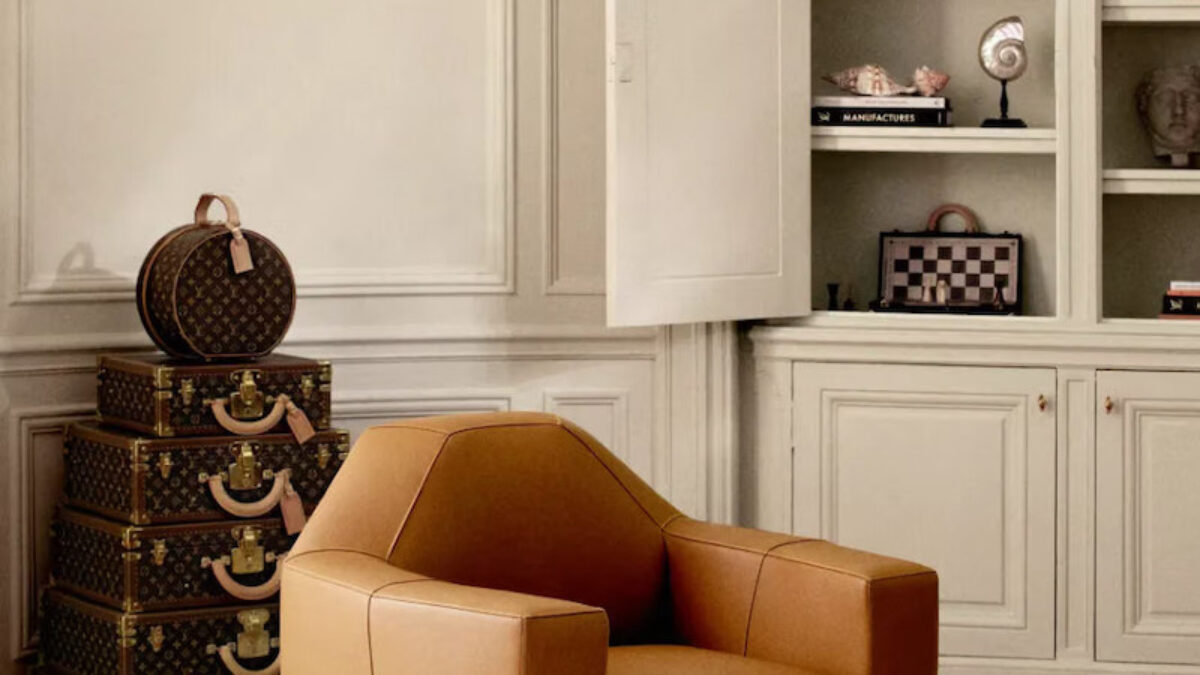
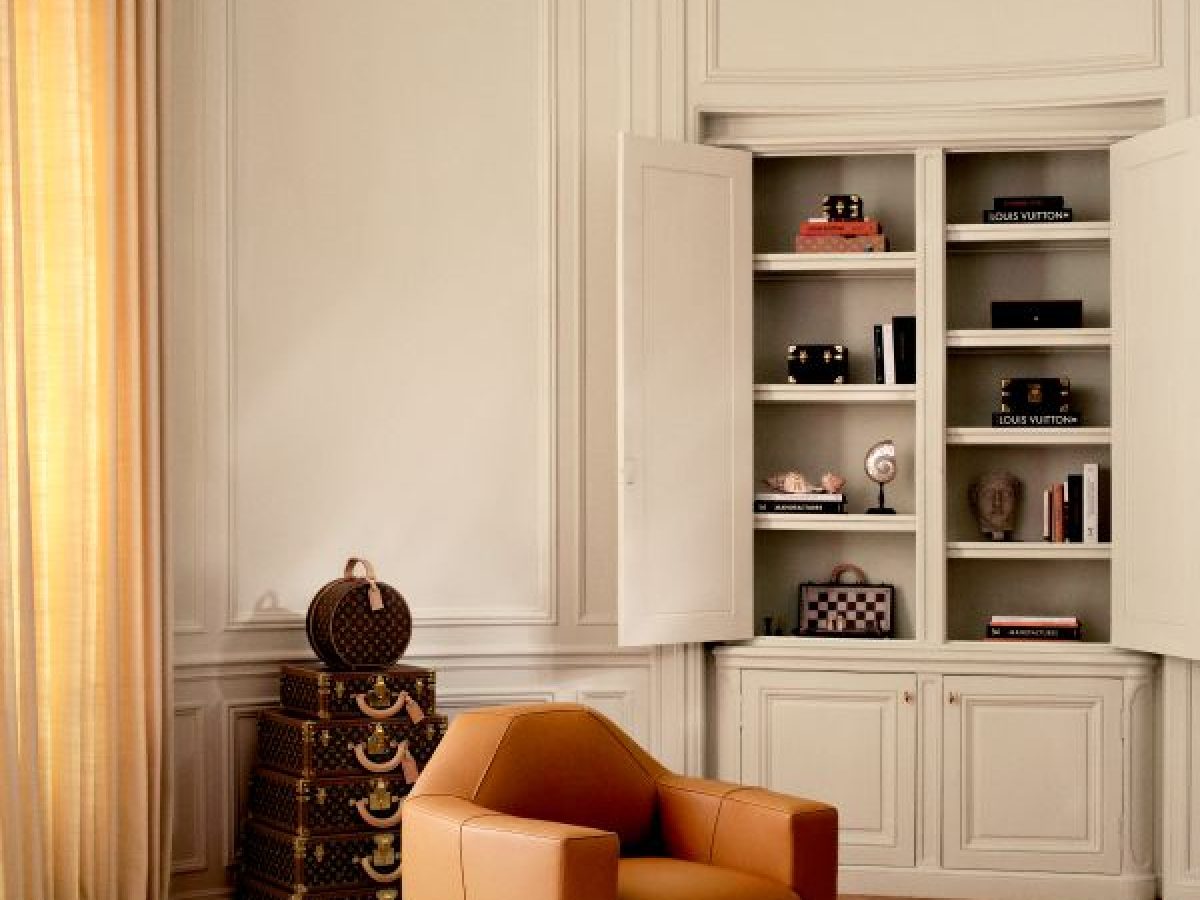
In Paris, the exhibition on Rue de Martignac narrows its focus on Louis Vuitton’s original heritage. The exhibition design creates a dialogue between vintage trunks, period illustrations, and travel-related objects to rekindle the vibrant atmosphere of the 1920s. Centered around this core of history, the other showrooms present a contemporary take on tableware, textiles, and furnishings, all infused with Legrain’s spirit.
The Archive as a Driver of Domestic Expansion
This meticulous curatorial effort goes beyond a simple homage to heritage. It serves a much broader strategic purpose for a brand whose legend was built on equipping travelers. The historic collaboration between Pierre Legrain and Louis Vuitton serves as a foundational milestone: it was for the trunk maker that the bookbinder designed his very first piece of furniture, the famous Louis Vuitton dressing table. This gradual evolution of the business—from luggage to interior design—resonates particularly strongly today.
The Objets Nomades collection, launched in 2012, served as the testing ground for this residential ambition. The massive expansion of the home furnishings lineup in 2025, as reported by the trade publication Archiscene, confirms that the home has become a priority area for growth. Rather than flooding the market with aesthetic proposals devoid of roots, the artistic direction chooses to draw upon its heritage.
The Kubic ultimately embodies a dual ambition: to bring a specific heritage out of the shadows and inject it into the heart of an extremely competitive contemporary market. The success of this reissue will not be measured solely by the narrative it conveys. It will depend on the precision of the craftsmanship and the chair’s ability to stand on its own, far from the confines of exhibition spaces. The tension between preserving a 1923 design and its reinterpretation by contemporary design offers a fascinating perspective, but the true test of the Kubic will be its integration into the private sphere, where the object must inevitably outlive its own history.