Make Texture a preferred source on Google to support us
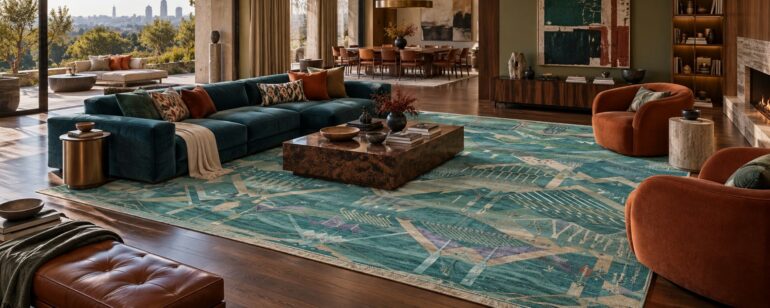
Add Texture to GoogleThe eye first glides over the cool surfaces: a polished concrete floor with clinical smoothness, vast swaths of white plaster, and window frames made of raw steel. Contemporary interior architecture, with its sometimes ascetic minimalism, masterfully controls light and space, but often suffers from a certain acoustic and tactile barrenness. There, resting directly on the floor, an element breaks this austerity: a wool rug whose hues, softened by the decades, catch the low afternoon light. Its edges are slightly asymmetrical, its pile weathered by foot traffic. There’s nothing new about it. By 2027, that’s exactly what will make it the centerpiece of the most discerning spaces.
The luxury market is undergoing a quiet transformation. After years marked by the frenetic turnover of collections and an obsession with polished perfection, collectors and trendsetters are turning toward an aesthetic of permanence. The hand-knotted rug, once confined to classic living rooms or subdued interiors, now stands as an indispensable anchor in renovated lofts and modernist villas. It is no longer merely a floor covering, but an object imbued with historical depth, capable of defining a space without the need for any partitions.
The Mark of Time: Spun Wool and Color Variations
To understand this craze, one must focus on the material itself. Unlike synthetic fibers derived from petrochemicals, hand-spun wool possesses a natural suppleness, with a slightly oily feel due to the presence of lanolin. This texture retains plant-based pigments with a depth that industrial production cannot replicate. Underfoot, the material feels alive—dense without being stiff.
Above all, hand-dyed wool exhibits a sought-after visual phenomenon: abrash. This subtle variation in color, forming faint horizontal bands across the rug’s field, reveals the use of different dye baths or distinct batches of wool. Far from being a flaw, this irregularity is evidence of human craftsmanship. Museums meticulously document these characteristics. The Springfield Museums, for example, holds a 19th-century Talish rug from northwestern Iran, whose long, dark blue field—woven with symmetrical knots—plays with these chromatic variations to evoke the shimmering surface of Persian garden ponds. Similarly, a carpet made between 1906 and 1913 by the Bezalel School in Jerusalem, documented by the Jewish Museum, illustrates this interplay between a cotton base, a wool pile, and the fascinating irregularity of abrash.
These pieces require a level of patience that defies contemporary logic. A medium-sized rug requires several hundred thousand knots, a process that often takes several months to complete. Visible wear along high-traffic areas or the softening of colors due to sun exposure tell a story of thirty, fifty, or even eighty years of use. During an appraisal conducted in 2012 for the television show *Antiques Roadshow*, the analysis of an 1880s Senneh Persian rug served as a reminder of how an ancient motif— in this case the boteh (the precursor to paisley), develops a patina without losing its clarity, and how one should distinguish natural discoloration from variations caused by the original dye baths.
The Urgency of Circular Design
The appeal of these heritage textiles goes beyond mere aesthetic considerations. It stems from a stark realization of the environmental impact of our interiors. Figures published by the United Nations Environment Programme (UNEP) paint an undeniable picture: the textile sector generates 92 million metric tons of waste each year. In 2023, barely 8% of fibers came from recycled materials, and closed-loop recycling (fiber-to-fiber) accounted for less than 1% of the global market.
Another UNEP report warns of the limitations of an economic model based on perpetual novelty, which overwhelms landfills and incinerators due to a lack of adequate recycling infrastructure. Machine-made rugs with heavy plastic content do not age well: their fibers flatten, their colors fade uniformly, hastening the end of their useful life. Conversely, choosing an existing wool rug is, from the outset, part of a circular approach. The raw material has already been extracted, and the energy required for manufacturing was expended decades earlier. Naturally flame-resistant, stain-resistant, and biodegradable, vintage wool proves its resilience over time simply by its very survival.
Orchestrating Contrast
However, integrating a piece steeped in history into a minimalist architectural style requires a certain visual acuity. The success of these combinations rests on the concepts of contrast and scale.
Rather than trying to match elements, interior designers now use the rug as a chromatic starting point. Two or three secondary hues drawn from the weave—a faded indigo, a powdery pink, a soft ochre—are enough to dictate the color of an upholstered armchair or living room cushions. Sun-drenched rooms instinctively harmonize with the muted greens and earthy tones that are all the rage for 2027. In spacious rooms, layering is key: a small tribal rug with geometric patterns, placed over a large base of natural jute or sisal, structures the space and warms the atmosphere.
The blending of eras becomes the norm. An Oushak in muted tones slipped under a sculptural dining table, or an Anatolian runner enlivening a kitchen with smooth cabinet fronts, instantly conveys that collector’s vibe that homeowners seek.

Distinguishing the Work of Art from the Artificial
Growing demand has inevitably given rise to a parallel market. Reassuring terms abound to mask recent machine-woven productions that have been artificially aged using harsh chemical washes. While the illusion may sometimes hold up in photographs, the physical experience—especially when barefoot—quickly dispels the misconception.
Certain telltale signs can help you spot counterfeits. Homes & Gardens magazine emphasizes the importance of examining the back of the rug: on a truly hand-knotted rug, the pattern appears clearly on the reverse side, revealing the weaver’s minute irregularities in tension. A rigid grid or the presence of a glued-on cotton backing indicates machine-made or tufted construction. The fringe provides another decisive clue. On an authentic piece, it is not sewn on afterward but forms a natural extension of the warp threads.
The color and texture confirm the assessment. High-quality wool should never feel dry, brittle, or plastic-like. As for the color, chemical bleaching produces a uniform, artificial pallor, whereas time alters pigments gradually and subtly.
Avoiding these disappointments explains why buyers are turning away from major home decor retailers in favor of specialized dealers. Companies like Rug Source undertake this meticulous authentication process. Providing the exact origin and period, detailing any damage caused by moths, pointing out areas where the velvet is weakened, or specifying the nature of any restoration: this transparency is an integral part of the object’s value. A professional doesn’t just sell a piece of fabric; they guarantee its architectural provenance.
This level of rigor profoundly changes the way we view interior design. Walls will change color, sofas will be reupholstered, and light fixtures will be replaced, but an antique wool rug outlasts all decorative trends. It moves from one room to another, from one home to another. By freeing itself from the frantic pace of trends, it offers living spaces the rarest of qualities: a quiet foundation around which everything else is free to evolve.