
Make Texture a preferred source on Google to support us
Add Texture to GoogleSotheby’s reached an all-time high with $4.4 billion in sales, capitalizing on a booming market and sophisticated strategies, ranging from the highly publicized launch of its new New York venue to the bold diversification of its auction categories.
The Art of the Deal: An Extraordinary Half-Year
In the first half of 2026, Sotheby’s posted the highest six-month sales total in its history, reaching $4.4 billion. This figure, up 58% from the previous year, sends a strong signal of recovery in a market that has long been held back by buyer caution. However, this spectacular growth also highlights a reality of the times: enthusiasm is focused almost exclusively on the most coveted works, collections with a powerful narrative, and the categories generating the highest margins.
Public auctions totaled $3.4 billion, while private sales reached $826 million—an all-time record for the auction house during this period. This trend is telling: today, an institution of this caliber no longer relies solely on the auctioneer’s gavel but cultivates a global ecosystem where discreet, almost confidential transactions carry decisive weight.
The Provenance Premium: From New York to London
The real rebound began in the spring. In New York, the major sales in May and June generated nearly $909 million, driven by the dispersal of prestigious collections from a single owner. With an impressive sell-through rate of 92.5% for its major sales and 96% for estate sales, the message is crystal clear: the market favors, above all, pieces with impeccable provenance.
The sale of art dealer Robert Mnuchin’s collection thus brought in $173 million in May. In June, London took the lead with $556.5 million, a historic high for a season in the British capital. The Lewis Collection alone brought in $392.6 million. According to the auction house, these results reaffirm London’s status as an essential hub on the international art circuit, attracting capital from the United States, Asia, Europe, and the Middle East.
The Breuer Building: Architecture as a Catalyst for Desire
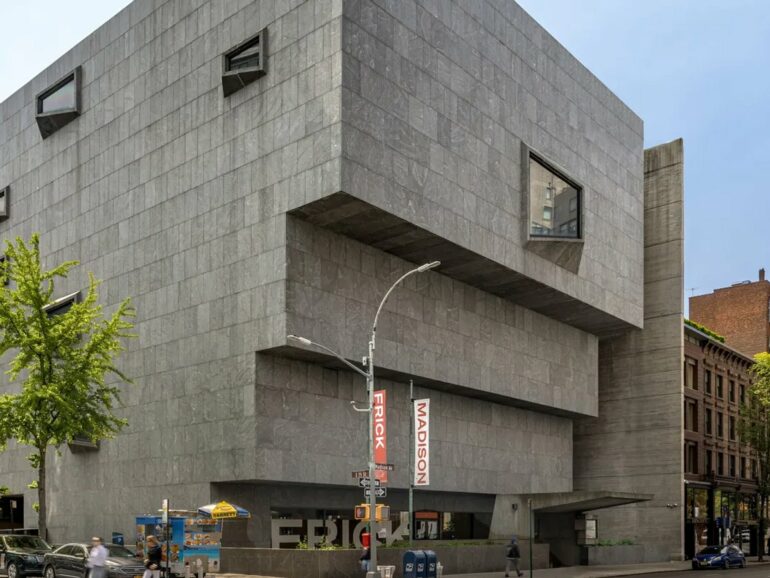
For Charles F. Stewart, CEO of Sotheby’s, this momentum owes much to the move into the famous Breuer Building on Madison Avenue. Opened last November, this masterpiece of Brutalist architecture has significantly enhanced the institution’s visibility in New York. In fact, visitor numbers more than doubled in the first half of the year compared to the former headquarters on York Avenue.
But this venue is much more than just a backdrop. It seamlessly blends immersive exhibition spaces, majestic auction rooms, and intimate reception lounges. In a metropolis where location dictates prestige, this architecture becomes a formidable selling point. While this approach is not unprecedented in the art world, it remains relentlessly effective: enhancing the presentation of the artworks maximizes desire and, by extension, optimizes sales.
The Triumph of Collectible Design
Among the season’s flagship events, Sotheby’s held its very first design auction dedicated to a single collection at its new venue. The Jean and Terry de Gunzburg collection surpassed the $96 million mark, establishing itself as the most valuable design auction ever held in the United States. The highlight of the event was a set of fifteen mirrors by Claude Lalanne, which fetched a total of $33.5 million, setting a new record for the artist and for a design piece at auction.
This success confirms a growing trend: collectible design has definitively moved beyond the realm of fine art. It now openly rivals these categories, especially when it combines rarity, an iconic signature, and legendary provenance. In a market driven by visual impact and heritage, design has found its place of honor, skillfully navigating the space between sculpture and the art of living.

The Old Masters also held their own. In New York, the season generated nearly $95 million, highlighted by a drawing by Rembrandt that sold for $18 million. In Hong Kong, modern and contemporary art auctions generated $91.3 million. Joan Mitchell set an Asian record for a female artist there with *La Grande Vallée VII* (1983), which sold for $17.6 million. The market thus continues to celebrate its leading figures.
The Unstoppable Vitality of Luxury
This wave of optimism extends far beyond the walls of Sotheby’s. A report by ArtTactic highlights a sharp rebound for global auction houses in 2026, with cumulative sales of $6.8 billion—a 70% increase year-over-year. Prestigious collections and luxury goods are the true driving forces behind this general upturn, a trend shared by its major rival, Christie’s.
At Sotheby’s, the luxury-related departments have been particularly instrumental in driving these results: watch sales soared by 64%, classic car sales through RM Sotheby’s jumped by 61%, while fine jewelry posted a more moderate increase of 13%. Another positive indicator is that the average number of bidders per lot rose to 4.9, a 6% increase. While this does not guarantee lasting stability, it is an undeniable sign that buyers are back—in greater numbers and determined to compete for exceptional pieces.
Financial Engineering in the Service of Prestige
As a private entity, Sotheby’s jealously guards its financial data. However, to reassure its investors and partners, the auction house recently lifted the veil on significant financial maneuvers. Following a $900 million securitization completed in January through its financial division, it finalized an $825 million bond issuance in April to refinance its debt, earning favorable ratings from credit rating agencies in the process.
The message is unequivocal: Sotheby’s is committed to demonstrating both commercial and structural strength. This is a crucial factor in the art industry, where people are often dazzled by the volume of auction sales while overlooking the reality of profitability. While these historic records bolster the auction house’s confidence and leadership, history humbly reminds us that the market loves to celebrate peaks but rarely dwells on plateaus.