
Make Texture a preferred source on Google to support us
Add Texture to GoogleThe Twilight of a Monolith: Why the Central Island Is Losing Its Luster
In the understated world of interior design, every decade has its own trophy, its indelible social marker. While the 2000s were the era of the bubbling hot tub and the 2010s that of the monumental, showroom-style walk-in closet, the 2020s have undeniably crowned the kitchen island. This geometric block, often topped with marble or quartz, flanked by three bar stools and a sculptural pendant light, has become a must-have for any self-respecting renovation. Whether it’s a 250-square-meter loft or a 60-square-meter city apartment, the island is no longer seen as a design option but as an emotional necessity. Yet behind this aesthetic craze, a backlash is brewing. Architects and designers are sounding the alarm: what if this piece of furniture, placed like an altar in the middle of the room, is killing the soul of our homes?
The kitchen island’s rise in the collective imagination has been meteoric. In less than twenty years, it has moved from professional kitchens and California mansions to take over every nook and cranny of our European homes. This phenomenon owes much to the visual power of algorithms. From Instagram to Pinterest, the image of the open kitchen with its central island has been repeated until it has become an absolute standard—irrefutable proof of modernity. But this standardization poses a major problem: it completely ignores the reality of square footage and, even more seriously, the diversity of our lifestyles. Why have we suddenly decided that the free flow of movement in a room must be obstructed by a massive piece of furniture, simply because it “looks good” in a photo?
From the Ancestral Hearth to the Contemporary Altar
To understand this obsession, we must go back to the origins of the hearth. For centuries, the fire was the beating heart of the home. People gathered there to keep warm, work, and, of course, cook. Industrialization severed this connection by relegating the kitchen to a closed-off, utilitarian, almost shameful space that was hidden from guests. Architect Raúl Almenara points out that opening the kitchen up to the living room created a void that the kitchen island has come to fill. “Often, people don’t want the object itself; they want everything it represents,” he explains. The kitchen island is not just a countertop; it is a modern reinterpretation of the hearth of yesteryear. It has regained that ability to bring people together, becoming, by extension, the new domestic altar around which social life unfolds.
Beyond its function, there is a clear aspirational dimension. Owning a kitchen island projects the image of a spacious home and generous hospitality. Interior designer Manuel Such, founder of Manuel Such Studio, analyzes this desire as a direct legacy of the American imagination. “The kitchen island has become a symbol of domestic social status. It suggests a large home, even if it’s sometimes just a visual illusion.” This standardization crosses borders: from Madrid to Miami, the climate and culture change, but the kitchen remains the same. We now design our interiors as if we were checking off a pre-set shopping list: open kitchen, L-shaped sofa, central island. The result? A uniformity that robs our homes of their unique character.
The Sacrifice of the Dining Table and the Loss of Rituals
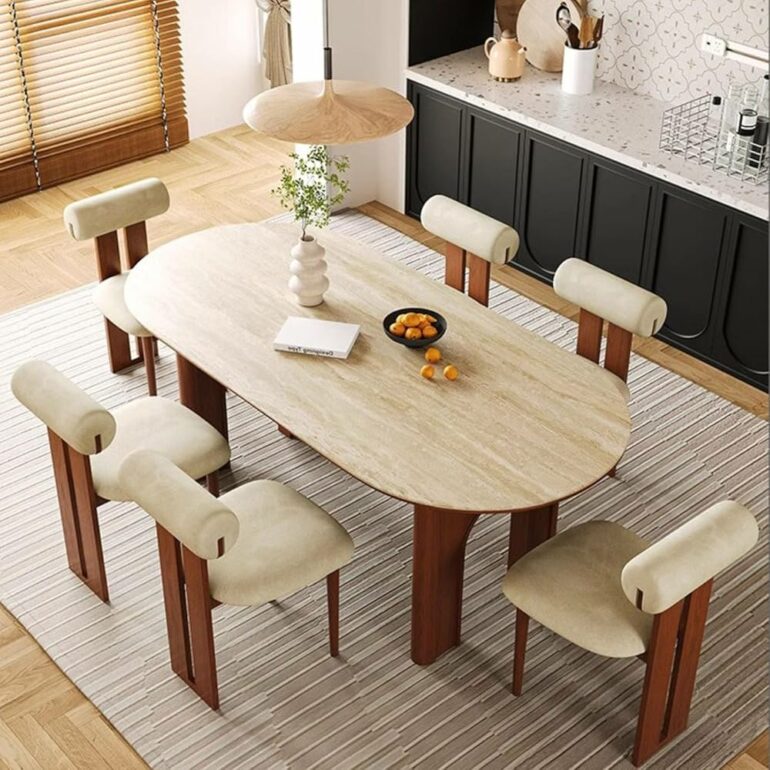
In this frantic quest for the perfect kitchen island, a major collateral victim has been sacrificed: the dining table. In many contemporary renovation projects, the traditional table disappears in favor of an extension of the countertop. We eat on the go, perched on often uncomfortable stools, with our eyes fixed on the sink or the stovetop. While this setup is ideal for a quick morning coffee or checking a few emails, it’s disastrous for French- or Spanish-style socializing. Can we really imagine spending three hours putting the world to rights with friends, with our feet dangling in the air and our backs hunched over a block of granite?
Raúl Almenara laments this gradual loss of one of the most fundamental rituals of our social life. “A table has never been merely a slab resting on four legs. It’s the place where the family gathers, where bonds are forged. If I had to choose a single element capable of representing the idea of home, it would be the table.” For him, the table should not be a mere piece of furniture added as an afterthought, but a true work of architecture that is born with the structure of the house. In contrast, the kitchen island fosters occasional, transactional interaction. Once the glass is empty or breakfast is finished, the space reverts to a functional thoroughfare. The table, on the other hand, invites a sense of belonging. It is the center of an essential Mediterranean tradition: the “sobremesa,” that endless conversation that follows a meal and which defines, perhaps better than anything else, the art of living together.
Visual Clutter and Space Constraints: The Pragmatic Reality
Beyond the philosophy of space, there are practical considerations that are all too often overlooked before signing a kitchen designer’s quote. Manuel Such points out that an island doesn’t just take up its own floor space. To be functional, it requires generous walkways all around it, the space needed to open drawers, the dishwasher, or the oven, and a fluidity of movement that small apartments simply cannot provide. Installing an island in a 60-square-meter space often makes the room feel cramped.

Furthermore, the central island introduces what experts call “visual and acoustic noise.” By placing food preparation at the center of the living space, you also invite cooking odors, the noise of kitchen appliances, and the inevitable sight of dirty dishes. For Manuel Such, the alternative is clear: a perfectly integrated linear kitchen and a modular table adapted to the actual space. “The question isn’t whether an island physically fits in the room, but whether it actually makes daily life better.”
Toward Personalization in Home Design
These experts’ goal isn’t to banish the kitchen island from our lives for good, but to break free from the dictates of trends. Raúl Almenara shares the story of a client living in a small studio who, during an in-depth discussion, realized he didn’t want an island per se, but rather the warm atmosphere he’d experienced at friends’ homes that had one. The solution? Design a unique, hybrid piece of furniture capable of adapting to different uses throughout the day, rather than adding a standardized unit. The idea is to “pack more life into fewer elements.”
The role of tomorrow’s architects and interior designers will be to transform the “must-haves” dictated by fashion into personal choices dictated by use. A trend deserves to endure only if it tangibly improves residents’ quality of life. Open-concept kitchens, so popular in the 1990s, eventually disappeared because they no longer met the needs of the times. It is highly likely that the central kitchen island will follow the same path, giving way to interiors that are more flexible, more human, and above all, less constrained by geometric certainties. Ultimately, the most beautiful room in a house isn’t the one that follows the rules, but the one that makes you say, as Manuel Such points out: “We’re so comfortable here that we can’t bring ourselves to get up from the table.”