
Make Texture a preferred source on Google to support us
Add Texture to GoogleSeeking shelter from the rain under a meticulously cut canvas or jotting down one’s thoughts on paper of the utmost fineness ultimately boils down to the same principle: that of a shield. British luxury has been built on this idea of elegant protection against the elements. It is therefore not so surprising to see the partnership today between Burberry, which built an empire on waterproofing, and Smythson, the guardian of London’s stationery tradition. These two institutions are launching a joint collection of leather accessories, games, and notebooks that goes beyond a mere image-building exercise. In this all-digital age, offering a travel chess set or a physical diary becomes a statement of intent. These historic houses understand that clothing alone is no longer enough to hold the attention of a constantly solicited clientele; they must engage people during downtime, commutes, and moments of waiting. They must keep hands occupied.
The irony of the weather as a cultural signature
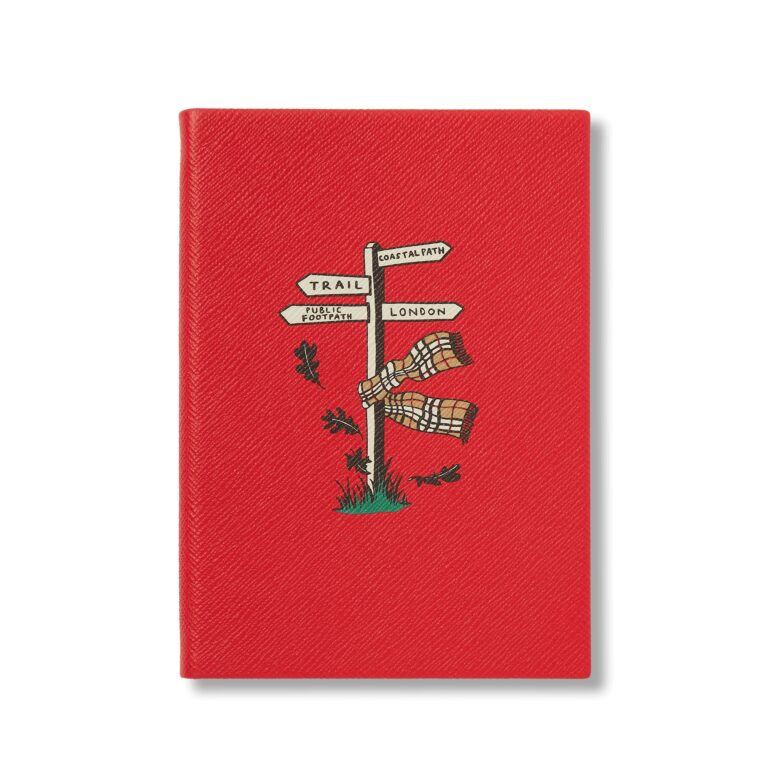
The aesthetic of this line is rooted in a cultural foundation shared by all residents of the United Kingdom: an obsession with the weather. While other parts of the world celebrate sunshine or the good life, the British narrative embraces gray skies and drizzle. The covers of the notebooks resulting from this exchange openly play on this theme. They feature maxims stamped into the leather, such as “Lovely weather for ducks,” “Come rain or shine,” and “Rain check.” The approach borders on playground humor or the sarcasm found in a pub on a November evening, but the twist proves remarkably effective.
By appropriating these common expressions, the collection is firmly rooted in a tangible reality. This is not an idealized or abstract vision of heritage, but a direct nod to Burberry’s very roots, whose early commercial successes stemmed precisely from the ability of its fabrics to withstand the worst weather conditions. Transforming a meteorological nuisance into a source of aesthetic pride is a complex endeavor that this series of pieces masters through the restraint of its execution.
Paper and Leather: The Geography of Craftsmanship
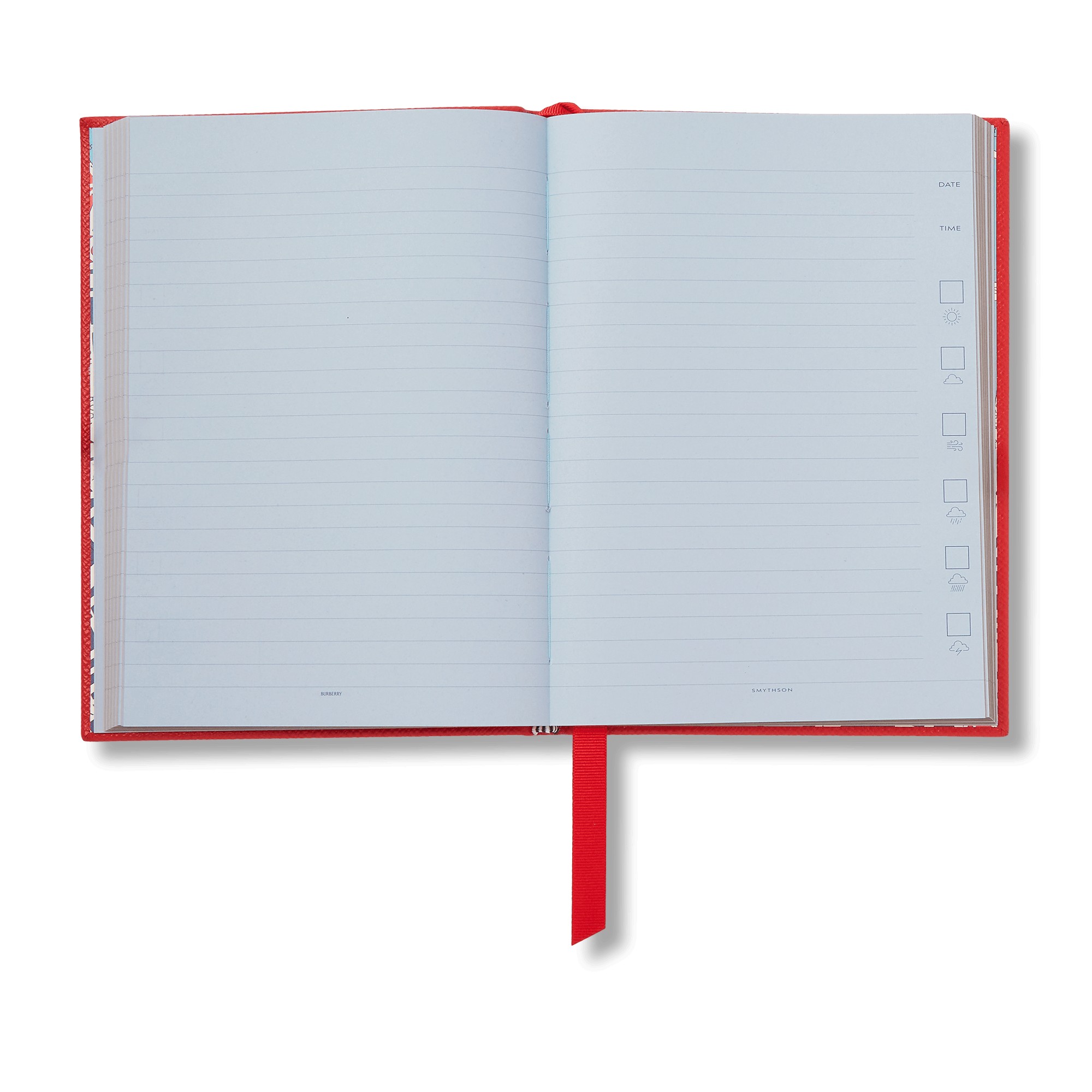
The materiality of the objects reveals another facet of this partnership. The production of the notebooks was entrusted to the artisans at the Smythson workshops in Hertfordshire. There, the workshop carries on precise techniques, from assembly to hand-binding. We find the famous light blue paper, as light as a feather, which has made the brand’s reputation far beyond the island’s borders. But the collaboration truly comes into its own in the details hidden within the pages.
The endpapers, traditionally reserved for neutral or heraldic motifs, here reveal a map of London drawn directly from the creative process behind Burberry’s Fall 2026 collection. This design choice creates a striking temporal bridge: the classic handcrafted object, meant to embody permanence, is subtly tied to the fast-paced world of fashion. This approach avoids the pitfall of a shallow, derivative product. It places the notebook within a seasonal narrative while preserving its timelessness.
The stylistic intervention remains understated. The famous check pattern, the “house check,” does not overwhelm the exterior of the pieces. Instead, it discreetly lines the zipped compartments of certain accessories. On the outside, Panama leather reigns supreme. For those who demand complete personalization, a customization service allows for three initials to be gold-stamped onto the surface. The message is clear: the brand steps back just enough to make room for the individual.
The spirit of exploration brought into the living room
The collection’s scope broadens considerably as it ventures into the realm of play. The introduction of card decks with gold-edged cards, carefully slipped into leather cases, as well as backgammon and chess boards designed to be rolled up, shifts the focus from the practical to the indispensable frivolity. These objects evoke the passage of time, ocean liner crossings, evenings in hushed clubs, or waiting in private airport lounges.

Yet this apparent indolence draws its roots from a far harsher history: that of exploration. Smythson’s archives are filled with commissions related to extreme conditions. In the 1970s, the company supplied the logbooks for the Transglobe expedition, proving that its paper and bindings could withstand the planet’s harshest climates. Long before that, in the 1890s, it furnished the offices of Queen Victoria’s residences, before patenting the very first portable planner in 1908, thereby freeing handwriting from the constraints of bulky furniture.
For its part, Burberry has outfitted aviation pioneers and polar explorers. Bringing these two legacies together in a roll-up chess set creates a fascinating contrast. Equipment designed for survival and territorial conquest is transformed into an entertainment accessory for leisurely travelers. The harshness of past expeditions lends a certain gravity to these leisure items. The supple leather and game pieces simply reenact, in a subdued and peaceful manner, the golden age of British adventure.
Building a Brand Image Ahead of the Anniversary
The timing of this joint release follows a very specific corporate strategy. Burberry is celebrating its 170th anniversary this year. Next year, Smythson will celebrate its 140th anniversary. The convergence of these two dates is prompting the creative teams to assert their legitimacy through tangible actions. Partnering allows them to pool a prestige that competitors often struggle to achieve on their own.
The pricing strategy also reflects this desire to remain in an exclusive sphere, albeit one that is accessible in stages. Purchasing one of the notebooks requires an initial investment of 210 pounds. The price climbs to 850 pounds for the leather chess set. Distributed both through the physical store networks of both entities and on their digital platforms, the collection targets a clientele seeking to acquire a piece of the country’s history, embodied in a tangible object.
Tapping into centuries-old archives always carries a risk for the luxury industry: that of becoming trapped in a museum of its own successes, of freezing history to the point of rendering it silent. By choosing items whose sole purpose is to be handled—stained by ink, folded, tossed into a travel bag, or laid out on a train table—the two manufacturers sidestep this danger. They reject the display-case item. The British tradition they champion here does not demand to be gazed upon from behind protective glass. It simply asks to be slipped into a suitcase, ready to face the next downpour.