
Make Texture a preferred source on Google to support us
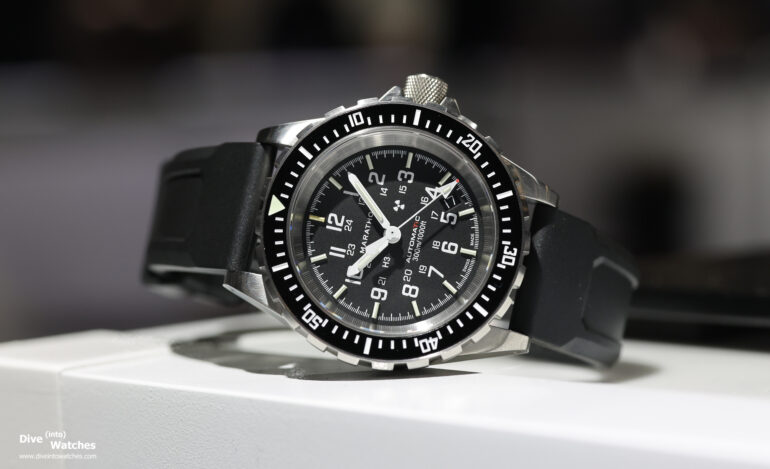
Add Texture to GoogleA military watch isn’t judged by the shine of its case or the sophistication of its design. It comes down to less photogenic details: a crown you can grip without hesitation, a bezel that won’t endanger the wearer in the event of an impact, and a dial that remains legible when the light fades. With the 41 mm Titanium GSAR, Marathon takes this philosophy all the way to the very material itself. For the first time in its permanent collection, the brand has placed titanium at the heart of its Government Search and Rescue watch.
Weight as the Primary Function
Titanium has sometimes become a marketing gimmick, especially in sports watchmaking. Here, however, it serves a more practical purpose: to lighten an object meant to remain on the wrist for long hours. Crafted from Grade 5 titanium, the GSAR’s case is 30% lighter than that of an equivalent steel watch. The benefit, therefore, isn’t just about urban comfort—the kind where you can forget your watch is there under a cashmere sleeve. Rather, it’s about the wearer’s endurance in conditions where every gram carried ultimately counts.
This development marks a measured shift for Marathon. The brand had previously used titanium in limited editions; it is now making it the material of choice for a model intended to remain in the catalog. This choice does not transform the GSAR’s design into a futuristic stylistic exercise. On the contrary, it retains the compact, solid, and immediately functional look that defines this family of tool watches.
The case measures 41 mm in diameter and 13.5 mm in thickness. These proportions remain substantial without resorting to the oversized dimensions often associated with field watches. All surfaces feature a brushed finish. The absence of a mirror-polished finish serves a very practical purpose here: to reduce glare. In this world, visual discretion isn’t an aesthetic choice; it’s a functional necessity.
A Watch Designed to Account for Error
The GSAR Titanium is water-resistant to 300 meters, or 30 bar. But the feature that best illustrates its design philosophy is found on its rotating diving bezel, also made of titanium. It has 120 notches and rotates in only one direction. This unidirectional mechanism safeguards the calculation of dive time: if the bezel is accidentally moved, it can only indicate a dive time longer than the actual duration. In other words, it prompts the diver to surface too early, never too late.
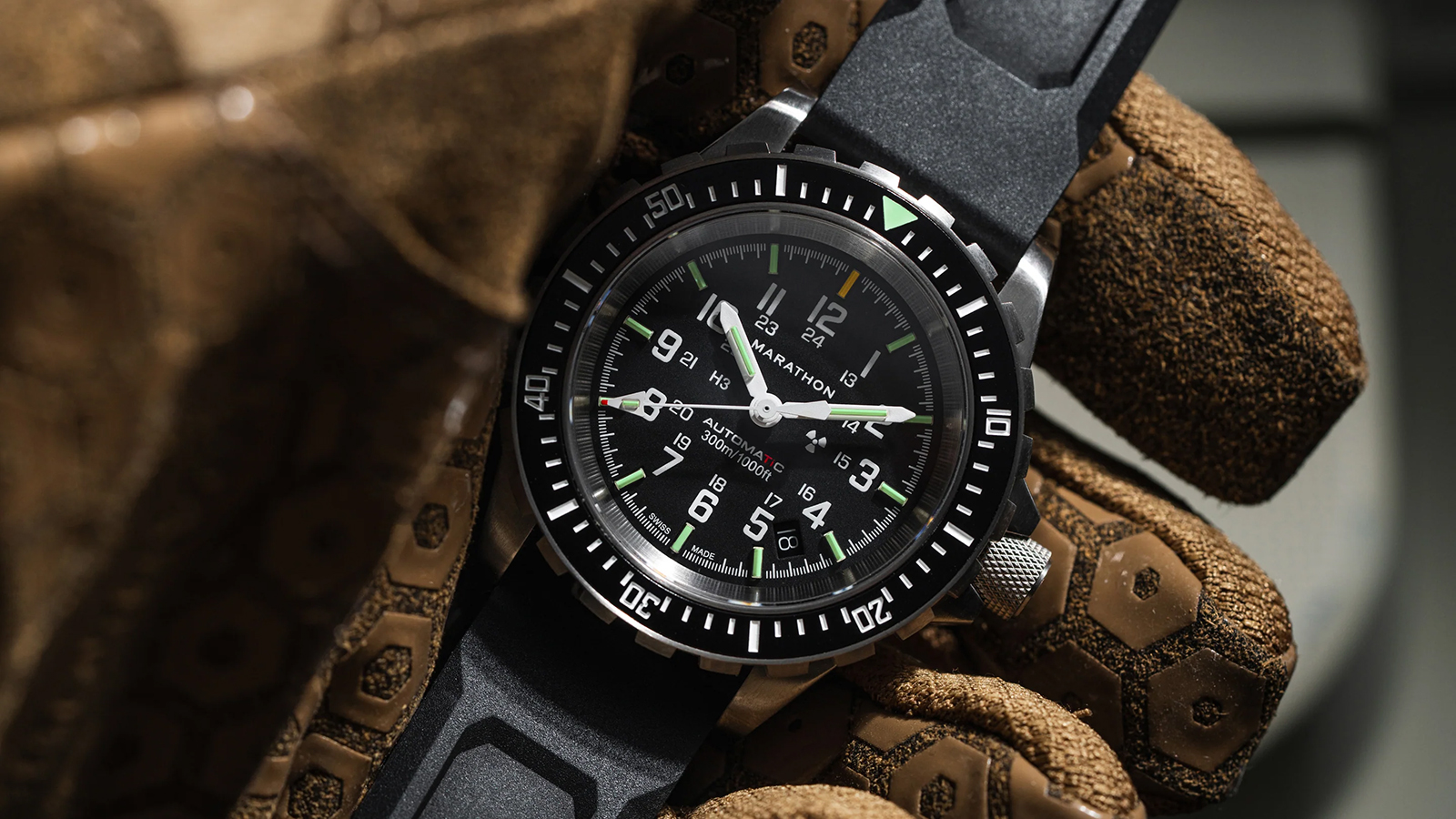
This principle sums up the spirit of the piece quite well. The watch does not try to hide the fact that it is an instrument. It makes its purpose visible, from the understated case to the raised details on its oversized crown. Positioned at the 3 o’clock mark, the crown features a “hobnail” grip, consisting of small raised dots that make it easier to handle. Its size is deliberately generous to ensure a secure grip even in challenging conditions.
This technical straightforwardness sets the GSAR apart from many contemporary dive watches, which are often designed to navigate a business meeting or a weekend by the water with equal ease. Marathon makes no attempt to hide the thickness, presence, or safety features of its model. It treats them for what they are: practical solutions to demanding specifications.
A dial with a refined aesthetic
The black dial has also undergone targeted refinements. The date window, positioned between 4 and 5 o’clock, has abandoned the dark-on-light-background display in favor of a white indication on a black disc. The information remains legible but blends more naturally into the dial’s surface. This modest change reduces the sense of disruption created by the date within a display designed above all to be taken in at a glance.
The typography has evolved more noticeably. The letters and numbers have become bolder, more angular, and more substantial in design. The number 8 provides a good measure of the change: whereas its previous design resembled two overlapping circles, it now takes on a more square silhouette. This is no mere detail. In a watch where the hour markers must be quickly identifiable, the shape of the numerals contributes as much to the overall character as it does to its clarity.
The word “Automatic,” beneath the central axis, introduces the only notable touch of color: the letters “Ti” are printed in red, a direct nod to titanium. The rest of the design avoids unnecessary contrast effects. The hands and hour markers are fitted with tritium gas tubes, designed to ensure readability in low-light conditions. The GSAR therefore does not rely solely on prior exposure to light to remain legible after dark.

A movement designed for downtime
The redesign isn’t limited to the case. Beneath the dial, Marathon has installed a Top Grade-finished Sellita SW200-2 self-winding movement. It beats at 28,800 vibrations per hour—or 4 Hz—and displays the hours, minutes, seconds, and date. Its power reserve is 65 hours.
This figure deserves special mention, as it tangibly changes how you interact with the watch on a daily basis. The steel version of the GSAR was equipped with an SW200-1 offering 41 hours of power reserve. With 65 hours, the Titanium GSAR can remain tucked away in a bag for two days without requiring immediate adjustment of the time and date when it returns to the wrist. This added power reserve better reflects the reality of a timepiece that isn’t necessarily worn according to the strictly regimented routine of a city watch collection.
The movement does not seek to captivate with a theatrical display of mechanics. It is part of a watch where precision, perceived robustness, and ease of use take precedence over any temptation toward ornamentation. The choice of a Sellita Top Grade automatic caliber reinforces the model’s move upmarket without causing it to lose its original essence: that of an instrument meant to be used rather than admired through a transparent case back.
The price of titanium, plain and simple
On the wrist, the watch comes with a black FKM rubber strap, secured by a titanium pin buckle. Here again, Marathon prioritizes practicality. The rubber complements the model’s nautical character, while the buckle maintains material continuity with the case and bezel.
The pricing reflects the scale of this evolution. A price of 2,475 pounds sterling has been announced, compared to 1,700 pounds for the steel GSAR—a difference of 775 pounds. The technical specifications also list 2,066 pounds, approximately 2,750 dollars. Regardless of the figure used, the switch to titanium, the revised dial design, and the 65-hour movement place this GSAR in a more ambitious category than its steel predecessor.
This increase might seem paradoxical for a watch designed to be scratched, bumped, and exposed to the elements. Yet it highlights a less glamorous reality of utilitarian watchmaking: building an object capable of withstanding harsh conditions while remaining accurate, water-resistant, legible, and wearable is not a matter of simplification. The Titanium GSAR embodies this contradiction with a certain rigor. Its main selling point lies not in a new design, but in the 30% reduction in weight that you feel every time your wrist has to keep moving forward.