
Make Texture a preferred source on Google to support us
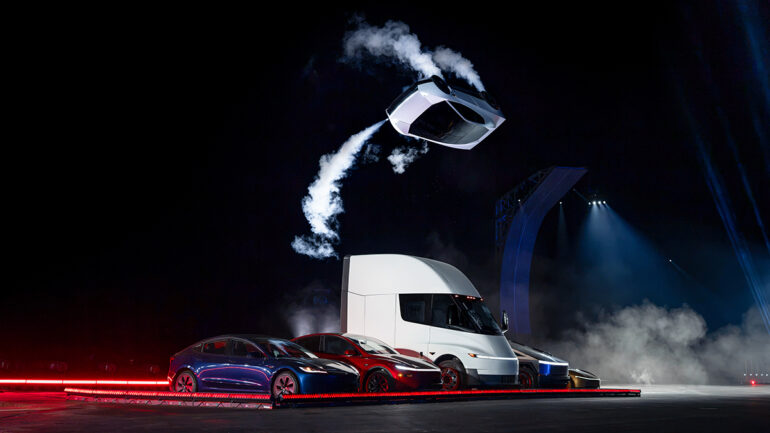
Add Texture to GoogleNo one was sitting in the car. That is the first detail to remember from the evening of October 15, 2026, in McGregor, Texas, at SpaceX’s rocket development and testing center. The prototype of Tesla’s new Roadster climbed a curved ramp until it was driving completely upside down, held against the structure by its own fans. It then launched from the top, pivoted 180 degrees in midair, and landed on all four wheels. All these maneuvers were performed in autonomous and remote-controlled modes, without a driver or passenger. Elon Musk had promised a car capable of lifting off the ground. He kept his word—in his own way. It remains to be seen what this demonstration guarantees for those who will one day get behind the wheel.
A nine-year wait—and two more weeks
The Texas event had initially been scheduled for October 1. High winds and bad weather at the outdoor venue pushed it back by two weeks. This setback is minor in the grand scheme of the model’s history. The next-generation Roadster was first unveiled in November 2017, with deliveries announced for 2020. That date came and went without a car, and the 2026 unveiling comes nearly nine years after the initial promises.
On stage, three men shared the narrative: Elon Musk, CEO of Tesla and SpaceX; Lars Moravy, vice president of vehicle engineering; and Franz von Holzhausen, chief designer. The choice of venue was no accident. The Roadster no longer merely draws on its sister company’s space-age imagery—it also incorporates some of that technology.
What the car actually accomplished
The most talked-about sequence remains the upside-down section. It relies on a vacuum system that creates a mechanical suction under the chassis, powerful enough to keep the car pressed against the ramp even as gravity tries to pull it away. The jump that follows follows a different logic. The prototype leaves the structure, performs a rotation in midair, and then cushions its landing with a burst of compressed air.
The second jump made an even bigger impression. The Roadster cleared an entire row of lined-up Tesla models—including a Semi truck—while performing a spin midway through the jump. Its landing was slowed by reverse thrust. A third demonstration, less spectacular but more technically significant, showed it briefly lifting off from a standstill before performing a roll.
However, we must consider what the word “flight” actually means in this context. Tesla and its executives refer to the car as “air-ready,” or even a “flying car.” The aerial phases observed in Texas were ballistic bursts lasting a few seconds—parabolic leaps covering a few dozen meters. There was neither sustained flight nor cruising, and nothing resembling the ability for sustained flight in the aeronautical sense. The Roadster jumps, pivots, and lands with remarkable precision. It does not fly.
No fuel, just pressurized air
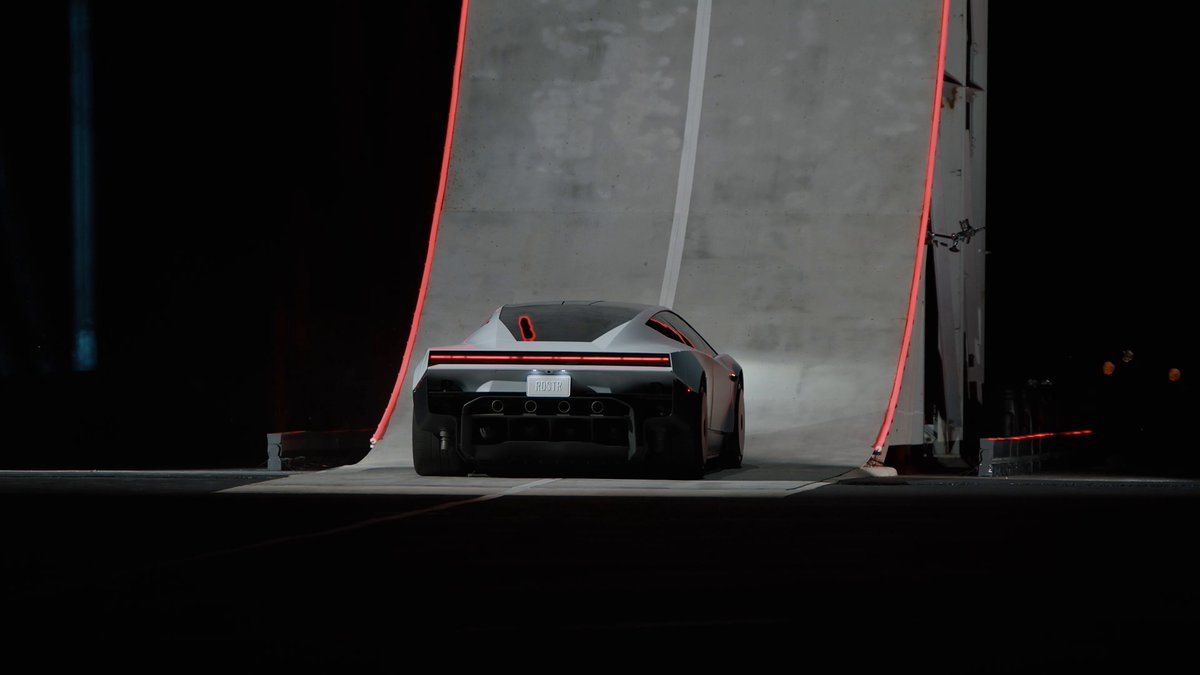
At the heart of the system is a cold-gas auxiliary propulsion system, developed using SpaceX’s attitude control technologies. No dedicated fuel is required: the nozzles expel compressed air, which can be recharged. Lars Moravy provided details on the onboard supply. Up to 600 liters of ultra-high-pressure air—equivalent to about 250 kg—are distributed across two COPV-type carbon-fiber-wound tanks. At the rear, the nozzle system delivers a thrust of over 80 kN.
Beneath the rear diffuser, suction turbines generate up to 2 G of vertical mechanical downforce even at low speeds. The principle is reminiscent of that of the McMurtry Spéirling, which popularized the idea of downforce independent of speed. Steering and braking are fully electronic, with no direct mechanical connection between the driver and the wheels. This choice of steer-by-wire and brake-by-wire systems makes unmanned demonstrations possible.
A tiered lineup, from road-going to off-road
The Roadster’s configurator offers three versions. The logic is simple: the higher up the range you go, the further you move away from open-road driving.
The two-seater Performance version does away with gas propulsion entirely. It retains the active aerodynamics and the multi-mode intake system, and is rated for 0 to 60 mph in under 1.6 seconds. It is the only variant designed for conventional road use.
The Thrust version, also a two-seater, combines the intake system with rear-facing cold-gas thrusters. It was this version that delivered the most concrete figure of the evening: a 0 to 60 mph time clocked live at 0.81 seconds. The measurement was taken after subtracting a “one-foot rollout,” the convention that excludes the first foot traveled. For the final production model, Tesla says it’s aiming for under 0.9 seconds.

The Rocket version takes this concept to its logical extreme. It becomes a single-seater, as the passenger seat is removed to make room for tanks and piping. It features a complete system of ten nozzles distributed around the body, designed to provide forward and upward thrust and to control yaw and roll. The official website states it plainly: “Not approved for public road use.” Its 0 to 60 mph time of less than 0.59 seconds remains a target figure, as this version has not yet been publicly tested. The same applies to the top speed of over 230 mph—approximately 370 km/h—announced for the Thrust and Rocket versions.
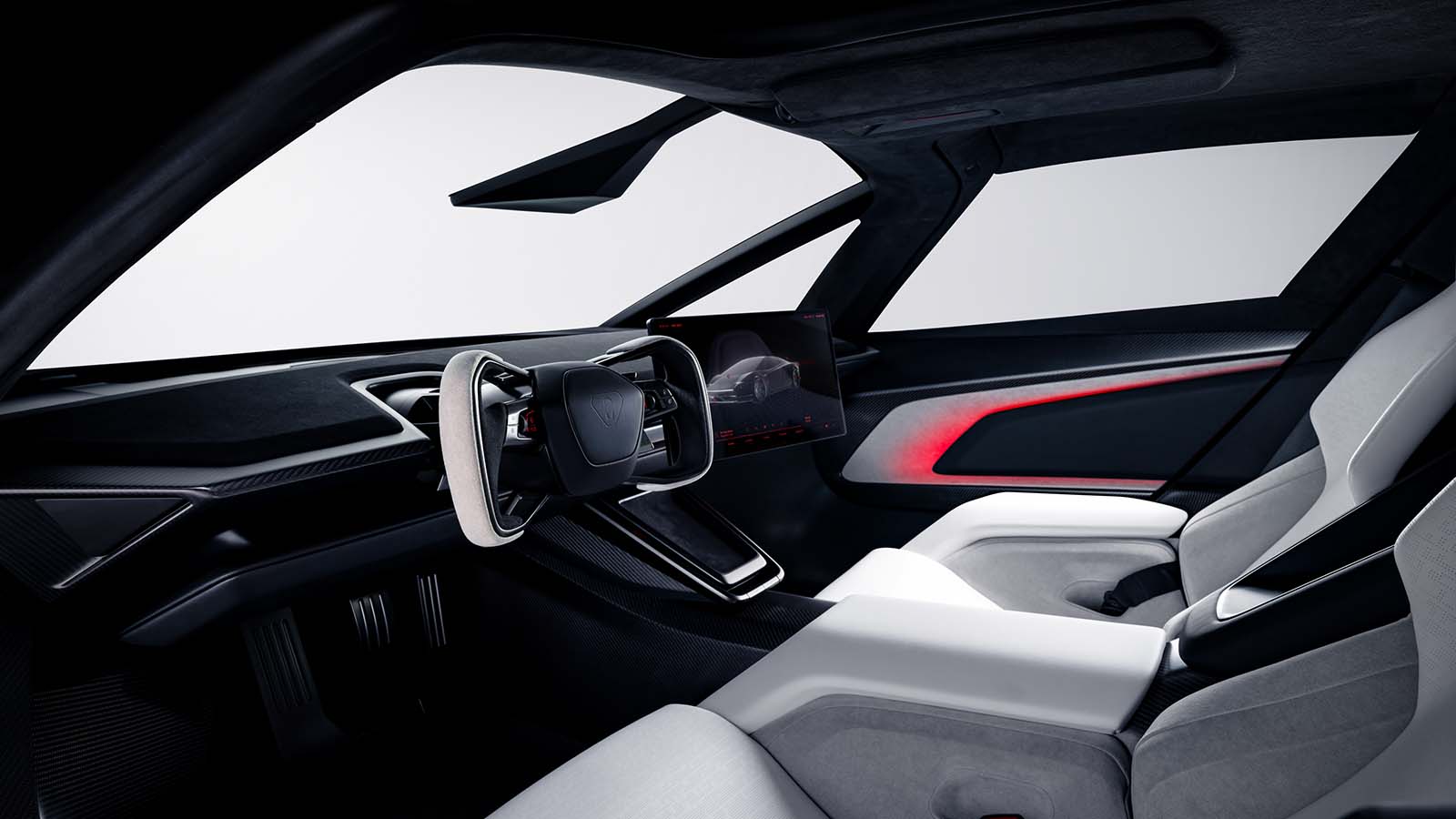
The question of road legality therefore arises for any model above the Performance trim. To date, there is no indication that compressed-gas nozzles or aerial lift will be permitted on public roads—whether in the United States, Europe, or by aviation authorities. As it stands, anyone buying a Thrust or a Rocket is purchasing a vehicle intended for the racetrack and demonstrations rather than an everyday car.
What Has Been Lost Along the Way Since 2017
A comparison with the 2017 prototype isn’t flattering in every respect. The range promised at the time was 620 miles, or 1,000 km, thanks to a 200 kWh battery. The figure cited for 2026 is around 300 miles, or approximately 483 km—half as much. The first Roadster was a 2+2 coupe with three electric motors. The new model does away with the rear seats across all its versions, and the Rocket even sacrifices the passenger seat in favor of its pneumatic system.
This compromise is intentional. The space and energy that were intended for long-distance travel have been reallocated to compressed air, suction, and thrust. The 2026 Roadster is no longer the long-distance electric road car envisioned nine years ago. It is a machine built for acceleration and acrobatics, the most successful demonstration of which took place without a human on board.
Deposits, but No Price Yet
As of October 17, 2026, Tesla had not released any list prices. Only reservation deposits were listed on the official website. They amount to $50,000 for the Performance model—approximately 46,000 euros—and $250,000 for the Thrust model—approximately 230,000 euros. The Rocket is available by invitation only, with a deposit amount that has not been disclosed. These amounts represent only a security deposit. The total price remains unknown, even for those who have already paid a quarter of a million dollars.
Another, more subtle detail is important for European customers who prefer right-hand drive: the regional versions of the website show the model as left-hand drive only.
As for the timeline, Elon Musk has mentioned a 2028 production start at the Texas Gigafactory. This date should be viewed as an intention rather than a firm commitment. Previous deadlines for the Roadster have all been missed, and Tesla has not released any information that would allow us to take this date for granted. If it were met, the car unveiled in November 2017 would arrive nearly eleven years later.