

Make Texture a preferred source on Google to support us
Add Texture to GoogleIn the large room on the ground floor, the bar serves primarily as a barrier. The interior designers placed it there to keep guests at a distance from a cast-iron column, a metal beam, and a section of firebrick covered in black and white lines. The drawing was created using a mixture of shoe polish and rubbing alcohol, a water-soluble medium. Its creator, Keith Haring, was in his twenties and had just arrived in New York. The entire piece, including the wall, is for sale for $25 million.
A Student, a Cast-Iron Column
The work dates from around 1979. Haring, born in 1958 and who died in 1990, was then attending the School of Visual Arts in Manhattan. In the late 1970s, the school used the lower level of the building as a gallery and venue for temporary exhibitions by its students. The young man drew directly on his surroundings: the column, the beam, the bricks, the ceiling. He did not work on a stretched canvas or on a panel that could have been taken down later. He painted on the building’s structure.
This choice, no doubt dictated by the limited resources available at the time, now settles the entire legal issue. The mural is an integral part of the building’s load-bearing elements. It cannot be removed or relocated, nor can it be sold separately. Anyone who wants to own this Haring must purchase the apartment that houses it.
The drawing, in black-and-white monochrome, is unsigned. The Keith Haring Foundation has formally authenticated it, which secures its place in the artist’s body of work. For an early, unsigned piece, this recognition matters.
More Than Twenty Years Behind a Partition
In the early 1980s, the School of Visual Arts moved out of the building. The space became a restaurant, then a storage area. In the meantime, the mural had disappeared beneath sheets of drywall. This neglect protected it. For more than two decades, the shoe polish and alcohol were spared from wear and tear, humidity, and the brushstrokes of potential new owners.

It reappeared during renovations carried out by two architects, Todd Ernst and Frank Servidio, on behalf of the owner at the time, Mark Colaio. A broker at Cantor Fitzgerald, he died in the September 11, 2001, attacks. The exact date of the discovery remains unclear. The two architects place it in 2001. Other accounts cite 2007, a date that could correspond to the resumption of construction or to the first time the mural’s existence was made public following a sale. The available sources do not allow for a definitive conclusion.
A Place of Wool and Yarn
The apartment occupies the ground floor of 260 West Broadway in TriBeCa. The building is now called the American Thread Building. It was originally built as the New York Wool Exchange Building, the New York wool exchange. This name evokes the neighborhood’s textile and commercial past, long before its lofts. The Neo-Renaissance-style building is designated as an individual historic landmark by the city and listed on the National Register of Historic Places.
Its year of completion varies depending on the source. The agency’s description lists 1894, while many specialized art and architecture publications cite 1896. Only the facade, the cast-iron elements, and the large arched windows are universally agreed upon: they date from the last decade of the 19th century.
Eight thousand square feet centered around a column
The property is a ground-floor triplex, what New Yorkers call a “maisonette.” It has a separate entrance while still benefiting from the services of a doorman-staffed condominium. The living area totals 8,000 square feet, approximately 743 square meters, spread over three levels. It features seven bedrooms and nine bathrooms, as well as a screening room, a gym, and a sauna.
The large, square reception room measures 45 feet on each side, or approximately 13.7 meters. Three arched windows provide light. Regarding ceiling height, the official listing states 26 feet—approximately 7.92 meters—but several reports mention 28 feet—approximately 8.53 meters. On this scale, the difference is negligible. In either case, the room retains the height of an exhibition hall—the kind Haring was familiar with.

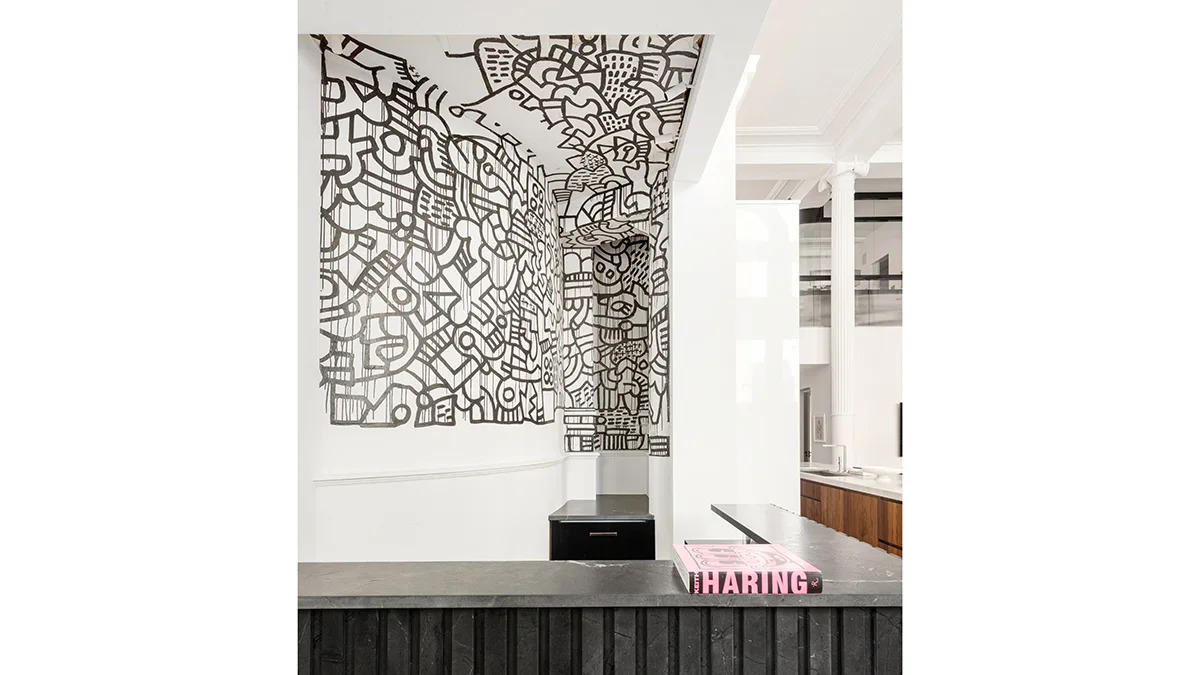
The seller, Adam Zoia, founder and president of the recruitment firm Glocap Search, had the entire space renovated over the course of two years by the design firm Sottile & Co. The renovation team had to contend with an unusual challenge: a fragile artwork mounted on the structure that could neither be packed up nor stored elsewhere during the work. That’s why the bar was placed in front of the mural—it serves as both a piece of furniture and a railing.
The price of a work of art that cannot be sold
How much of the 25 million requested is attributable to the mural? No one says, and no one can say for certain. No independent appraisal has separated the value of the mural from that of the property. The brokers acknowledge that they did not have it appraised separately. For real estate specialists as well as art market experts, the exercise makes little sense: a work that cannot be legally or physically separated from the walls has no market value of its own. One must therefore be wary of any figure that purports to quantify Haring’s share.
This paradox makes the object unique. On the market, Haring’s works circulate, are traded, and go up for public auction. This particular piece can only change hands along with the property. The buyer who desires it also takes on the responsibility of preserving it, in a space they will inhabit, beneath a ceiling they cannot repaint.
From 6.5 to 25 million
The apartment was listed in October 2024 by Compass, through the Trove Partners team: Ian Slater, Michael Koeneke, and Eduardo Martinez. At the current exchange rate, $25 million is equivalent to approximately 23 million euros, an indicative conversion that will fluctuate with currency movements.
The property’s history sheds light on this figure. In 2007, the duplex was listed at $16 million, then at $23 million, without finding a buyer. By 2021, the asking price had dropped to $7.9 million. Adam Zoia reportedly purchased it for around $6.5 million, with the sale taking place in 2022. Three years and a complete renovation later, the listed price has nearly quadrupled.
Meanwhile, the mural hasn’t moved. It still sits on the cast-iron column where a student painted it around 1979, using shoe polish and rubbing alcohol, in a school hallway that everyone had forgotten about. It remains to be seen which buyer will pay to have it in their living room.