
Make Texture a preferred source on Google to support us
Add Texture to GoogleThere is something quite delightful about the gesture: pulling out the crown to freeze time, waiting for the right moment, and then releasing the hand at the exact second. This ritual, inherited from marine chronometers, finds a particularly literal expression today at Arnold & Son. With the DSTB Stop-Seconds, the brand has finally added to its jumping seconds display the ability to adjust it with the same precision it claims to embody. A discreet, almost invisible improvement, yet essential for a watch whose entire personality rests on the legibility of the moment.
The Second as a Mechanical Object
The DSTB, short for Dial-Side True Beat, has been one of Arnold & Son’s most recognizable collections since 2014. Its uniqueness stems from a choice that may seem paradoxical: advancing a mechanical seconds hand in successive jumps, much like a quartz watch. Whereas a traditional second hand appears to glide continuously—because it advances in several micro-increments every second—the DSTB’s second hand marks time with a sharp, distinct jump.
Yet this result has nothing to do with electronics. In a quartz watch, a motor drives the hand at regular intervals. Here, the movement remains entirely mechanical, and the balance wheel oscillates at its usual rate. Between this regulating mechanism and the second hand is a device consisting of a lever and a notched wheel. The system stores energy, momentarily blocks the transmission, and then releases it once per second. To the eye, only one effect is apparent: a hand that lands precisely on each mark.
This design is less about promising improved daily accuracy than it is about readability. A sweeping second hand is always somewhere between two markings, leaving the eye to estimate its position. A jumping second hand, on the other hand, unambiguously points to a specific mark. For a watch inspired by the world of timekeeping and navigation, this nuance is far from trivial. It is, in fact, the founding principle of the DSTB.
The paradox resolved by the crown
Until now, however, the collection harbored a technical contradiction. A watch designed to display the second with such clarity did not allow for such simple synchronization with a time reference. On a classic mechanical watch, pulling out the crown generally stops the second hand. This mechanism, called a “stop-seconds” function, allows you to set the hands, wait for a reference time, and then push the crown back in to resume at the chosen moment.
On previous DSTB models, the second hand continued its jerky motion when the crown was pulled out. The reason is mechanical: a true beat involves a continuous cycle of storing and releasing energy. Simply stopping the balance wheel is therefore not enough to cleanly interrupt the chain that drives the second hand.
The A&S6303 caliber provides the solution by adding a specific lever. As soon as the crown is pulled out, this component stops the seconds hand as well as the tension accumulated by the mechanism. Once the crown is pushed back in, the entire mechanism restarts immediately. The lever is deliberately hidden from view: it is not visible from the dial side, despite the DSTB’s open architecture, nor through the sapphire caseback. It is a complication for connoisseurs, whose value is measured by its function rather than its visibility.
The gesture recalls that of navigators of old adjusting their chronometers. The hands were set in advance, then released at the hourly signal. The stakes were far from theoretical: Arnold & Son estimates that a one-second error can cause a ship to deviate by 463.8 meters. The DSTB Stop-Seconds is obviously not intended to navigate a ship, but it captures this age-old idea of time that must be able to be read—and then acted upon—with precision.
Two aesthetics rather than a predictable harmony
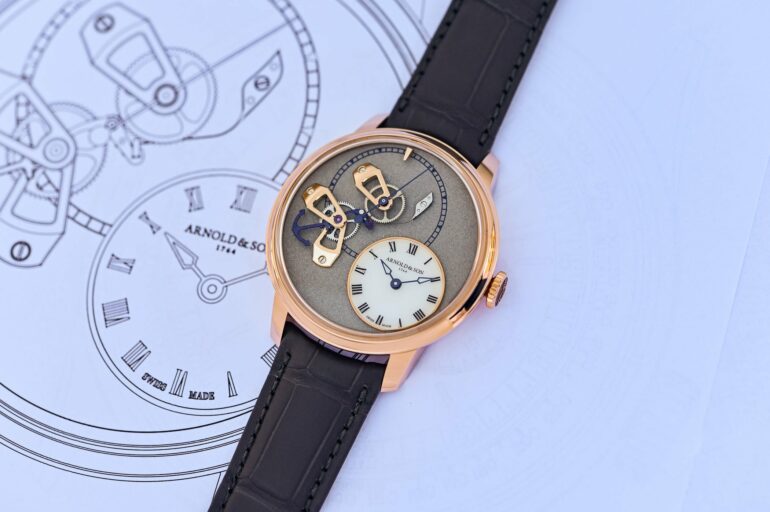
This new mechanical timepiece is available in two limited-edition 42-mm models that prioritize contrast over tone-on-tone harmony. The 18-karat 5N red gold version features a Cliff Grey dial—a cool gray with a grained finish. The 950 platinum watch, on the other hand, features Kingsand, a warm shade with golden undertones. Eighteen pieces of each version will be produced, for a total of 36 pieces.
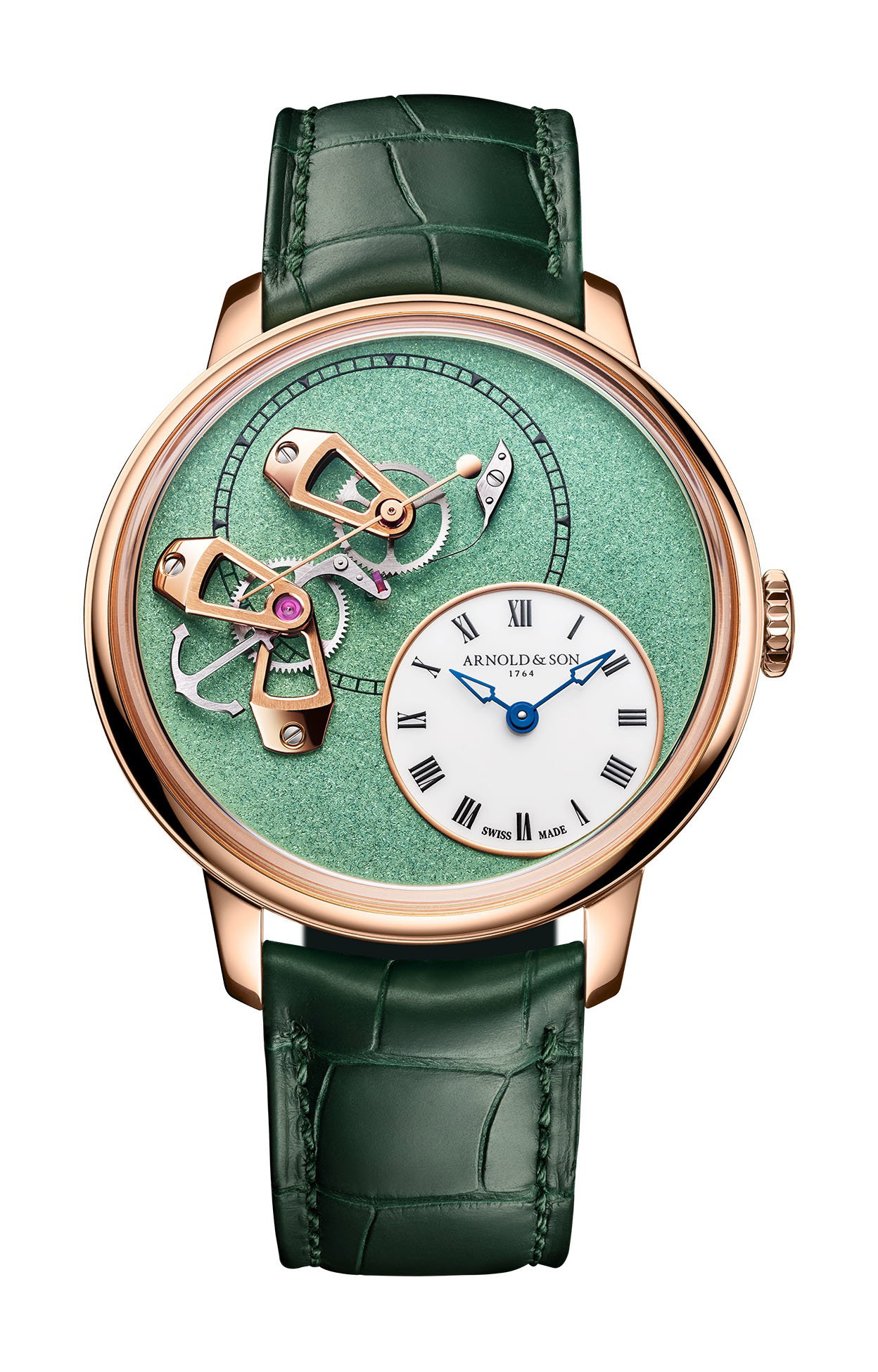
These colors mark an interesting shift in the recent history of the DSTB. The collection had previously embraced bolder tones, such as mint green or Ascot Blue. Cliff Grey and Kingsand appear more subdued, but they were not chosen at random. The former evokes the cliffs of Cornwall, John Arnold’s homeland. The latter references the gold-plated brass main plates of the historic movements associated with his name.
This homage is woven into a very contemporary design. In the upper part of the dial, the true seconds mechanism is on full display. Its gold bridges and fire-blued steel anchor accompany the hand on its circular path, delineated by a blue outer minute track. Below, the hours and minutes are displayed on a slightly concave white opal subdial featuring Roman numerals. Its bezel matches the case material: red gold for Cliff Grey, platinum for Kingsand.

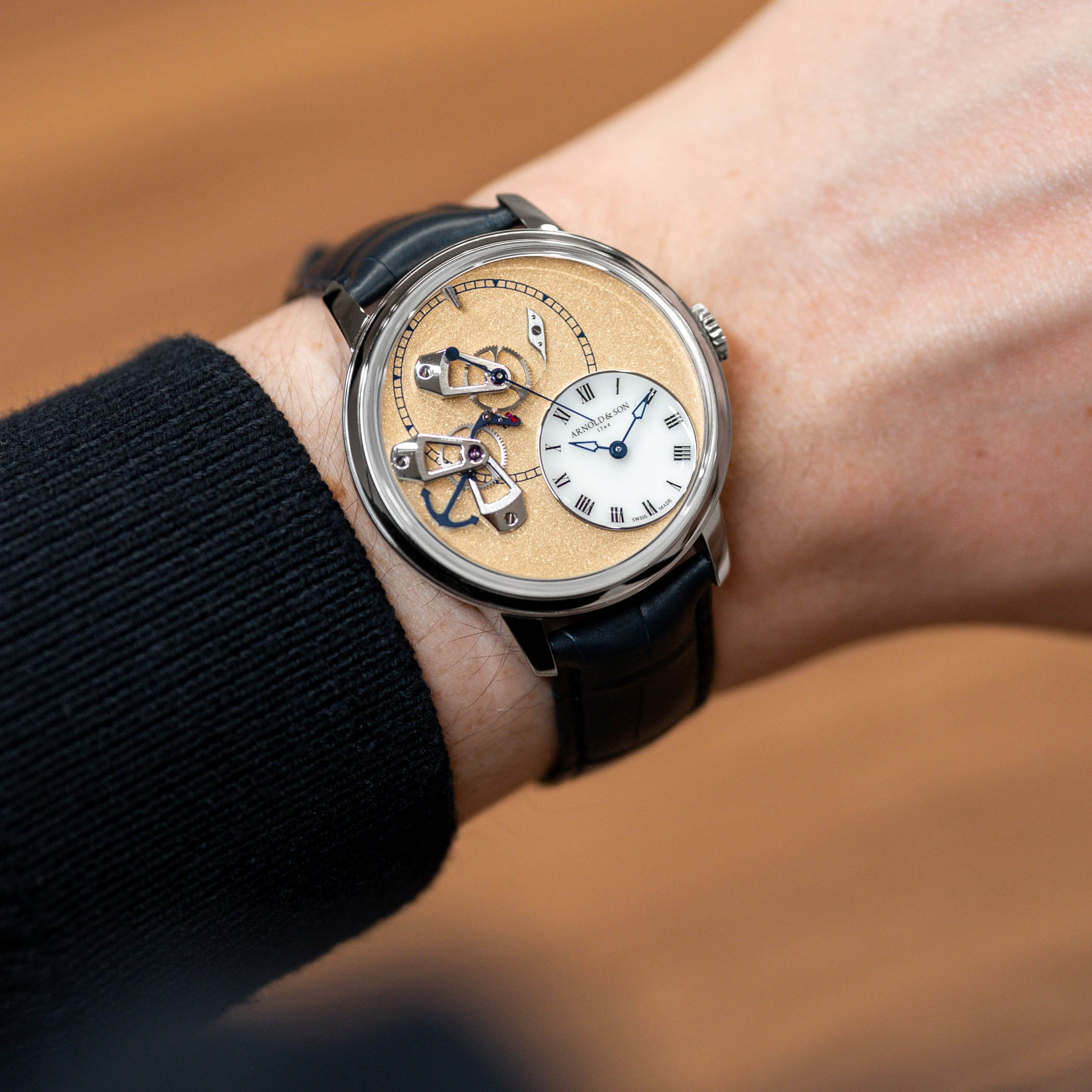
The dial does not seek symmetry for its own sake. Instead, it highlights the separation of functions: at the top, the mechanical movement that regulates the seconds; at the bottom, the more traditional display of hours and minutes. This separation gives the watch an almost instrumental presence, tempered by the softness of the opal, the grained texture of the casebacks, and the warmth of the bridges.
A 42-mm timepiece designed for the wrist
Both models retain the established dimensions of the DSTB 42: 42 mm in diameter and 12.95 mm thick. The case is topped with a domed sapphire crystal, treated with an anti-reflective coating on both sides, while the flat sapphire caseback allows a view of the automatic movement. Water resistance is rated at 30 meters, or 3 bars.
The straps continue the interplay between metals and colors. The DSTB Stop-Seconds in red gold with a Cliff Grey dial comes on a warm gray alligator strap, fastened with a red gold pin buckle. The platinum version with a Kingsand dial is paired with an ink-blue alligator strap, featuring a platinum pin buckle. These choices avoid an overly predictable match between the dial and strap, while maintaining a restrained color palette.
On the back, the in-house A&S6303 caliber beats at 4 Hz—or 28,800 vibrations per hour—and offers a 55-hour power reserve. It succeeds the A&S6203 used in the existing DSTB 42. The functions are deliberately limited to hours, minutes, and seconds. All attention is focused on the seconds hand, made visible by its discontinuous movement and, from now on, controllable during setting.
The Price of an Invisible Improvement
The 1ATCR.N01A.C0246A, in red gold with a Cliff Grey dial, is priced at 48,300 pounds sterling. The 1ATCX.H01A.C0263X, in platinum with a Kingsand dial, is priced at 59,600 pounds sterling. The price difference compared to the current DSTB 42 models in red gold and platinum remains modest: an additional 1,200 and 1,100 pounds sterling, respectively.
This positioning reveals quite clearly the nature of this new model. The DSTB Stop-Seconds does not alter either the collection’s aesthetic language or its everyday use. Rather, it brings to a close a watchmaking concept that had remained unresolved for years. The hand already possessed the visual precision of a timing instrument; it can now be set in motion at the exact moment of one’s choosing. In a case that proudly displays the inner workings of the actual movement, the most significant improvement remains the one that cannot be seen.