
Make Texture a preferred source on Google to support us
Add Texture to GoogleOn Balkrishna Rao Road in Mysuru, a mansion with a peach-and-white facade bears witness to a princely past that refuses to fade away. The “Raj Vilas” bungalow, built during the first decade of the 20th century, has been restored to its former glory under the leadership of Aditya Guru Dev and his sister Samyukta Lakshmi. This six-year restoration project is not merely an exercise in architectural preservation; it is a family tribute. The property’s name combines a historical reference to the British Raj with a personal nod to their father, Raja Chandra. He had purchased the property in 1992 from the Balkrishna Rao family, before renting it out for more than two decades.
Aditya Guru Dev and Samyukta Lakshmi are the grandchildren of the late Jayachamaraja Wadiyar, the 25th and last reigning maharaja of the State of Mysore. This royal lineage permeates the restoration effort undertaken in 2019. Although some sources suggest a recent acquisition, family archives confirm that the building has remained in the family’s possession since the early 1990s. After the last tenants moved out in 2014, the brother and sister decided to transform what was originally intended to be a four-bedroom guesthouse into a private vacation home, dedicated to their weekend getaways.
A Structure Saved by Traditional Techniques
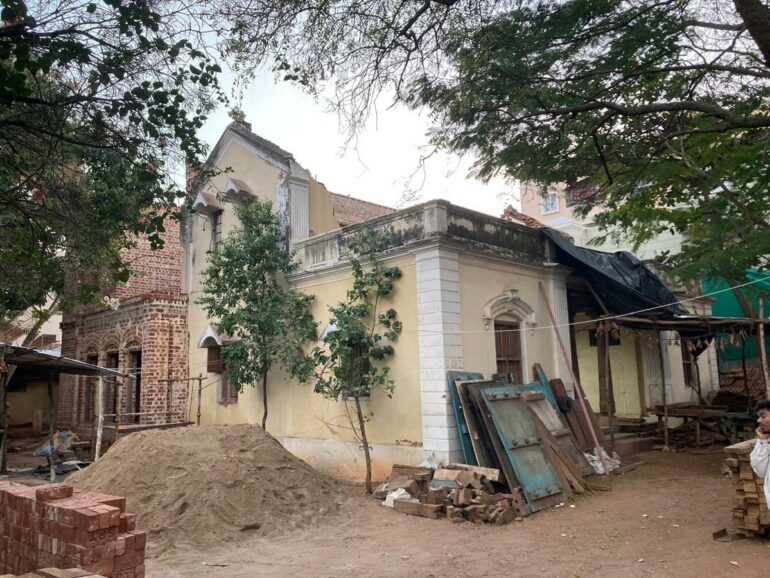
The restoration, led by heritage architect Sanjog Shetty and structural consultant S. Raghunath, required a surgical approach. The single-story building, flanked by outbuildings and an attic, bore the marks of time. Priority was given to the structural work. The original load-bearing walls were preserved but stripped of successive layers of modern paint and cement-based renderings that prevented the masonry from breathing. The entire structure was re-plastered using a traditional lime mortar, ensuring the structure’s longevity in Karnataka’s climate.
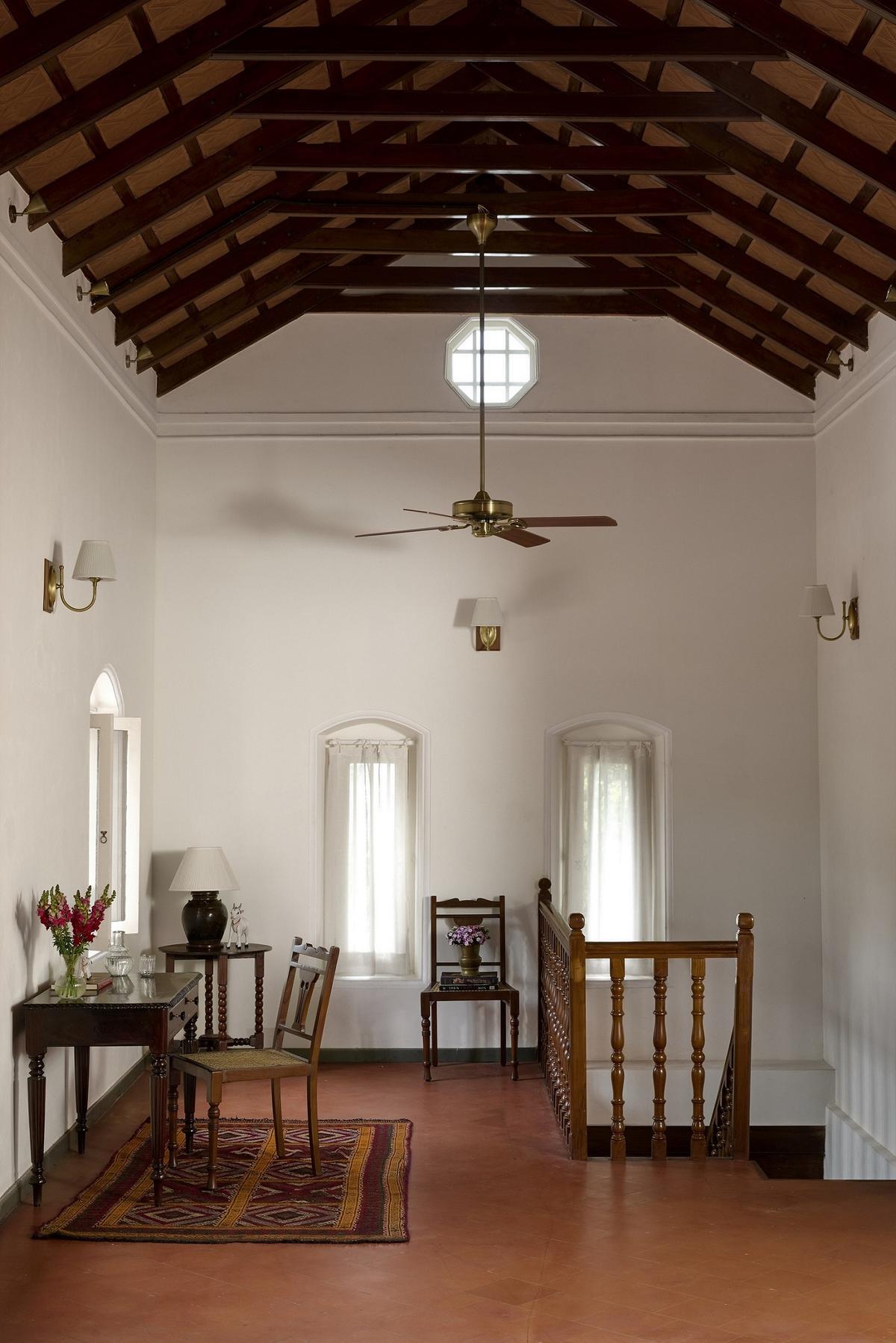
The roof presented the most complex technical challenge of the project. The original building combined three distinct systems: a Madras-style terrace roof, a Malnad-style plank ceiling, and a sloped wooden roof frame. Sanjog Shetty’s teams carefully dismantled these elements. Beams damaged by moisture were replaced, while sound wood was treated. The final roofing was completed using Mangalore tiles, chosen for their compliance with historical specifications from the 1900–1910 period. Externally, the covered veranda—a central feature of Indian social life at the time—has been restored to its original red terracotta tiles and classical columns, accentuated by shuttered woodwork painted a deep teal color.
Inside, the preservation of period elements was carried out with meticulous attention to detail. The century-old wooden staircase was restored, and its missing balustrades were custom-made for the landing, identical to the original. The stucco cornices and moldings, which were often damaged, were faithfully reproduced to maintain the harmony of the spaces. As for the floors, fortunately, early 20th-century terracotta tiles produced by the Basel Mission were preserved in certain rooms. To fill in the missing sections, the owners commissioned the Royal Engraved Tiles company.
Ornithology as the Design’s Central Theme
For the interior design and decoration, Aditya Guru Dev and Samyukta Lakshmi enlisted Shruti Jaipuria, founder of MAIA Design Studio. The creative starting point was the two owners’ passion for ornithology. Located near the Ranganathittu sanctuary, the bungalow draws direct inspiration from the local birdlife to define the color palette of its private spaces.
Each bedroom is designed as a tribute to a specific species found in the region. The first bedroom features a soft ochre hue, modeled after the plumage of the yellow-throated bulbul. The second bedroom explores a range of vibrant blues, inspired by the Indian roller, the official bird of the state of Karnataka. Finally, the third room is adorned with shades of pink and white, evoking the elegance of the Indian tantale, a large migratory wader commonly found in the surrounding wetlands. These natural color palettes avoid the pitfall of literal thematic decor, instead fostering an atmosphere of organic serenity.

The furniture and lighting are the result of a meticulous sourcing process from Indian design studios and antique dealers. Pieces were sourced from flea markets or commissioned from companies such as Saanchi, Qurio Furniture, Accurate Antiques, Gulmohar Lane, and Mahendra Doshi. This blend of old and new fits seamlessly into spaces where modern technology remains discreet. Air conditioning and new electrical systems have been recessed to avoid disrupting the architectural lines, while the kitchen and bathrooms feature a colonial style with aged brass fixtures and retro tiles.
Regional Craftsmanship and Iconographic Heritage
Raj Vilas also celebrates Karnataka’s craftsmanship through highly symbolic works of art. The living room and common areas feature lacquered wooden figurines and dolls from Kinnala. Originating from the Koppal district, these objects are the product of a 500-year-old traditional craft, once supported by the princely courts. Their presence in the bungalow reflects a desire to reconnect the residence with the local artisanal heritage.
This cultural dimension is reinforced by a collection of framed reproductions of illustrations from the Sri Tattva Nidhi. This major iconographic and encyclopedic treatise was compiled in the 19th century under the patronage of Maharaja Krishnaraja Wadiyar III. By displaying these images, the owners situate the restoration within a historical continuity that extends beyond the mere domestic setting to touch upon the history of thought and art in Mysore.
Far from being a museum, the house now serves as a private family retreat. Although the total cost of this six-year project has not been disclosed, the final result prioritizes the authenticity of materials over ostentation. Between the Basel Mission tiles and the hues of migratory birds, Raj Vilas stands as a bridge between the legacy of a princely state and the contemporary lifestyle of its descendants. The property is not available for tourist rentals, thus preserving the privacy of a restoration conceived by and for the family.