
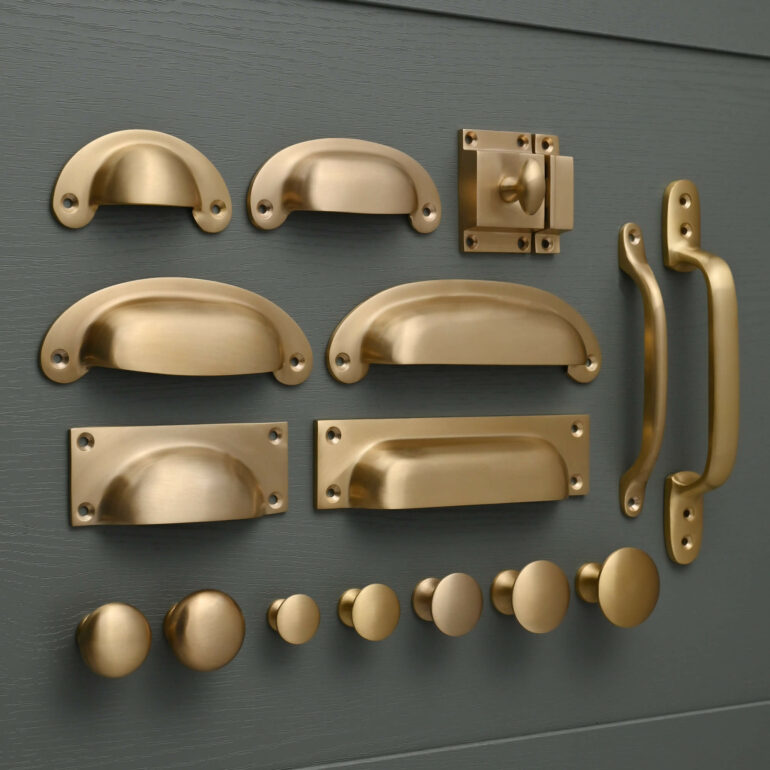
In the world of interior design, knobs and handles are often referred to by professionals as the “jewels of the home.” This description, used by leading publications such as Architectural Digest and Urban Living Magazine, highlights a technical reality: changing a piece of furniture’s hardware remains the quickest and most cost-effective way to transform the look of a kitchen or bathroom without undertaking major carpentry work. This “micro-architecture” of everyday life is divided into specific categories. Knobs, which are single-point fasteners, are designed for lightweight cabinet fronts, while pull handles or knobs require precise center-to-center measurements for multi-point installation—essential for heavy-duty drawers. Variations such as recessed handles, for a rustic look, or edge-mounted handles, favored by the minimalist movement, round out this stylistic arsenal.
Historical References and the American Revival
Founded in 1981 in California, Emtek has established itself as a pillar of high-end hardware. Now part of Fortune Brands Innovations, the City of Industry-based manufacturer offers solid brass, rustic bronze in its Tuscany Bronze Twist line, and crystal through collections such as Georgetown and Forza Crystal. This ability to navigate between classicism and modernity has earned the brand a consistent presence in the selections of Elle Decor and HGTV Magazine.
With a focus on preserving heritage, Rejuvenation, a subsidiary of the Williams-Sonoma group, centers its development on historically inspired designs. Their solid brass collections—such as the Donahue, Eloise, and Holt lines—are designed for projects seeking to restore or infuse a sense of vintage charm. In Portland, Schoolhouse—now part of the Food52 group—explores a different direction. The brand embraces vintage and “mid-century” design, exemplified by the Ledge Pull handles and the Somerset collection, which resonate with contemporary interiors seeking a touch of graphic nostalgia.
Art Foundries and AD100 Collaborations
The ultra-luxury segment is dominated by companies specializing in hand-cast bronze. Rocky Mountain Hardware embodies this artisanal approach, forging numerous collaborations with AD100 designers. This includes Roger Thomas’s work on the Paris and Flute collections, as well as the Trousdale line designed by Lenny Kravitz. More recently, Suede Studio created the Phases collection for the brand. Sun Valley Bronze shares this positioning. Based in Idaho, between Bellevue and Hailey, this family-owned business produces custom cast bronze hardware, regularly furnishing architects’ homes known for their radical aesthetics.
In Brooklyn, Ellis Works brings a more sculptural dimension to the sector. Founded by Alex Bellos, a former executive at West Elm and Schoolhouse, the company collaborates with local artists to design knobs and handles that are true miniature sculptures. This approach is also evident at Katonah Architectural Hardware, whose showrooms in New York and Chicago are frequent stops for specifiers working on custom projects.
Ornamentation and Precious Materials
Luxury decorative hardware is now venturing into territory akin to fine jewelry. Modern Matter stands out for its use of gemstones inlaid into sculpted solid brass or intricate botanical motifs, such as the Dogwood collection by Barrie Benson. Their collaborations with the design duo Pierce & Ward reinforce this trend toward highly ornate details. Mi & Gei is part of this movement with a studio dedicated to handcrafted brass. Their sculptural pieces, notably the Forme N°29 and Heritage collections, are regularly recognized by AD India and AD Pro for their artisanal character.
Schaub and Company, another division of Fortune Brands Innovations, also explores the use of fine materials and precious inlays through its Symphony, Vinci, and NOHO lines. Taking a more understated approach, the British brand Plank Hardware offers a contemporary take on solid brass, drawing on industrial or modern design cues, as seen in their Albany bowl-style handle, which combines functionality with a minimalist aesthetic.
Trends for 2025–2026: Patina and Texture
Projections for 2025 and 2026 confirm the dominance of unlacquered brass. This material is sought after for its vibrant finish: it oxidizes naturally upon contact with air and the touch of the hand, creating a unique patina that evolves over time. This quest for authenticity goes hand in hand with the “Modern Heritage” movement, which sees the return of highly detailed surface finishes. Polishing, striations, hand-hammering, and geometric grooves break up the monotony of traditional smooth surfaces.
In addition to brass and cast bronze, crystal, stainless steel, and mineral inlays have become the hallmarks of high-end design. On the budget side, while pieces from small designers or select shops on platforms like Etsy start between $4 and $12, prices rise significantly for collections designed by established designers or produced by American and British art foundries.