Make Texture a preferred source on Google to support us
Add Texture to GoogleSwiss men’s fashion defies simplistic interpretations. Far from being limited to the austerity of a Geneva banker’s suit or the hyper-technical nature of high-altitude mountaineering gear, the Swiss style is fragmented and self-contradictory, yet with a certain elegance. By observing the work of various local brands, we can discern a complex aesthetic landscape, torn between the weight of the Alpine myth, the rigor of urban pragmatism, and a creative irreverence that takes pleasure in subverting conventions. Through the historical trajectories of Bally, the industrial constructions of Strellson, and the visual experiments of Julian Zigerli, an entire sociology of men’s clothing takes shape, revealing very distinct ways of inhabiting the territory and the city.
The Protective Architecture of Urban Daily Life
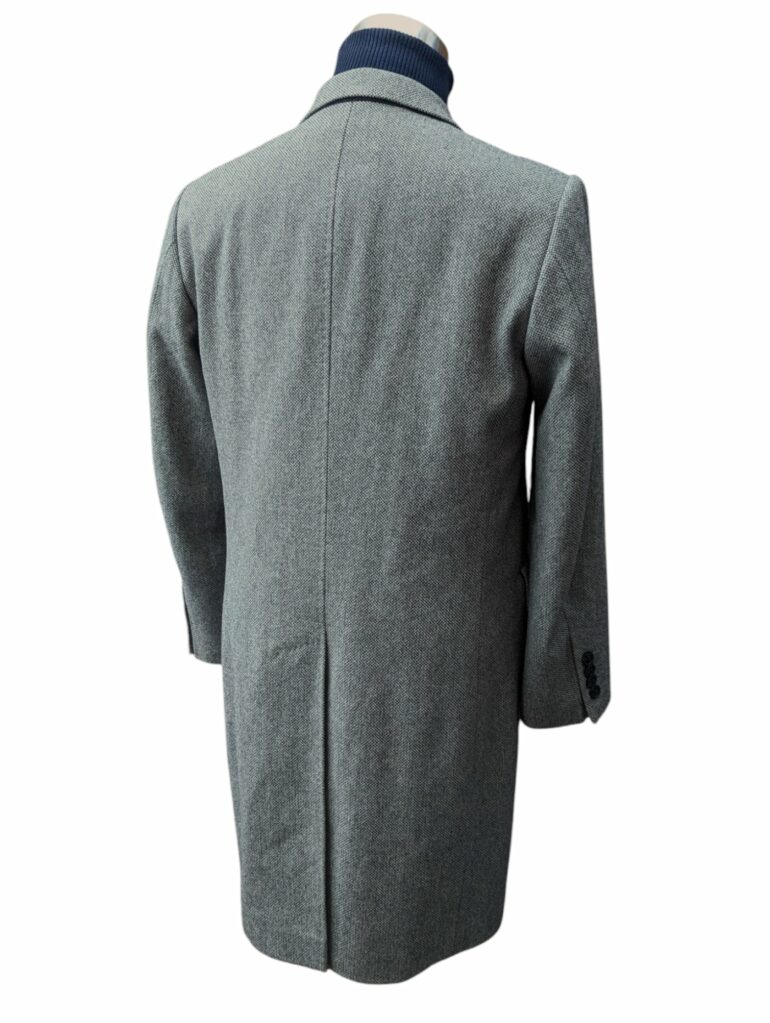
To understand men’s fashion, one must often trace it back to its most fundamental anchor: the coat. It is around this protective garment—designed to withstand the city—that Strellson’s identity has been built. Founded in Kreuzlingen in 1984, the brand draws its roots from a purely industrial heritage. The Holy Fashion Group’s timeline notes that the founders, Jochen and Uwe Holy—who had previously led Hugo Boss—built their new company on the foundations of a former coat factory, Friedrich Straehl & Co.
This manufacturing heritage continues to define the brand’s aesthetic today. Outerwear sets the tone. One of their recent looks perfectly illustrates this layering technique: a checkered overcoat with clean, sharp lines frames a green zippered top—significantly more relaxed—paired with matching pants. The coat imposes a formal direction and visual authority, while the layers beneath inject an immediate sense of casualness. This dialogue between the rigor of tailored clothing and the fluidity of casual wear actually gained momentum in the early 2000s.
In 2003, a bold move cemented this transition. The brand launched the Swiss Cross jacket, a limited edition cut directly from old Swiss Army blankets. The commercial success of this raw piece, steeped in military history and functionality, served as a springboard for the expansion of an entire sportswear line. Today, the man these collections are aimed at navigates an environment where the line between office wear and casual attire is blurring, favoring pragmatism at all times.
Altitude as a fantasy and an aesthetic playground
While urban precision dictates the cuts in Kreuzlingen, a completely different approach is cultivated in Schönenwerd. It was there, in 1851, that Bally’s history began. Surprisingly, the company did not start with leather, but with a modest family-run ribbon factory. The shift toward fine footwear, followed by the rapid opening of branches around the world, transformed this workshop into a major player in the leathercraft industry. Yet, despite its early international reach, the brand has never ceased to look to the peaks to nourish its image.
Here, the mountain’s imagery serves not as a list of technical constraints, but as a rich source of nostalgic elegance. The Fall/Winter 2023–2024 capsule collection, named “Mountain,” encapsulates this vision. Here, high altitude is no longer a hostile environment to be conquered, but a vacation setting. The resulting wardrobe gives pride of place to comforting textures: quilted pieces, heavily ribbed knits, and thick fleece fabrics.
The look is resolutely focused on comfort. A bright red sweater, emblazoned with a crest, paired with jeans whose fabric has been faded by time and a pair of chunky boots, is all it takes to set the scene. This silhouette doesn’t evoke the effort of a mountaineer, but rather the tranquility of hours spent warm in a chalet or the carefree elegance of upscale ski resorts. Après-ski thus becomes a full-fledged style of its own, where the ruggedness of the rock gives way to a polished and deceptively casual look.
Color and irreverence at the heart of Zurich
In stark contrast to this understated heritage, Julian Zigerli offers a radically different take on Swiss masculinity. His career, which began with studies at the Berlin University of the Arts, quickly took root in Zurich, where his earliest archives document the launch of his label in 2011. The designer’s rise stands out for its speed and international exposure. Barely three years later, in January 2014, Giorgio Armani spotted him and opened the doors of his Teatro Armani to showcase his fall-winter collection during Milan Men’s Fashion Week. This milestone was documented at the time by the cameras of Swiss Radio and Television (SRF).

Zigerli’s aesthetic is based on the principle of contrast. He takes pieces from the most basic men’s wardrobe and subjects them to changes in color and material. The carpenter’s jacket is a striking example. The designer preserves the garment’s utilitarian essence: the large pockets designed for tools and the sturdy metal buttons remain intact. But he disrupts this workwear regularity by inserting panels in bold, contrasting colors, and further shifts the silhouette by tying a bright pink scarf around it. Humor seeps into the seams, transforming a work garment into a graphic statement.
This boundary-pushing approach extends far beyond the mere cutting of fabric. The brand’s universe draws inspiration from a multitude of related disciplines, incorporating live performance, music, and ongoing dialogues with contemporary art. The brand’s archives document cutting-edge collaborations, such as its partnership with artist Shirana Shahbazi and projects developed with the luggage brand QWSTION. This creative effervescence will be celebrated in 2026 during a major retrospective in Zurich. The event promises to bring together 170 looks selected from 21 collections, marking the fifteenth anniversary of a label that stubbornly refuses to settle down.
Contrasting Geography of the Retail Sector
The vitality of this local creativity, however, clashes with a complex commercial reality, where Swiss identity is often conflated with the presence of foreign giants. A look at the country’s major commercial hubs reveals a striking contrast. On the shores of Lake Geneva, Geneva showcases global brands, such as Ferragamo boutiques, while in the hills of Gstaad, houses like Louis Vuitton have no qualms about incorporating the typical architecture of wooden chalets to house their collections. These prestigious locations confirm the region’s power of attraction for the international luxury sector, without, however, contributing to the definition of a distinctly Swiss style.
To observe the actual spread of local consumption patterns, one must look beyond the ultra-luxurious storefronts. Department stores such as Globus and Manor serve as gathering places, bringing together a wide variety of brands and price points that more accurately reflect the purchasing power and tastes of the general public. At the same time, far from the hustle and bustle of major cities, the network of small towns reveals a different dynamic. Their pedestrian streets are home to a tapestry of independent boutiques and neighborhood retailers. It is within this diversity of retail outlets—from chic department stores to intimate provincial boutiques—that Swiss fashion finds its balance, proving that clothes don’t just make the man, but also tell the story of a country’s geography.