Make Texture a preferred source on Google to support us
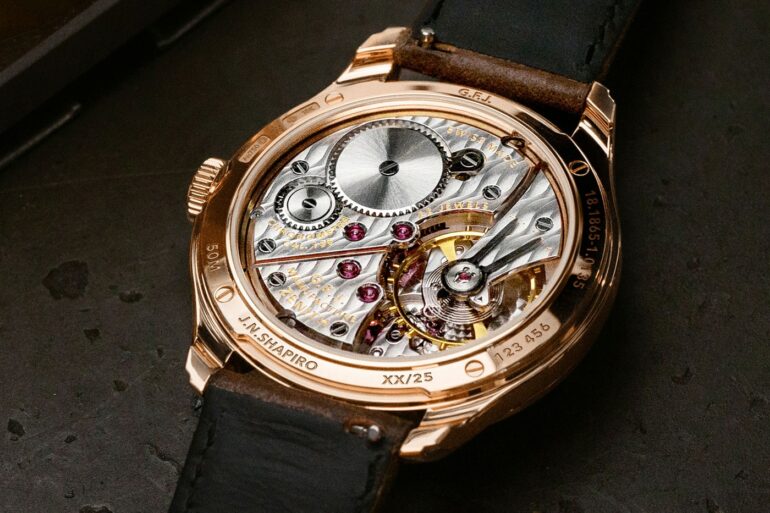
Add Texture to GoogleYou have to turn the watch over to see what has changed. Beneath the sapphire crystal case back, the bridges of the Caliber 135 feature a design one would expect to see more in a display case dedicated to American pocket watches than on a movement from Le Locle: damasquening—that undulating texture that manufacturers across the Atlantic once applied to their calibers. For the second installment of its “Double Signed” program, Zenith invited California-based watchmaker Joshua Shapiro to extend his creative vision beyond the dial and into the movement itself. Unveiled on November 12, 2026, the Zenith G.F.J. Caliber 135 Double Signed with J.N. Shapiro is produced in a limited edition of 25 numbered pieces.
A program open to independent watchmakers
Zenith launched “Double Signed” in 2026 with a simple rule: entrust its G.F.J. platform to independent watchmakers from other countries and let them reinterpret it. The acronym refers to Georges Favre-Jacot, who founded the manufacture in 1865. The reference number for this new timepiece, 18.1865-1-0135/01.C215, incorporates both the year of founding and the caliber number.
The first edition, unveiled in June 2026, was created by the Japanese firm Naoya Hida & Co. At that time, the collaboration was limited to the dial. With J.N. Shapiro, the scope has expanded, and this is where the real difference between the two editions lies: the American workshop is responsible for both what you see on the wrist and what you discover when you turn the watch over.
The choice of partner was by no means random. J.N. Shapiro Watches, a workshop founded in 2018 and based in Los Angeles, specializes in traditional mechanical guilloché work. For a Swiss brand owned by the LVMH group, partnering with a workshop of this size amounts to seeking out niche expertise—and, no doubt, a audience of collectors who closely follow the independent watchmaking scene.
Three guilloché patterns on a silver disc
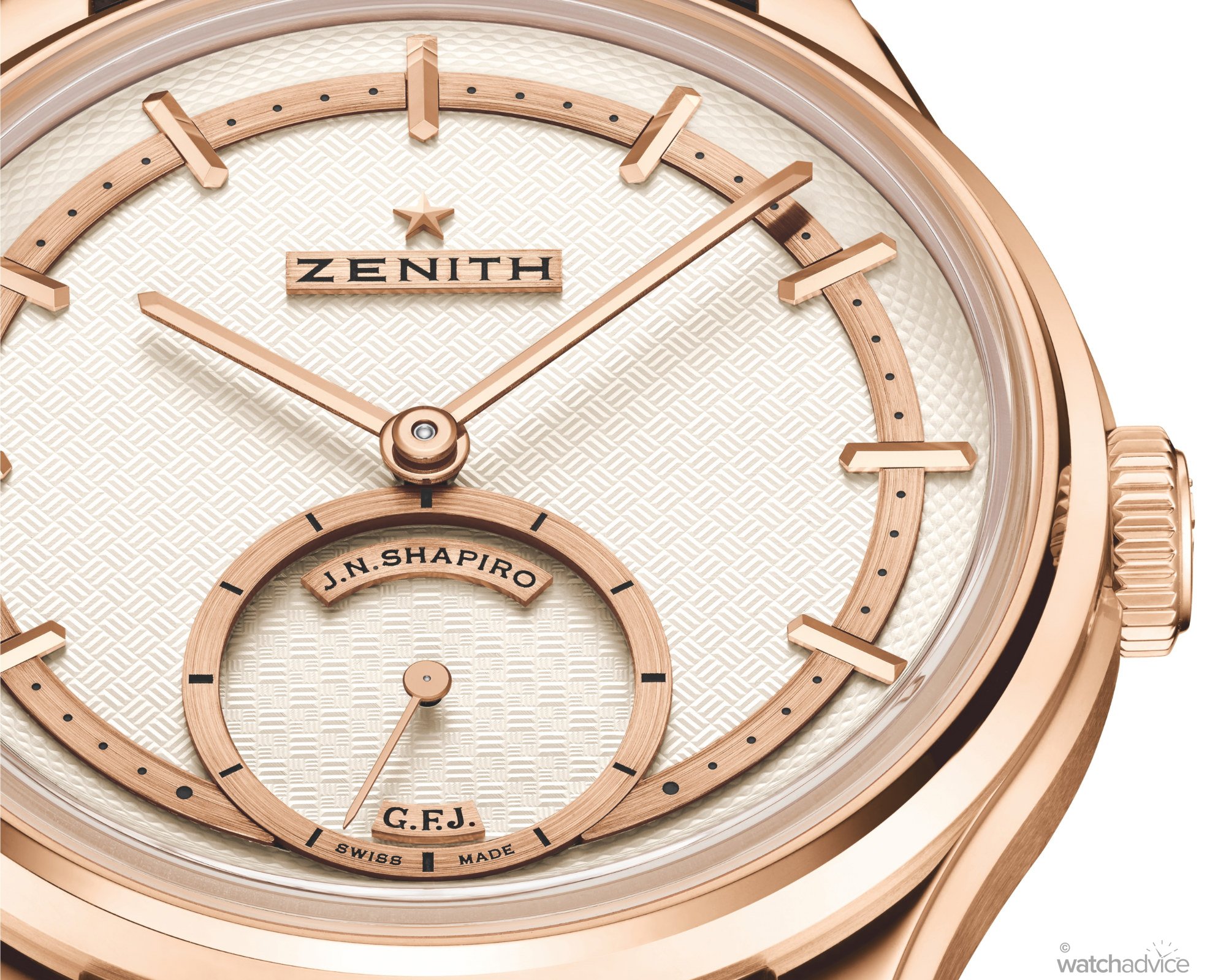
The dial was entirely handcrafted in the United States, at Shapiro’s California workshop. The base is made of solid silver. Two machines were used: the guilloché lathe, or rose engine, and the straight-line machine. They produced three interlocking patterns, each assigned to a specific area.
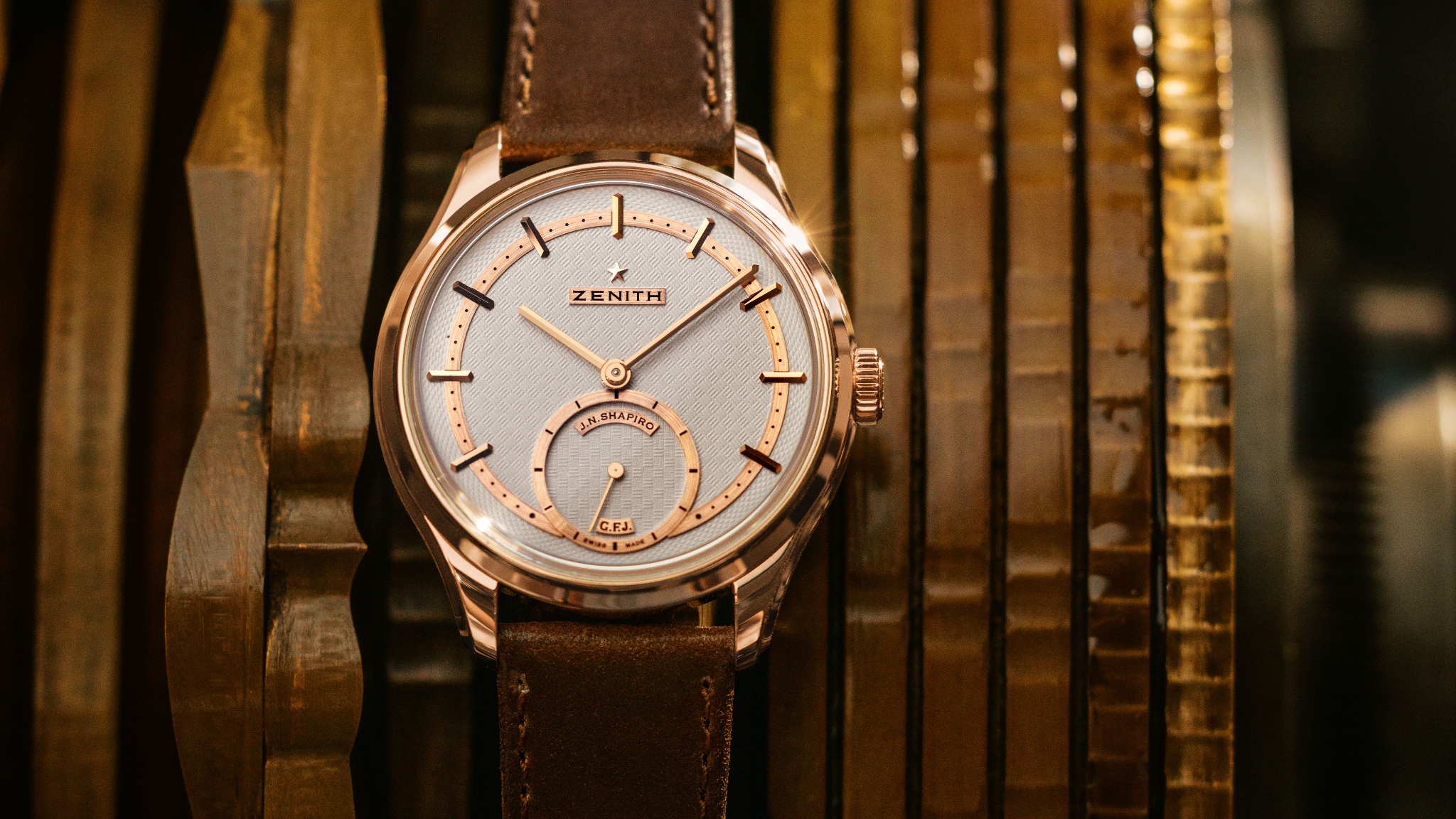
Around the edge, a barleycorn pattern forms the outer ring. The center features a basketweave pattern. The small seconds sub-dial, positioned at 6 o’clock, features the “Infinity Weave,” an infinite weave pattern created exclusively by Joshua Shapiro. It is on this small circle that the workshop’s signature is most clearly visible, long before one reads his name.
The name does appear, however, and in a prominent position. The minute track rings, hour markers, and cartouches are crafted from 18-karat rose gold, engraved and applied. They bear the dual signatures “ZENITH” and “J.N. SHAPIRO,” as well as the inscription “G.F.J.” The hands are also crafted from solid 18-karat rose gold. The overall color scheme remains monochromatic, and the dial’s readability depends entirely on the way light catches the various geometric patterns of the guilloché.
The 135: A Competition-Winning Caliber
Beneath this dial beats a movement with a distinguished track record. The Caliber 135 was designed in 1948 by watchmaker Ephrem Jobin for the chronometry competitions organized by the observatories. In its original version, the 135-O won five consecutive victories at the Neuchâtel Observatory competition from 1950 to 1954.
Zenith has reissued and reengineered it. The movement remains hand-wound and beats at 18,000 vibrations per hour, or 2.5 Hz—a modest frequency that stands in contrast to the race toward higher rates. The power reserve is 72 hours. The regulating organ combines a balance wheel with variable inertia weights and a Breguet overcoil. The functions are limited to hours, minutes, and a small seconds hand, with a stop-seconds mechanism for precise time setting.
The observatory heritage is reflected in the certification. The caliber is COSC-certified as a chronometer, and the manufacture adjusts it in-house to a tolerance of -2/+2 seconds per day.

Damasquinage, a finish originating in America
It is on the dials that this collaboration takes on its most distinctive character. Damask engraving (damaskeening) is a textured finish associated with historic American pocket watches. On this Caliber 135, it combines the geometric patterns characteristic of the guilloché lathe with the look of Côtes de Genève, the striped decoration that Swiss watchmakers have long used on their movements.
The result is a kind of translation. A Swiss caliber designed for the Neuchâtel competitions is adorned with a motif drawn from the American industrial tradition, executed by a craftsman whose specialty is precisely guilloché work. The sapphire crystal case back reveals this decoration as well as the escapement, allowing one to observe the weight-balanced balance wheel in action at its slow frequency of 2.5 Hz.
A case with balanced proportions
The case is made of 18-karat rose gold (750/1000). There is a slight discrepancy regarding its diameter across different sources: the technical specifications list 39.15 mm, while the official website rounds it to 39.00 mm. In either case, the size remains modest, as confirmed by a thickness of 10.5 mm and a lug-to-lug length of 45.75 mm. These dimensions should suit a wide range of wrist sizes. The watch is water-resistant to 5 ATM, or 50 meters.
The watch comes with three straps, allowing you to dramatically change its look: a brown Cordovan leather strap, a beige nubuck alligator strap, and a black calfskin strap. The 18-karat rose gold pin buckle is engraved with the “G.F.J.” monogram.
Twenty-five pieces worldwide
The production run is strictly limited to 25 numbered pieces. The official retail price announced at launch is 68,900 CHF before taxes. Converted at November 2026 exchange rates, this amounts to approximately 73,500 euros and approximately 82,800 U.S. dollars, though these figures are estimates: final prices in each country will depend on local taxes and exchange rate fluctuations. Distribution is handled through the network of authorized retailers and Zenith boutiques.
With two editions in a single year—one Japanese and one American—the “Double Signed” program has already demonstrated its ability to evolve from one release to the next. The first focused on the dial, while the second addresses the movement. The name of the next watchmaker invited to the G.F.J. platform has not been disclosed.