Make Texture a preferred source on Google to support us
Add Texture to Google273 kilograms. The number doesn’t seem like much, especially when compared to the names listed alongside it: Amazon, H&M Group, Inditex Group, Zalando, among others. It represents the amount of textile waste collected since May by raccogli-AMO, an initiative led by Erion Textiles in Italy. It does not yet signify an industrial transformation. Rather, it marks a beginning—with its limitations and its significance: moving circularity from the realm of intentions to a tangible activity whose results can be measured. For the fashion industry, this initiative encourages a shift in focus away from the next product to be sold.
The Store: A Point of Return
Launched in Naples and then rolled out in Turin, the raccogli-AMO initiative has now arrived in Milan. Fifteen retail locations belonging to major chains are participating, with support from the city government and Amsa. This geographical scope gives the project its substance: cities, stores, and a collection system. The initiative thus moves beyond the realm of corporate commitments alone to enter spaces where brands meet their customers.
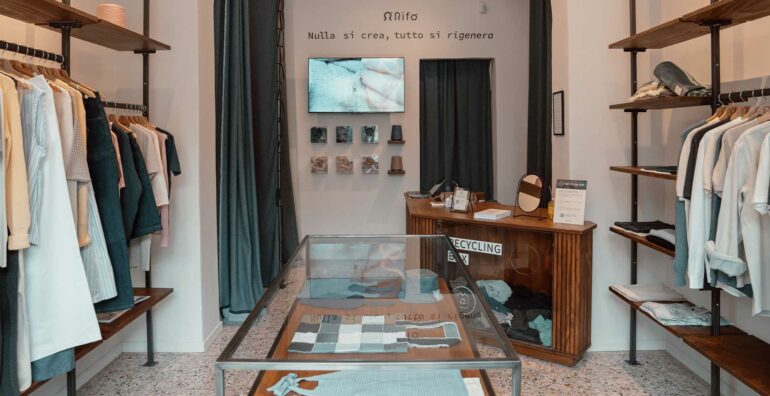
The choice of retail stores as collection points is worth considering. Here, the store is viewed in a way that reverses its usual function: a product can return there in the form of textile waste. This shift seems simple. Yet it poses a very concrete question for retailers: what role should be given to items that are no longer new—or even necessarily desirable? The relationship with textiles no longer ends when they go on sale.
The 273 kilograms correspond to the figures reported since May, prior to this new rollout in Milan. On their own, they do not provide information about the fate of the collected materials. They must therefore be interpreted for what they are: a volume collected, not a quantity claimed to have been recycled. This distinction prevents us from expecting an initial pilot project to prove more than it actually demonstrates.
A partnership that transcends the boundaries of fashion
Behind this collection effort, Erion Textiles brings together twenty-two companies. The composition of the consortium is undoubtedly as revealing as its initial numerical results. Amazon and Zalando are joined by H&M Group, Inditex Group, Mango, Kiabi, LPP, OVS, and Gruppo Teddy. Decathlon Italia, DF Sport Specialist, and Diadora are also part of the group. The list outlines a scope that is not limited to a single clothing category or a single way of marketing it.
Artsana, Essenza, Maisons du Monde, Miroglio, Pompea, Prenatal, Rifò, Save The Duck, Seven, and Twinset round out this group. Listing these names is not the same as handing out certificates of virtue. It helps us understand the nature of the project: bringing distinct companies together under a single framework to address a problem that no single brand identity can solve on its own.
Their shared commitment centers on building an operational model for managing textile waste. The key word is “operational.” An alliance is only worthwhile if it helps organize what happens after products are used. The consortium has specifically set itself the task of transforming a shared responsibility into concrete working procedures. The ambition is collective; the quality of its practical implementation remains the real issue.
Responsibility doesn’t end with the sale
Luca Campadello, CEO of Erion Textiles, frames this approach within the context of extended producer responsibility. According to him, this places fashion and apparel companies in an active role. Participating in the consortium should enable them to acquire skills and test solutions to build a circular supply chain. His remarks emphasize learning, rather than showcasing a fully developed model.
This is a crucial distinction. Declaring responsibility for a product after it has been used and knowing how to manage that responsibility are two different matters. The first is a matter of commitment; the second requires experience. Erion Textiles aims to provide a framework for this preparatory phase, during which companies can test their intentions against the real-world conditions of collection and the work of operators.
The stated choice is one of foresight. The participating companies want to move forward ahead of the new framework proposed by the consortium, in order to establish a common practice and strategy. No specific regulatory timeline accompanies the information presented. Nevertheless, the challenge can be articulated without it: to avoid discovering implementation difficulties at the very moment when we must already know how to address them.
Collection also requires rethinking the product
The project is not limited to setting up end-of-life collection. Among the approaches proposed is eco-design. The connection makes sense: focusing on what happens to a textile after use leads to reexamining the decisions made before it is brought to market. The end of the life cycle then becomes a matter of design, not just waste management.

It would be premature to infer specific changes in members’ collections from this. No examples of redesigned products are detailed here. The value of this approach, at this stage, lies in the connection it seeks to establish: lessons learned in the field can inform upstream decision-making, rather than remaining confined to the processing of items discarded by consumers.
Testing collection models and collaborating with operators are also among the stated objectives. These tasks are less glamorous than a collection presentation. Yet they are the very foundations upon which the project’s credibility rests. How should textiles be collected? What kind of joint organizational structure is needed? And how can these trials be turned into a valuable experience for participating companies? The consortium is launching this initiative without claiming to have all the answers yet.
Circularity: A Matter of Organization
Erion Textiles is itself part of a broader network: Erion, a system of nonprofit consortia dedicated to managing several categories of waste. Its scope ranges from electronic equipment to batteries, from packaging to tobacco products, and now includes textiles. The apparel sector thus joins a framework whose central focus is end-of-life management.
This affiliation sheds light on the initiative’s approach. It is not merely a matter of talking about fashion differently, but of viewing it through the lens of an industry that needs to be organized. The comparison with other waste categories does not imply that their solutions are interchangeable. Rather, it underscores that circularity requires a framework that transcends the discourse specific to each sector.
In Milan, this framework currently takes the form of fifteen retail locations, supported by the municipality and Amsa. Following Naples and Turin, this new phase will provide additional ground for testing the raccogli-AMO initiative. The next result to watch for will not be a new list of signatories: it will be what this initiative actually manages to collect, and then what happens to the textiles once they leave the stores.