Make Texture a preferred source on Google to support us
Add Texture to GoogleThe Timekeeping of the Invisible: Mariko Mori’s Odyssey
You have to climb to the fifty-third floor of Mori Tower, high above the hustle and bustle of Roppongi Hills, to truly appreciate how far she has come. In this space suspended above Tokyo, a figure dressed entirely in white stands out among the installations. Mariko Mori walks through her own retrospective. The exhibition, scheduled to run through March 28, 2027, holds special significance: the artist, born in Tokyo in 1967, had not enjoyed such a large-scale museum exhibition in her homeland since the “Pure Land” exhibition at the Museum of Contemporary Art Tokyo. That was in 2002. Nearly a quarter-century later, the child prodigy of the 1990s’ post-human aesthetic is making a spectacular comeback, bringing with her thirty years of visual, conceptual, and spiritual exploration.
Titled “All That Shines,” this journey through three decades of creation brings together two facets of the same obsession. On one hand, the pioneer of technological art who, at the dawn of the new millennium, staged her own body to question our shifting identities. On the other, the contemporary visual artist turned toward the infinite, who scrutinizes stellar movements and universal consciousness. Curated by Mami Kataoka, director of the Mori Art Museum, and Alexandra Munroe, curator at the Solomon R. Guggenheim Foundation, the exhibition demonstrates that this transformation is by no means a rupture. The exhibition’s four chronological chapters reveal an organic transition, in which light serves as a universal language.
From Pixel Avatars to the Fading of the Flesh
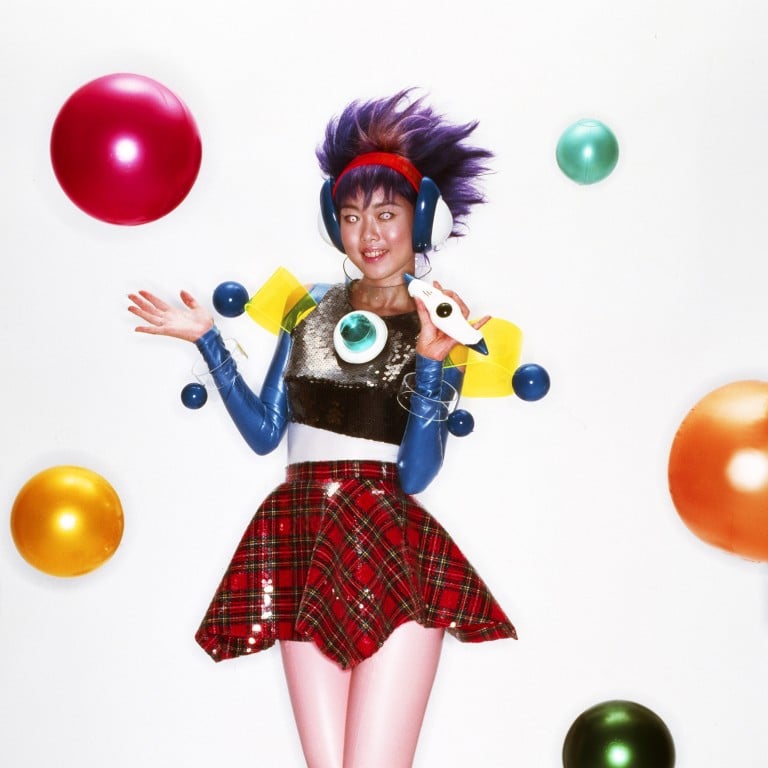
The retrospective’s starting point anchors the visitor in an era when digital aesthetics were just beginning to forge their first myths. After studying at the Chelsea College of Arts in London and participating in the Independent Study Program at the Whitney Museum of American Art in New York, Mariko Mori made a strong impression. Her early videos and photographs draw directly on the raw energy of Japanese popular culture. She appropriates the visual codes of manga, the imagery of video games, and the excesses of fashion to forge futuristic characters of a new kind.
In the “Cyborg” series, which left its mark on the 1990s and preceded her highly acclaimed participation in the 1997 Venice Biennale, she uses her own image as raw material. Her body becomes a projection surface, a territory where the boundary between machine and living being blurs. These late-twentieth-century avatars were already questioning the limits of the human condition. Yet, as one moves through the exhibition space, the physical body recedes in favor of much broader questions.
Technology as a Translator of the Cosmos
While the artist’s early work drew inspiration from pop culture, his later work engages with collaborators of a completely different nature: astrophysicists, high-tech engineers, and Buddhist masters. The exhibition masterfully illustrates this phase in which technology transcends its role as a mere visual artifice to become a sensor of the invisible—an interface between ordinary human perception and the monumental forces of the universe.
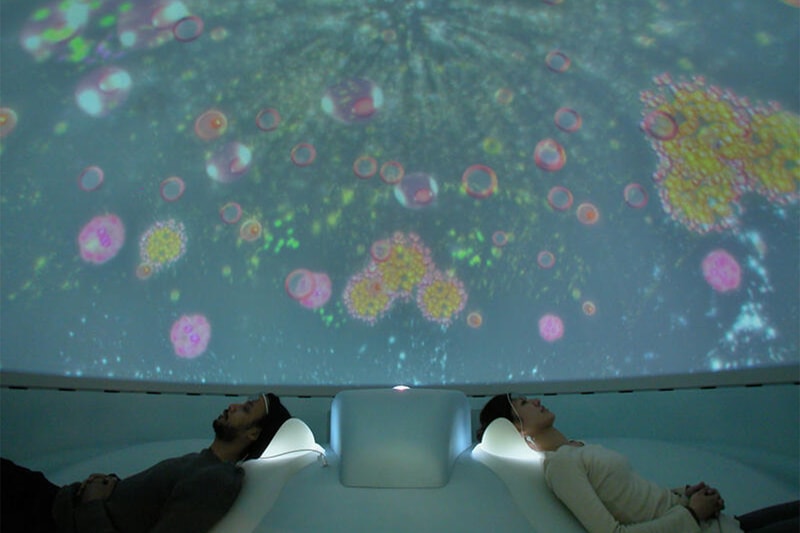
The immersive installation “Wave UFO,” created between 1999 and 2002, epitomizes this approach. Here, the visitor abandons the role of passive spectator to take a seat at the heart of the work. The installation captures participants’ brain activity and translates this intimate data into a stream of images, materializing human consciousness in real time. This approach goes even further with “Tom Na H-iu.” Here, it is no longer the human mind that is probed, but the depths of the cosmos. Through pulsating light, the work makes visible events inaccessible to the naked eye, such as phenomena related to neutrinos, the radiation from distant supernovae, or variations in solar activity.
In the texts accompanying these galleries, Mariko Mori weaves unexpected connections. She does not hesitate to create a dialogue between cutting-edge astrophysics, Buddhist teachings, and the study of sacred prehistoric sites. The ideogram 燦燦, chosen for the exhibition’s Japanese title, encapsulates this quest: it denotes an intense radiance, an absolute brilliance that transcends eras and disciplines, from the light of the stars to the awakening of consciousness.

Planetary Alignments and Earthly Sanctuaries
The artist’s reflection could not remain confined indefinitely within the walls of galleries. Since 2010, this thirst for vastness has been embodied in the monumental projects spearheaded by the Faou Foundation, which she founded herself. The exhibition at the Mori Art Museum extensively documents these environmental sculptures, which invite humanity to rethink its organic connection with nature.
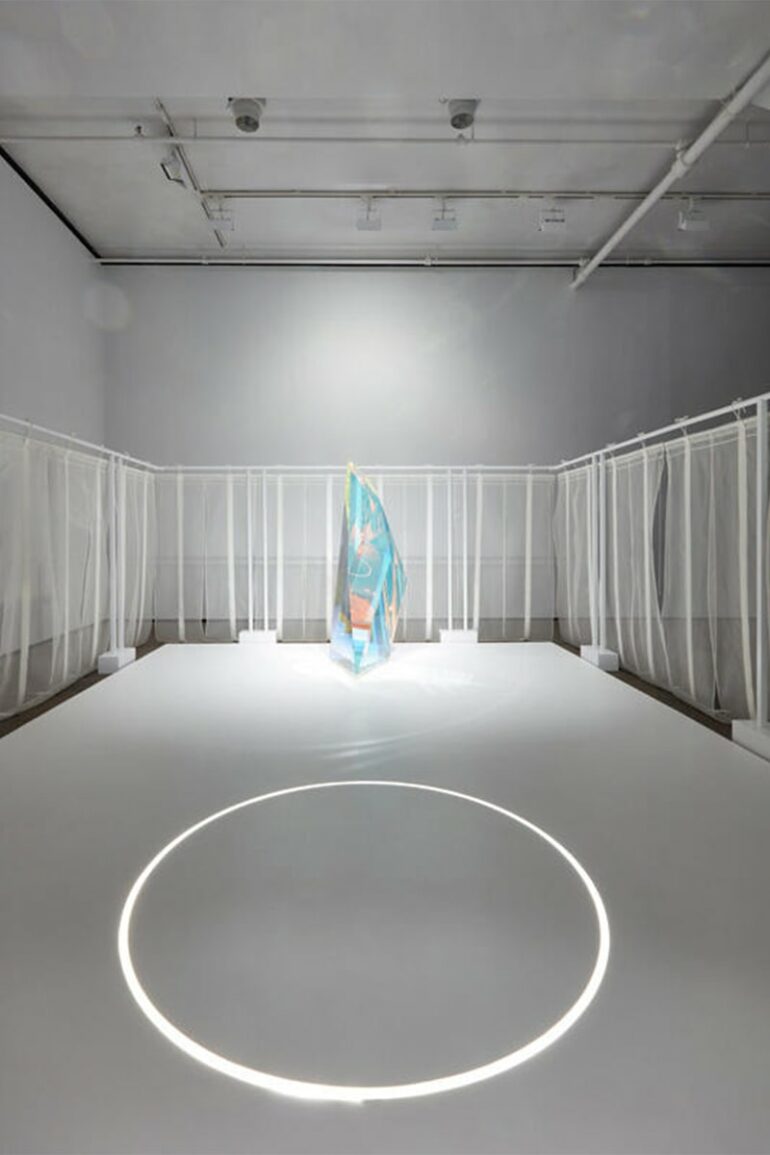
The ambition is both architectural and astronomical. In 2011, on Miyako Island, she erected “Primal Rhythm: Sun Pillar.” Five years later, in 2016, “Ring: One with Nature” was created in Rio de Janeiro .” The museum takes care to highlight the unique nature of these massive installations: they are rigorously aligned with the sun’s path during the winter solstice. The cosmic rhythm dictates the form of the work.
This international and pacifist dimension continues in her most recent works. The “Peace Crystal” project, conceived for Ethiopia and unveiled at the 2024 Venice Biennale, is part of this lineage of spiritual landmarks scattered across the globe. To connect these distant locations, the Tokyo retrospective features a previously unseen video work, which shares the exhibition’s title. In it, we discover the foundation’s creations set against the backdrop of the ceaseless movement of the ocean bordering the artist’s studio in Miyako, a retreat where she now divides her time between stays in New York and Tokyo.
The Anatomy of a Museum Selection
Curating thirty years of such a multifaceted body of work inevitably poses challenges of scaling. In this regard, the event’s promotional materials reveal a curious mathematical dichotomy. While Art Week Tokyo and the host institution publicize a selection of approximately forty works, curator Alexandra Munroe’s notes refer to a body of work totaling nearly eighty pieces, including numerous previously unseen archival materials. Whether due to a difference in counting methods or the last-minute inclusion of preparatory sketches, the exact scope of the exhibition can ultimately be gauged on site, based on the diversity of the media brought together.
Conceptual drawings, monumental sculptures, video installations, period photographs, and cutting-edge interactive installations coexist high above the Japanese capital. The true tour de force of “All That Shines” lies in this cohesion. Far from contrasting the young woman of the 1990s—immersed in the high-octane aesthetic of arcade machines—with the mature visual artist who sculpts the sun’s rays at the solstice, the retrospective paints a portrait of one and the same explorer. An artist whose compass, invariably pointed toward the light, has never ceased to seek to make the mysterious workings of the universe intelligible.