Make Texture a preferred source on Google to support us
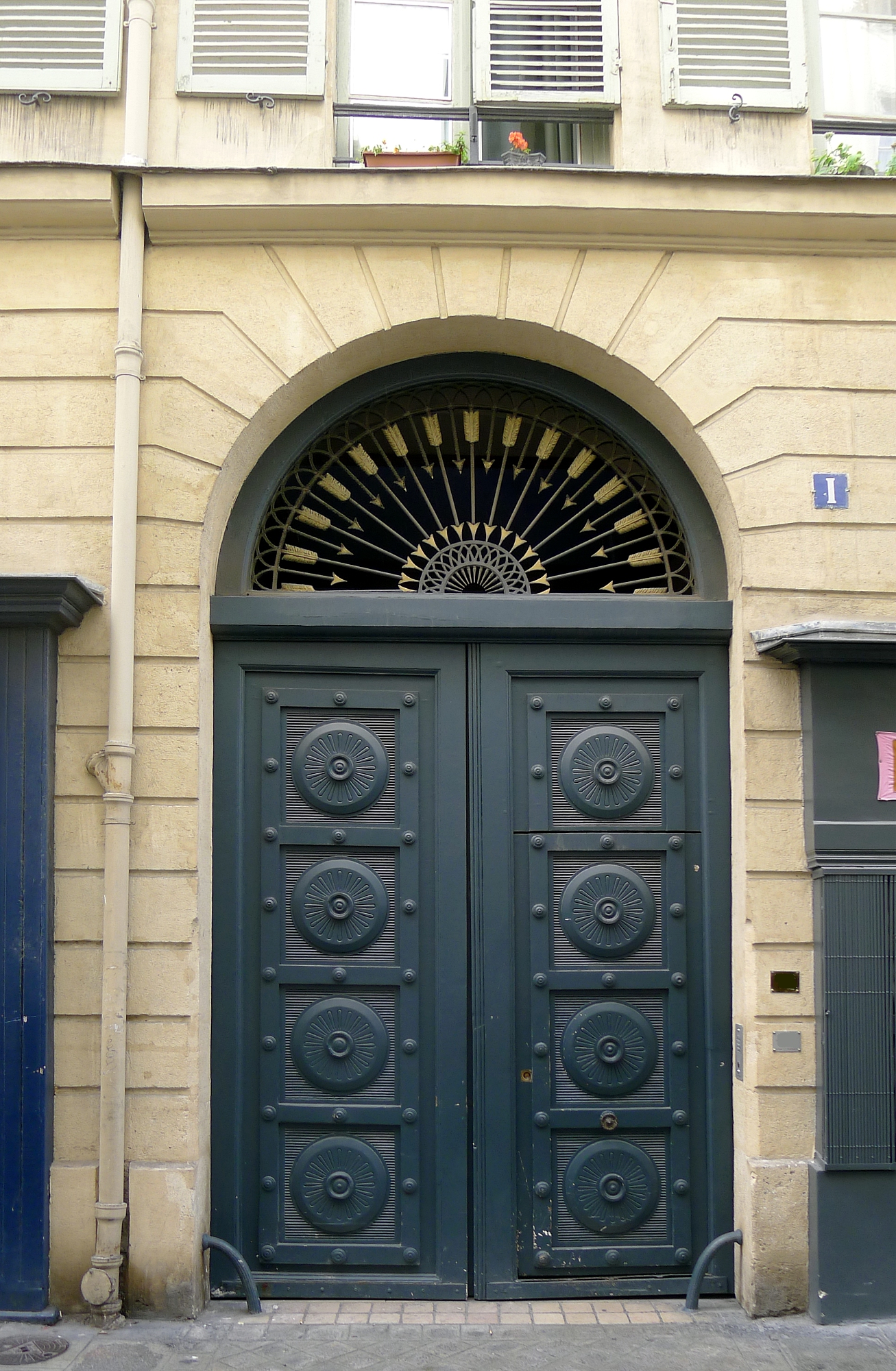
Add Texture to GoogleBehind the heavy carriage gates of Paris’s upscale neighborhoods lies a hidden landscape that tourist guides ignore and official maps never mention. While the French capital was built on the mythology of the café terrace—that democratic space where everyone watches everyone else—an elite continues to cultivate the art of invisibility. At these addresses—which lack brass nameplates or are marked only by simple initials engraved in stone—luxury is no longer measured in square meters or gilded details. It lies in the certainty of belonging to an exclusive circle. Joining a private Parisian circle is not merely a financial transaction; it is a process of initiation, a complex social choreography that reveals how power, money, and influence are structured behind closed doors.
The Strongholds of Pedigree and the Reign of Silence
To understand the essence of these institutions, one must go back to the historic strongholds of the Golden Triangle, where time seems to have stood still since the Third Republic. The Jockey Club, founded in 1834, embodies the archetype of this original model. Now located on Rue Rabelais, this strictly male-only club remains one of the most impenetrable places in the capital. Here, personal wealth holds no exchange value. What matters are only the antiquity of one’s name, family alliances, and a code of conduct of absolute rigidity. Business conversations are forbidden here, deemed unbearably vulgar. People come to read the newspapers, to have lunch in silence, and to perpetuate a certain ideal of the landed aristocracy amid a setting of dark wood paneling. Admission is an obstacle course: a candidate must be nominated by several sponsors and undergo a vote using white and black balls, where a single black ball can sometimes nullify a decade’s worth of diplomatic efforts.
A stone’s throw away, overlooking the Place de la Concorde, the Automobile Club de France (ACF) carries on this tradition in a version that is slightly more open to big industrial capital. Founded in 1895 by the pioneers of transportation, the club today embodies a fascinating paradox: created to celebrate the most modern machine of its time, it has become a sanctuary of unapologetic conservatism. Behind the monumental façade designed by Ange-Jacques Gabriel, the members—exclusively men, once again—move between a spectacular library housing tens of thousands of volumes, a renowned fencing hall, and an underground Art Deco swimming pool. The ACF functions as a natural extension of the CAC 40 boards of directors, a neutral space where industrial rivalries are set aside over a game of bridge or a glass of cognac.
The Diplomacy of Hidden Gardens
While male-only clubs cultivate secrecy, other institutions have made controlled openness their hallmark. The Cercle de l’Union Interalliée, founded in 1917 amid the urgency of World War I, embodies this more diplomatic and institutional approach. Housed in a sumptuous mansion on Rue du Faubourg Saint-Honoré, just a few steps from the Élysée Palace, it immediately stands out for a major revolution in this milieu: the admission of women.
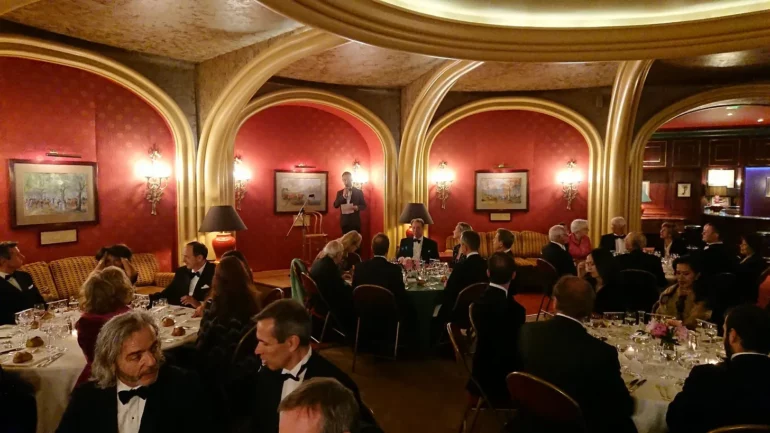
The Interalliée serves as a sounding board for the Republic and its foreign guests. Ambassadors, senior civil servants, corporate lawyers, and political figures mingle there beneath the high, moldings-adorned ceilings. The selection process remains rigorous, requiring sponsors, letters of recommendation, and an interview with a discerning committee. But what truly sets the Interalliée apart, aside from its address book, are its gardens. An incredible oasis of calm in the heart of the 8th arrondissement, with an immaculate lawn that slopes gently down toward the Champs-Élysées. On sunny days, the clinking of silverware on the tables set in the shade of tall trees offers a striking contrast to the frenzy of Parisian traffic rumbling just a few dozen meters away. A tie is still required here; jeans are banned, and using a cell phone in the dining rooms will earn you an immediate reprimand from staff in livery.
Anglo-Saxon Hybridization
On the fringes of this hyper-codified world, the French model eventually softened under the influence of London’s gentlemen’s clubs. The Saint James Paris, a majestic neoclassical château hidden behind wrought-iron gates in the 16th arrondissement, walks a fine line. Officially, it is a ultra-luxury hotel. Unofficially, its common areas function during the day as an exclusive private club, reserved solely for its members.
The atmosphere there is different—less overbearing than in century-old circles. The library bar, with its floor-to-ceiling bookshelves and hushed ambiance, attracts the bourgeoisie of western Paris seeking an elegant refuge without having to endure the constraints of old-fashioned membership requirements. The Saint James has understood that contemporary exclusivity no longer necessarily means banning business talk, but rather ensuring a setting where the discretion of the service allows such matters to be conducted smoothly. It represents a smooth transition between the old guard and the new elites.

The New Establishment and the Value of Cultural Capital
The most dramatic transformation of the Parisian private club landscape, however, has taken place far from the Golden Triangle. Over the past decade, the epicenter of desire has shifted northward, toward Pigalle and the Grands Boulevards. The admission rules have been completely rewritten. It is no longer about proving who your ancestors were, but about demonstrating what you create. Cultural capital has replaced financial and genealogical capital.
When the Silencio opened its doors on Rue Montmartre in 2011—with an aesthetic concept entirely conceived by filmmaker David Lynch—it laid the groundwork for this new paradigm. To obtain membership, applicants must demonstrate artistic practice or concrete involvement in the creative industries. Fashion, film, music, contemporary art, and literature have found their nighttime headquarters there. Behind the unmarked door, the descent into this golden, asymmetrical bunker plunges members into a hybrid space, part private cinema, part concert hall, and part futuristic smoking lounge. Suits and ties are viewed with suspicion here, while a pair of limited-edition sneakers serves as a social pass.
This redefinition of privilege finds its most accomplished embodiment in Soho House Paris. Housed in the former mansion of Jean Cocteau’s family in the 9th arrondissement, the Parisian branch of the British giant employs a formidable selection process. The selection process is as ruthless as that of the Jockey Club, but the committees are on the lookout for boredom and corporate conformity. Investment bankers and lawyers are politely but firmly discouraged from joining, in favor of art directors, screenwriters, or high-profile startup founders. The paradox of these new circles lies in their extreme codification of “cool.” Laptop use is meticulously regulated according to the time of day and the room; photos are strictly prohibited; and using the informal “you” with staff is the norm. The exclusive clique hasn’t disappeared; it has simply changed its uniform and vocabulary.
Ultimately, the existence and vitality of these various circles underscore an immutable urban reality. In an increasingly crowded metropolis, exposed to the speed and transparency of the digital age, isolation has become the most precious commodity. Whether one gains entry through the particle in one’s legal name, an ambassadorial post, or the success of a debut feature film, the private club satisfies the same instinct for self-preservation. To walk through that door is to purchase the fundamental right to escape the rest of the city.