Make Texture a preferred source on Google to support us
Add Texture to GoogleAt five o'clock in the morning, just as Paris is beginning to stir under its orange lights, a silent transition is taking place forty kilometers away, in the town of Presles-en-Brie. In the early morning darkness, electric vehicles are loaded with a harvest still fresh, having just been pulled from the ground. For Arnaud Dalibot, this moment is not just the start of a workday; it is the culmination of a meticulous cycle that defies the laws of modern agribusiness. This former finance executive at Moët Hennessy traded prestigious champagne for the ruggedness and nobility of market gardening. In 2014, he traded luxury for tilling the soil, with an ambition as simple as it is radical: to feed Parisians with the very best their own soil has to offer.
The Art of Market Gardening: Resistance Without a Motor
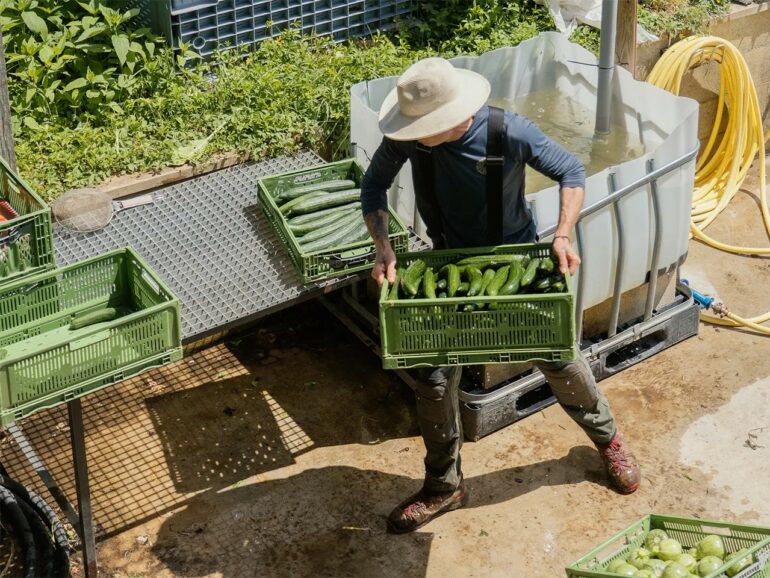
The Mûre estate covers just 1.5 hectares. To an observer accustomed to the vast grain fields of Brie visible from the windows of an RER train, this area might seem insignificant. Yet on these south-facing plots, the density of life is phenomenal. Unlike traditional commercial farms that exhaust themselves through monoculture, more than 150 varieties of fruits and vegetables are grown here. This diversity is the key to a resilient system, capable of adapting to the whims of increasingly unpredictable weather.
Here, the silence is broken only by the clucking of the farm’s 250 chickens—including the intrepid Linda, known for her forays into the Swiss chard rows—and the quiet footsteps of the donkeys Timy and Toumou. Mechanization is virtually banned. With the exception of a single machine dedicated to removing old roots, everything is done by hand. This choice, which might seem like a romantic anachronism, is in reality a remarkably efficient decision. By eliminating the need for tractors, Arnaud Dalibot reclaims the space usually sacrificed for traffic aisles and transforms it into productive growing areas. This traditional method of market gardening also allows for immediate responsiveness: if a crop fails, it is instantly replaced by a new variety, without waiting for the deployment of heavy technological machinery.
From farm to table: a cycle of trust
Mûre’s logistics run like clockwork. At 7:00 a.m., the produce arrives in Paris’s 11th arrondissement, at a neighborhood grocery store and five cafeterias and restaurants. The chefs then take over, transforming the morning’s harvest into dishes for the lunchtime rush. This closed-loop model is a rarity. While most market gardeners sell their produce to third parties, Dalibot has chosen to maintain control over the entire chain, from seed to plate. He is not just the producer; he is the delivery person, the recipe tester, and the manager.

This pace of life is exhausting. Arnaud Dalibot divides his time between the muddy fields of Presles-en-Brie three days a week and the Parisian streets the rest of the time, cycling between his various establishments. For him, the connection between agriculture and nourishing cuisine is a conviction that took root during a stay in New York, at a time when urban agriculture was beginning to flourish across the Atlantic. Upon his return to France, the reality was striking: while France accounts for 17.4% of the European Union’s total agricultural land, approximately 85% of its production is destined for export. A paradox he decided to tackle on his own scale, by focusing on the ten million residents of the Paris region.
The Sociology of the Parisian Lunch
At the new cafeteria on Rue des Italiens, the stream of office workers begins at noon. The concept behind Mûre—whose name evokes the fruit’s perfect ripeness—is based on a very concrete economic reality: the meal voucher. Arnaud Dalibot has tailored his prices to this payment method, offering a hot dish for €10.50. It’s a constant balancing act where margins are slim, but affordability is a guiding principle. The menu features lasagna with roasted vegetables, quiches with eggplant and sun-dried tomatoes, and pizzas with zucchini and Grana Padano.
The entrepreneur takes a clear-eyed view of his customer base. In his view, Parisians are, above all, epicureans: taste remains their top priority. Price comes second. The sustainable or ethical aspects of production, though fundamental to the project, often rank last on consumers’ list of concerns. That’s why Dalibot relies on a strong, educational visual identity. The restaurant’s motto is written on the chalkboards: “The cuisine of those who sow.” Even if some hurried customers don’t fully grasp the message’s significance, the essence lies elsewhere. For this former financier, satisfaction lies in the integrity of the approach and the clarity of a model that puts people and craftsmanship back at the center of the system.
The Prospect of Self-Sufficiency
The example of Mûre raises a broader question on a national scale: Can France truly achieve a form of food sovereignty? On paper, the resources are there. The country is one of Europe’s largest producers, performing particularly well in the grain, dairy, and wine sectors. Yet this agricultural powerhouse remains vulnerable, dependent on imports of oil, coal for its machinery, and industrial fertilizers.
The model championed in Presles-en-Brie offers a credible alternative—a return to basics that minimizes dependence on heavy infrastructure. By reducing distance and cutting out middlemen, Arnaud Dalibot does more than just serve meals; he demonstrates that food resilience requires reclaiming the local landscape. It is a vision of agriculture that is no longer merely an export industry, but a vital, hands-on community service. Every morning, the cycle begins anew: harvesting, the journey, cooking. A demanding routine that reminds us that to properly feed a city, one must first learn to listen to the land that surrounds it.