
Make Texture a preferred source on Google to support us
Add Texture to GoogleThe low morning light at seven o’clock strikes the ochre facades of Florence, stretching the shadow of the Palazzo Vecchio across the still-damp cobblestones. The Tuscan capital, steeped in history and full of sights, is best left at dawn, before the tourist crowds bring its narrow streets to a standstill. Embarking on a week-long road trip through Tuscany is less about racking up kilometers than about learning a rhythm. Here, the car is not merely a utilitarian vehicle for getting from point A to point B; it becomes the lens through which the landscape unfolds. With the engine running and the windows rolled down to let in the crisp air tinged with humidity, the escape from Florence’s urban embrace feels almost abrupt. The asphalt rises, the tiled roofs disappear in the rearview mirrors, and very quickly, the geometry of the Renaissance gives way to another architecture, just as masterful: that of the land.
Time in Tuscany has a particular density. A week seems woefully short to take in a region that has shaped the aesthetics of the West. Yet this span of time is enough to bring about a sensory transformation—provided one lets go of the obsession with exhaustiveness. The true journey isn’t mapped out on a GPS, but in the geological variations of the clay and the nuances of the olive trees’ foliage.
The Rhythm of the Chiantigiana
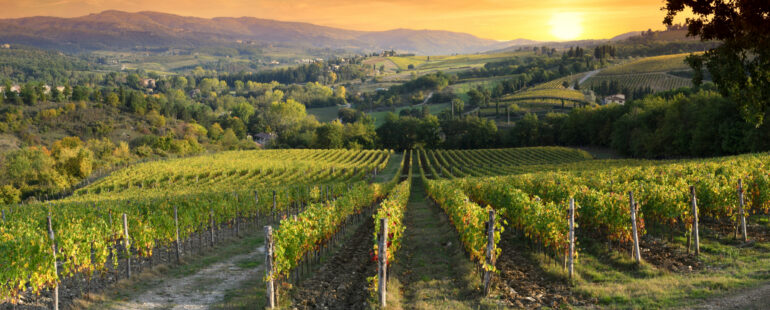
South of Florence, Regional Road 222—the legendary stretch of asphalt known as the Via Chiantigiana—immediately sets its own rhythm. The route winds its way, following the contours of the land with a deceptive smoothness. On either side, the landscape is a vertical tapestry where rows of Sangiovese vines stand in formation. Chianti is not wild nature; it is a garden that has been cultivated since ancient times, a region where human hands have sculpted every hill to optimize sunlight and drainage.
Passing through villages like Greve or Panzano mid-morning offers a glimpse into the local economy before the influx of tour buses. The storefronts of the butcher shops exude the scent of wild fennel and aged meat, while the wrought-iron gates of the wineries offer a glimpse of long, cypress-lined avenues. These trees, immense dark spires reaching toward the sky, serve as the traveler’s metronomes. They mark property lines, the entrance to a patrician villa, or the perilous curve of a bend. Behind the austere facades of the estates, the wine ages in the darkness. The Consorzio Vino Chianti Classico jealously guards the appellations of this terroir, where vines sometimes cling to steep slopes, requiring grueling manual harvests. On the road, drivers slow down, forced by the terrain to match the pace of the tractors sharing the roadway.
The Dictatorship of Brick
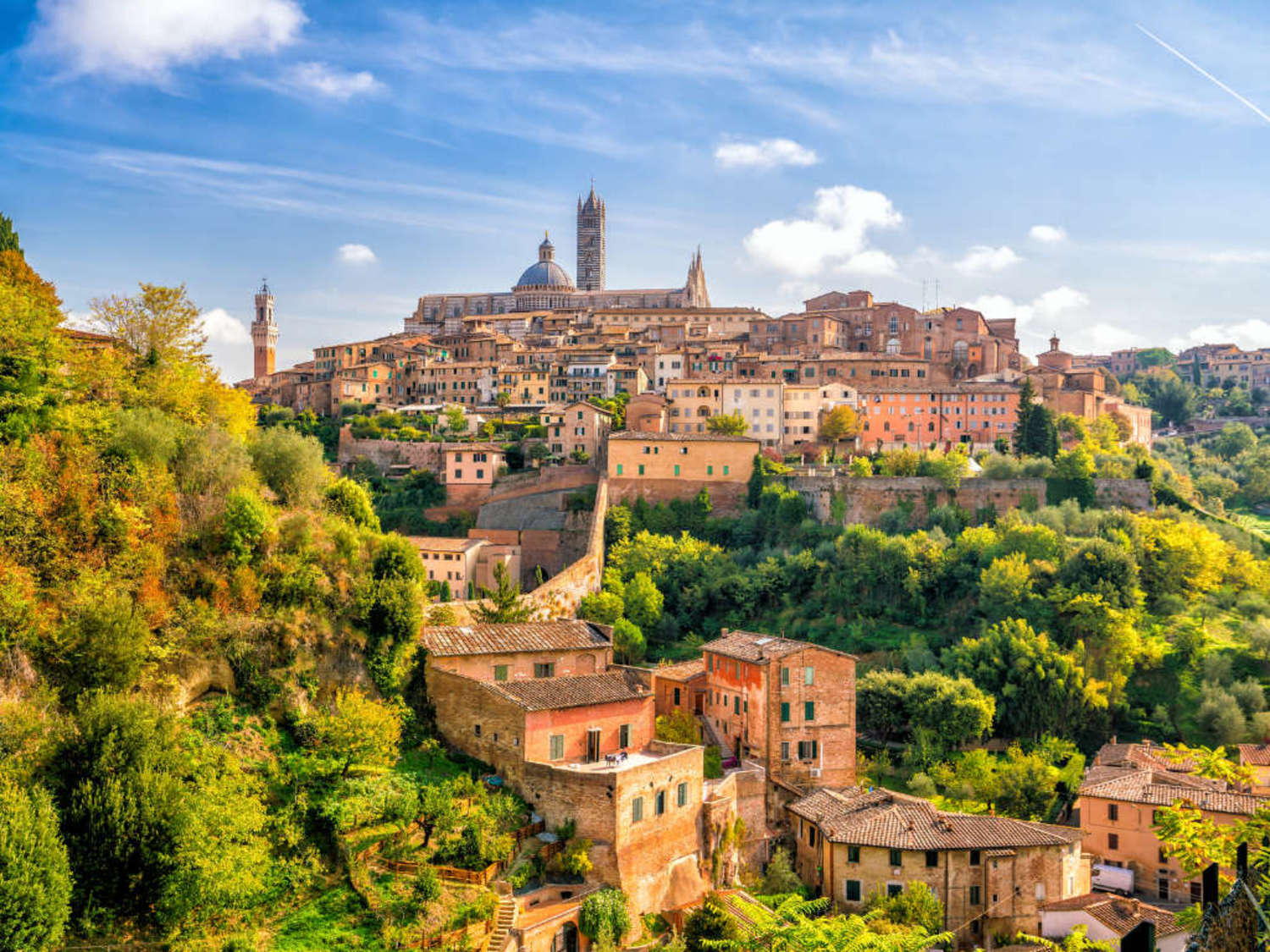
The dense green of Chianti eventually fades, scorched by a harsher light as one travels south. The approach to Siena marks a radical chromatic shift. Florence’s rival city turns its back on white and green marble to assert the reign of terracotta. Siena does not welcome visitors; it wraps itself in on itself.
Finding parking near the city walls requires a certain amount of patience, but the reward lies in the walk that follows. To enter the city’s Gothic fabric, one must embrace the shadows. The narrow streets, lined with palaces featuring mullioned windows, converge irresistibly toward the Piazza del Campo. This square, curved like a conch shell, acts as a gravitational magnet. Sitting there, on the bricks warmed by the afternoon sun, facing the defiant verticality of the Torre del Mangia, allows one to grasp the historical antagonism that divides Tuscany. If Florence is the triumph of mathematical rationality, Siena is a burst of medieval fervor, an organic city that seems to have sprung directly from the clay of its hills.
Lunar barrenness and the utopia of the Renaissance
Getting back behind the wheel south of Siena means venturing deep into the Crete Senesi. The SS2 highway becomes a gray ribbon slicing through a landscape of almost unsettling bareness. Erosion has carved out grayish and yellowish ravines here. A few isolated farmhouses sit atop bare mounds. The arid landscape demands your full attention. The asphalt occasionally gives way to the famous strade bianche—those white gravel roads that, as the tires roll over them, kick up a cloud of limestone dust that seeps into the car and coats the bodywork with a matte film.

This rugged geological landscape prepares the eye for the absolute harmony of the Val d’Orcia, a landscape so idealized that it is listed as a UNESCO World Heritage Site. It is here, amid wheat fields rippling in the wind and natural hot springs emitting sulfurous vapors, that Pienza stands. Founded at the behest of Pope Pius II in the 15th century, the town was conceived as the ideal Renaissance city. Its urban layout, centered on a trapezoidal square designed to correct perspectives, is a deliberate optical illusion. The narrow streets bear evocative names: Via dell’Amore, Via del Bacio. But behind the romantic facade, the pungent smell of Pecorino—that ubiquitous sheep’s-milk cheese drying in the back rooms of shops—serves as a reminder of the region’s deep agricultural roots.
Further west, the fortress of Montalcino stands with its massive walls. The vineyards surrounding it produce Brunello, a wine whose regulations require many years of aging in oak barrels before it can be sold. A tour of the cellars, carved into the tuff, offers a welcome respite from the heat when the Tuscan sun beats down on the plain at midday. Tasting an older vintage is like savoring a liquid distillation of the landscape you traversed the day before.
The Verticality of Stone
The week-long loop begins its return northward by veering westward, toward elevations where the sea breeze begins to make itself felt. The climb toward Volterra sharpens your driving instincts: the hairpin turns are tight, and the rock outcrops are exposed. The Etruscan city, perched on a windswept promontory, smells of alabaster dust—that translucent stone that has been carved in tiny workshops for millennia. The atmosphere here is rougher, less polished than in the wine-growing valleys.
A few dozen kilometers further on stands San Gimignano. From a distance, the town’s silhouette evokes an anachronistic mirage: fourteen stone towers stand out against the horizon, remnants of the seventy-two that noble families built in the 13th century to display their power. The climb up the Torre Grossa, via a narrow staircase worn smooth by the footsteps of generations of watchmen, takes your breath away. At the top, the view takes in the entire journey traveled over the past few days. The vineyards, olive groves, holm oak forests, and ridge roads form a vast checkerboard.
The descent back to the Arno plain to return the keys to a vehicle caked in white dust brings this journey to a close. The shoes still bear the clay of the Crete Senesi, and the acrid smell of leather heated by the sun has permeated the clothes. The final espresso, gulped down hastily at a zinc counter amid the clatter of clinking cups, brings one abruptly back to the present. The silence of the great Tuscan highways has already settled in, preserving the unhurried pace of a landscape that refuses to be consumed by haste.