Make Texture a preferred source on Google to support us
Add Texture to GoogleVenturing into the streets of Manhattan, lined with massive stone buildings, took a certain amount of bravado in the mid-1970s. At the time, the American metropolis had a notorious reputation for being unsafe, an urban harshness that stood in stark contrast to the glamorous opulence of its nightlife. Designer Renato Cipullo remembers this very specific nocturnal landscape, mapped out between the booths at Studio 54, the intimacy of the Club, and the dance floor at El Morocco. Behind these closed doors, jewelry took on a new purpose. Gone was the formality of traditional jewelry: people wore large earrings and imposing gemstones that added a playful touch to deliberately understated outfits. The party served as an incubator. Amid the deafening noise, fashion designers, artists, and creators crossed paths, transforming these spaces of celebration into true platforms for exchange where ideas circulated at breakneck speed. The aesthetic that took shape there was not merely a nightclub trend, but the affirmation of jewelry designed for movement and purely individual expression.
Ergonomics in the Service of the Body
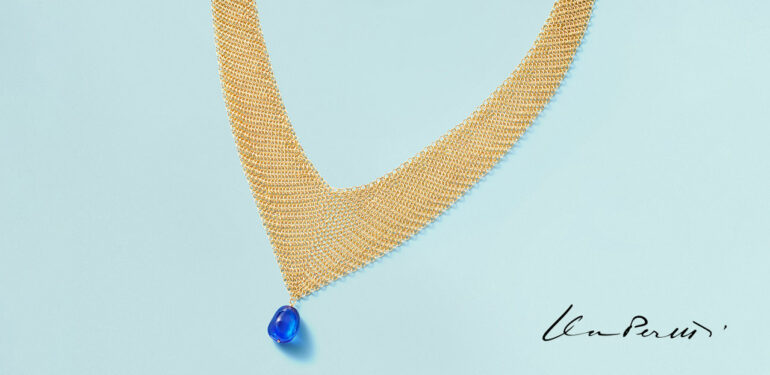
This physical liberation of the precious object found spectacular resonance on September 25, 1974, once again in New York. That evening, more than two thousand people flocked to Tiffany & Co. to discover the first pieces by a new collaborator: Elsa Peretti. Her introduction to the house was no accident; it was orchestrated by two leading figures of the era: fashion designer Halston and the influential fashion journalist Carrie Donovan. Peretti’s work redefined the point of contact between metal and skin. Her Bone bracelet exemplifies this breakthrough. The piece features a sculptural design, meticulously crafted down to the millimeter with the house’s artisans to conform to the body’s contours. It is no longer a matter of wearing an ornament, but of extending the body itself. The enduring popularity of this model, which remains part of Tiffany’s collection today, validates the success of a line where stylistic fluidity meets commercial viability.
A few years earlier, in 1969, the New York scene witnessed the emergence of another radical redefinition of jewelry design, this time by designer Aldo Cipullo for Cartier. The Love bracelet introduced a completely new visual vocabulary with its rigid oval shape and exposed screws. The break was as much formal as it was sociological: Cartier positioned the piece from the outset as a unisex creation, erasing the gender boundaries that had governed the industry. The strength of this original design allowed it to endure through the decades, even as it underwent structural changes. The contemporary Love Unlimited line thus offers a dynamic interpretation of the design. By replacing the rigid band with an assembly of flexible links, the Parisian house demonstrates a design’s ability to alter its physical principles while preserving the integrity of its distinctive features.

Breaking Free from Italian Conventions
The Italian peninsula played an active role in this decade of transformation, approaching materials from a distinct perspective. In Milan, 1967 marked the founding of Pomellato. The young brand immediately distanced itself from the rigidity of classic high jewelry. It built its aesthetic around the color of its gemstones and a deliberately less restrictive artisanal craftsmanship. Vincenzo Castaldo, the current creative director, sees in this legacy from the 1970s a spirit of freedom that he is committed to carrying forward. The challenge for the Milanese brand is not to literally reissue vintage designs, but to maintain a certain attitude: that of personal adornment, free from the weight of convention, designed to blend seamlessly into the daily life of the wearer.

In Rome, Bvlgari explores another form of temporal collision with its Monete line. The design of this collection illustrates how the 1970s managed to bring different eras into sharp contrast. A recent high-jewelry necklace, dissected in the pages of Wallpaper magazine, showcases this language of contrast. The piece creates a dialogue between rose gold, mother-of-pearl, and diamonds with ancient coins struck in bronze and silver. The tension arises from this juxtaposition between the archaeological patina of objects steeped in history and the precision of a resolutely contemporary setting. The archive is no longer a model to be reproduced, but raw material to be set.
Parisian Dialogues Between Light and Archives
The Parisian workshops, in turn, charted this creative frenzy, navigating between technical experimentation and symbolism. The year 1977 saw the debut of the Liens d’Or collection at Chaumet. The house’s internal chronology places this debut within the context of extensive research into goldworking. The motif of the link—an allegory of human attachment—became a enduring central theme in the collections. However, engaging with the past requires a certain degree of historiographical caution. While Chaumet fully acknowledges the symbolic intent and the launch date, the house’s records leave the precise details of the initial sketch in the shadows, notably refusing to formally confirm its attribution to the designer René Morin.
At Van Cleef & Arpels, the process of sifting through the archives takes on an almost kinetic quality. The Audrey earrings serve as a mirror reflecting the effervescence of the 1970s. The piece is rooted in a sketch unearthed from the 1971 records, drawing on the aesthetic of jeweled sequins. The house draws a direct parallel with the fashion of the era, evoking the visual impact of the metallic mesh dresses designed by Paco Rabanne. The earrings’ flexible structure and the incorporation of diamonds are not merely decorative references; they seek to recreate a physical quality—a specific interplay of light linked to the body’s movement. The legacy of this formative decade reveals its complexity here. Far from being limited to a repertoire of fixed forms, it is conceived as a method—a way of anchoring the precious object in the spirit of an era—requiring today’s houses to verify every historical connection with the utmost documentary rigor.