
Make Texture a preferred source on Google to support us
Add Texture to GoogleSome watches simply tell the time, while others force you to relearn how to read it. The Ressence Type 10 DN—short for “Dark Night”—belongs to the latter category. Beneath its domed crystal, the hands have vanished, replaced by a moving mechanical landscape of orbital discs and markers that seem to float in a dark substance. But the real breakthrough isn’t limited to the dial: with this timepiece, Ressence crosses a long-awaited threshold—that of an in-house movement.
The luxury of rediscovered coherence
Since its inception, the Belgian brand Ressence has built its identity in defiance of watchmaking conventions. Its watches seek neither a heritage-inspired aesthetic, nor vintage references, nor the usual display of visible mechanics. They offer a different language: a display without central hands, a reading by rotation, and dials filled with oil that give the whole an almost unreal depth.
This bold identity, however, came with a certain tension. The brand’s creations were based on ETA calibers, to which specific modules were added. A proven, rational solution widely used in the industry, but one that might seem at odds with the level of ambition reflected in the cases, the display interfaces, and the price points. When a timepiece claims such a radical vision of the watch, its movement cannot remain for long a component borrowed from a supplier’s catalog.
The Type 10 provides a clear answer to this question. Its development took four years—a timeframe that speaks to the project’s complexity. Ressence did not simply modify an existing movement: the brand designed an architecture tailored to its visual language and the physical constraints of its oil-filled dial. This change elevates the model to a new level. It is no longer merely a watch with an original display; it is a watch whose mechanism and form finally embody the same vision.
Two Chambers, One Movement
The starting point is almost paradoxical. Oil is one of Ressence’s most recognizable hallmarks: it gives the dial its unique visual appearance, enhances legibility, and visually blurs the boundary between the glass and the displays. However, a mechanical movement cannot operate in that same oil. The caliber’s components must therefore be protected in a separate environment.
The Type 10 is thus built around two separate spaces. On one side, an air-filled chamber houses the movement. On the other, an oil-filled chamber contains the dial and its display elements. The challenge lies in transmitting the movement from one chamber to the other without creating a physical passage that could compromise the watertight seal between the two.
The solution chosen is a magnetic transmission system. The moving parts required to animate the dial exist in duplicate: one version is located in the mechanical section, and the other in the oil-filled section. Small, powerful magnets connect these components without direct contact. The caliber thus drives the elements on its side, whose movement is reproduced magnetically on the discs visible on the dial side.
This mechanism is at the heart of the project, far more than just a technical detail intended for collectors. It defines the very design of the watch. At Ressence, the dial is not merely a facade placed over a movement; it is the visible culmination of a design conceived around oil, rotation, and the separation of volumes. The Type 10 is designed around its display, rather than as a traditional mechanical movement adorned with a spectacular dial.
A watch without hands, but not without hour markers
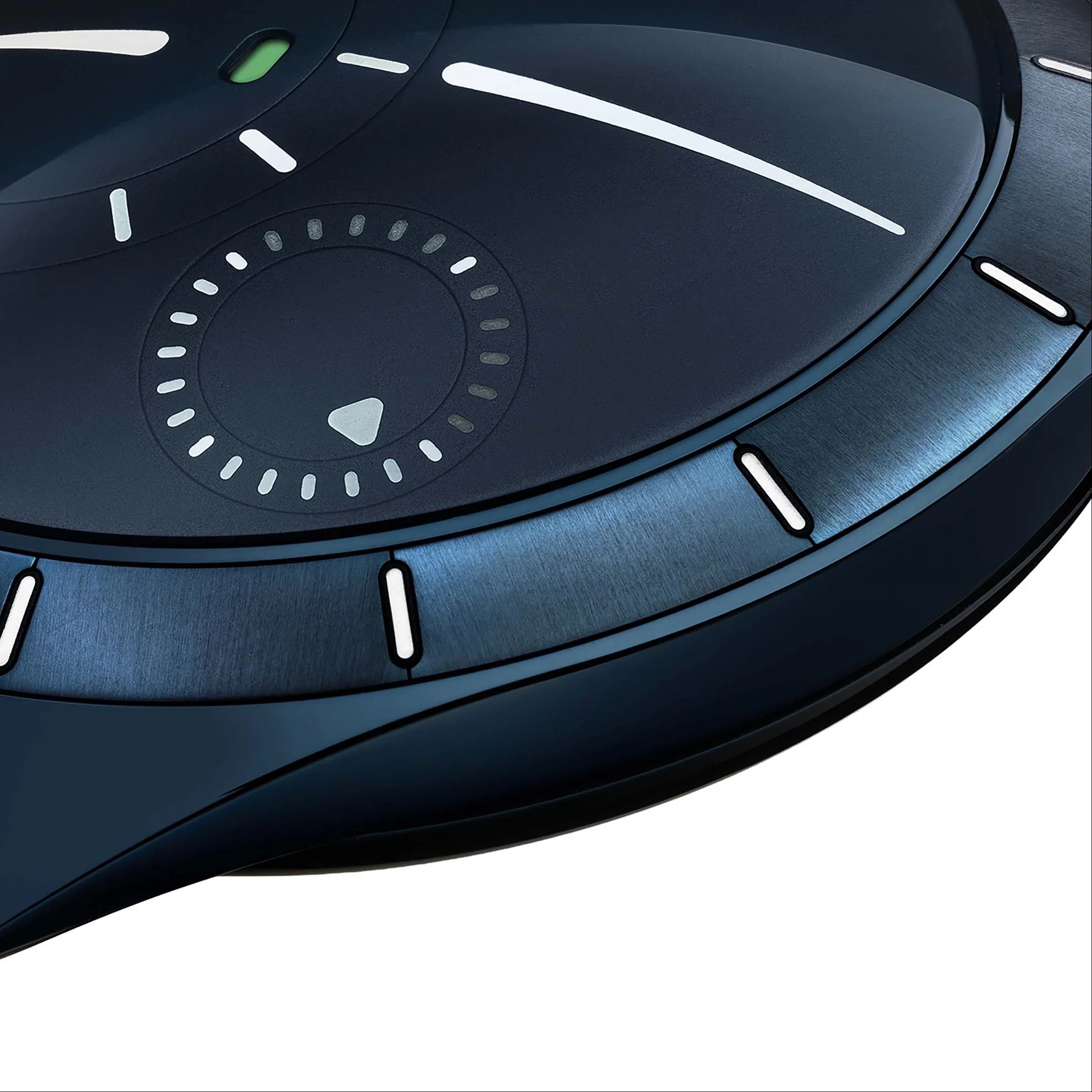
The 41.5-mm case is crafted from Grade 5 titanium. It features a dark blue HarDeCo coating, chosen both for its color and to enhance scratch resistance. This almost nocturnal hue justifies the name “Dark Night” without descending into uniform black. It extends the sense of depth on the dial, where the markings seem to shift beneath a liquid surface.
The fixed bezel contributes to the watch’s understated elegance. Here, Ressence avoids an overabundance of raised elements and decorative details. The eye is drawn to the convex crystal and the slow, choreographed movement of the discs. Reading the minutes relies on the rotation of the entire dial: a large hand points to the peripheral scale. The hours are displayed by an orbiting sub-dial, positioned at the base of this minute hand. The Ressence logo serves as a marker at 12 o’clock.
The system also features a small seconds hand, a second time zone, and an oil temperature indicator, signaled by a colored mark. This last function serves as a reminder that here, the oil is not merely an aesthetic element: it is integral to the watch’s operation. In a conventional mechanical watch, oil temperature simply wouldn’t be something you’d read off the dial. On the Type 10, it becomes a deliberate feature, integrated into the watch’s face.
It takes some getting used to deciphering this display, but that is precisely what gives it its personality. The Type 10 does not replicate the traditional dial by replacing the hands with discs. Instead, it reorganizes the information and requires a circular reading, more akin to a dynamic interface than a classic wristwatch. The effect may evoke an onboard instrument, without seeking to imitate a control panel or pile on ostentatious complications.
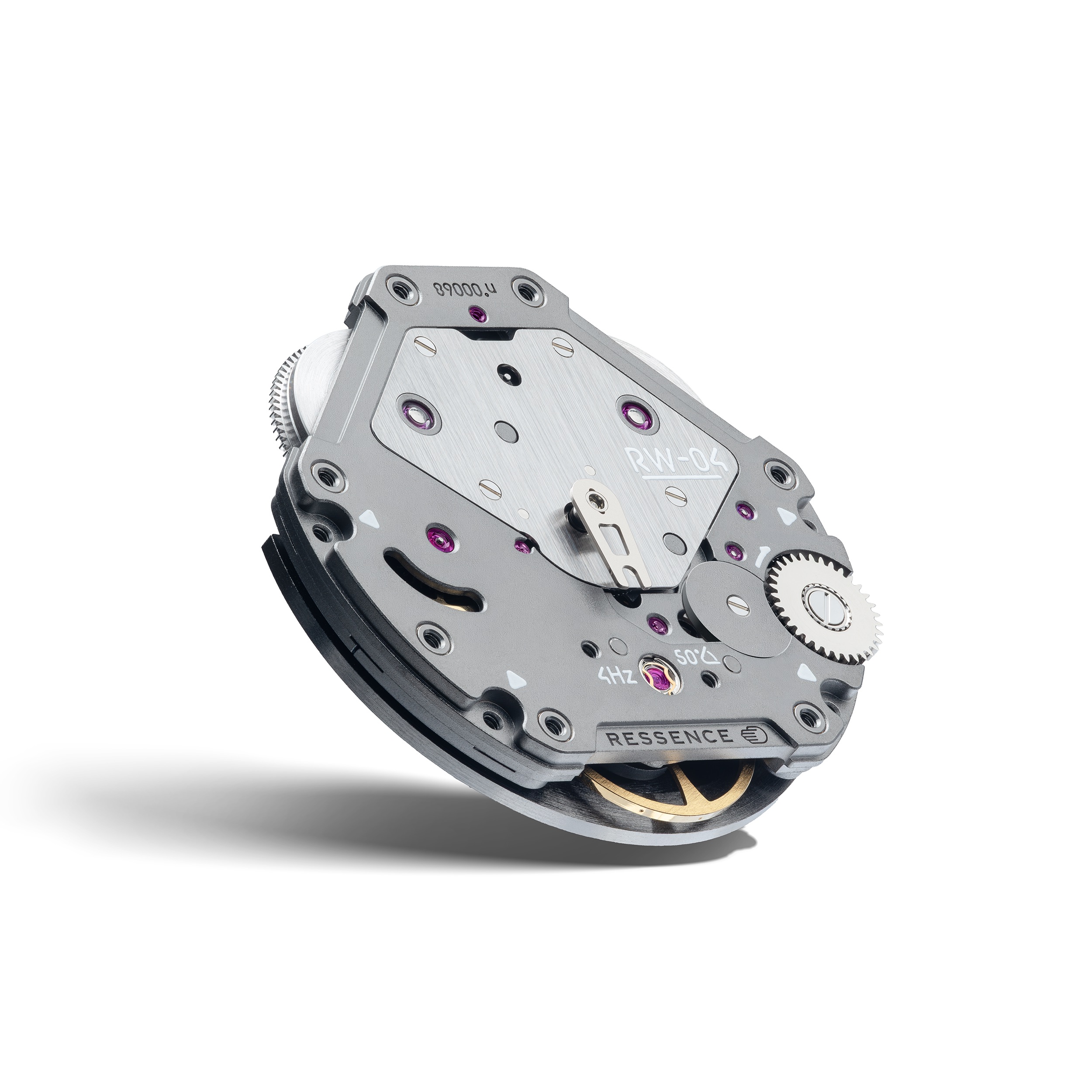
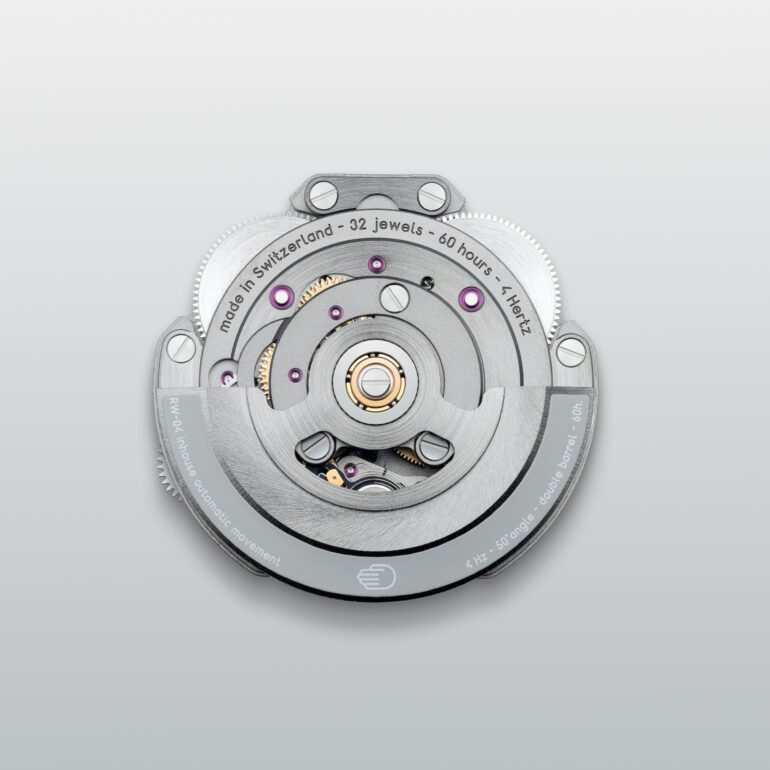
The RW-04 Caliber, the Cornerstone of the Type 10
At the heart of this design lies the Ressence RW-04 caliber, paired with the ROCS 10 module. It operates at 28,800 vibrations per hour (4 Hz) and offers a 60-hour power reserve. These specifications place the Type 10 firmly within the realm of contemporary mechanical watchmaking, but their significance lies above all in what they represent for the brand: the movement is no longer merely a base to which a Ressence concept is added. It has become the platform specifically designed for that concept.
A comparison with the evolution of transportation clearly illustrates this stage. The first automobiles replicated the structure of horse-drawn carriages, simply adapted to accommodate an engine. It took time for the automobile to develop its own industrial vocabulary and distinctive proportions. Ressence is following a similar trajectory: after building its identity on existing calibers enhanced with in-house modules, it is now bringing the mechanics themselves into its creative realm.
This evolution does not mean that previous generations have lost their appeal. On the contrary, they helped establish an instantly recognizable display and demonstrated the relevance of the ROCS principle—Ressence Orbital Convex System. But the Type 10 takes this design language to a more refined level, as the RW-04 caliber, the ROCS 10 module, the magnets, and the separate chambers were conceived as interdependent parts of a single object.
An exclusivity now more firmly established
The Ressence Type 10 DN is water-resistant to 50 meters (5 bar) and features an integrated rubber strap secured by a titanium buckle. This choice of material reinforces its contemporary character. The rubber strap prevents the watch from veering into a dressy or formal style; it is better suited to a case that asserts a technical presence and a compact form.
The price is set at 45,000 Swiss francs before tax, for a limited edition of 100 pieces. This price unambiguously places it among the most exclusive offerings in independent watchmaking. But the introduction of an in-house movement changes the nature of this equation. The buyer is not merely paying for an unusual dial design or the alluring strangeness of an oil-filled display. They are gaining access to an architectural design whose constraints required four years of development and in which every component seems to serve a specific purpose.
The Type 10 DN does not seek to reassure enthusiasts attached to classic conventions. It has neither the hands one would expect, nor the standard movement that was once criticized, nor the comfortable roundness of a watch designed to please everyone. Its 100 pieces are intended for those who believe that a watch can still redefine the standards—provided the mechanics are capable of keeping pace with the design.