
Make Texture a preferred source on Google to support us
Add Texture to GoogleThe watch industry frequently succumbs to the temptation of taking the easy route with color. Changing the shade of a dial is often enough to artificially reignite interest in an aging collection. By unveiling the Ice Blue version of its Metro Date Power Reserve, the German watchmaker Nomos gives the impression of playing along with this aesthetic trend, as light blue has become a highly sought-after shade among contemporary collectors. Yet this update conceals a much deeper intention. Behind the frosted facade of this new design lies a major mechanical overhaul, radically altering the daily relationship between the wearer and their timepiece.
The Glashütte-based manufacturer has always cultivated a sense of absolute discretion, prioritizing Bauhaus functionalism over ostentatious displays of power. This new iteration strictly adheres to this visual language. The decision not to loudly announce the internal revolution on the dial itself reflects an approach to watchmaking where engineering must serve practical use before flattering the ego. The watch thus demands close attention to reveal its true nature, contrasting subtle complexity with its apparent simplicity.
The Cartography of Time
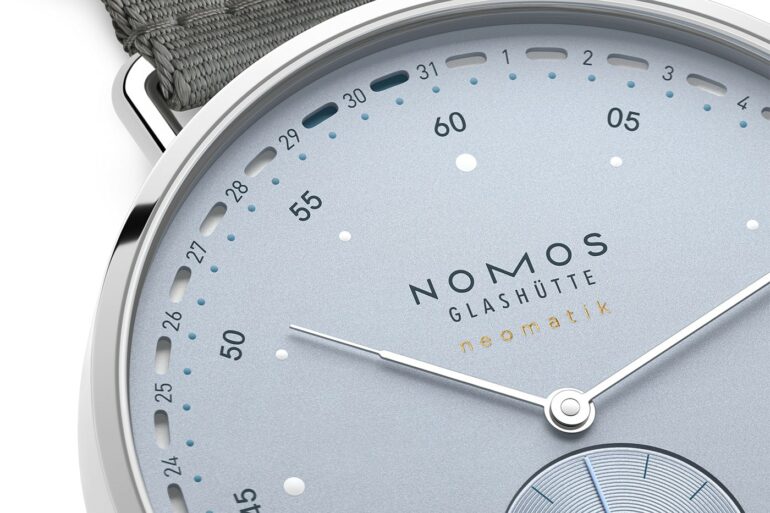
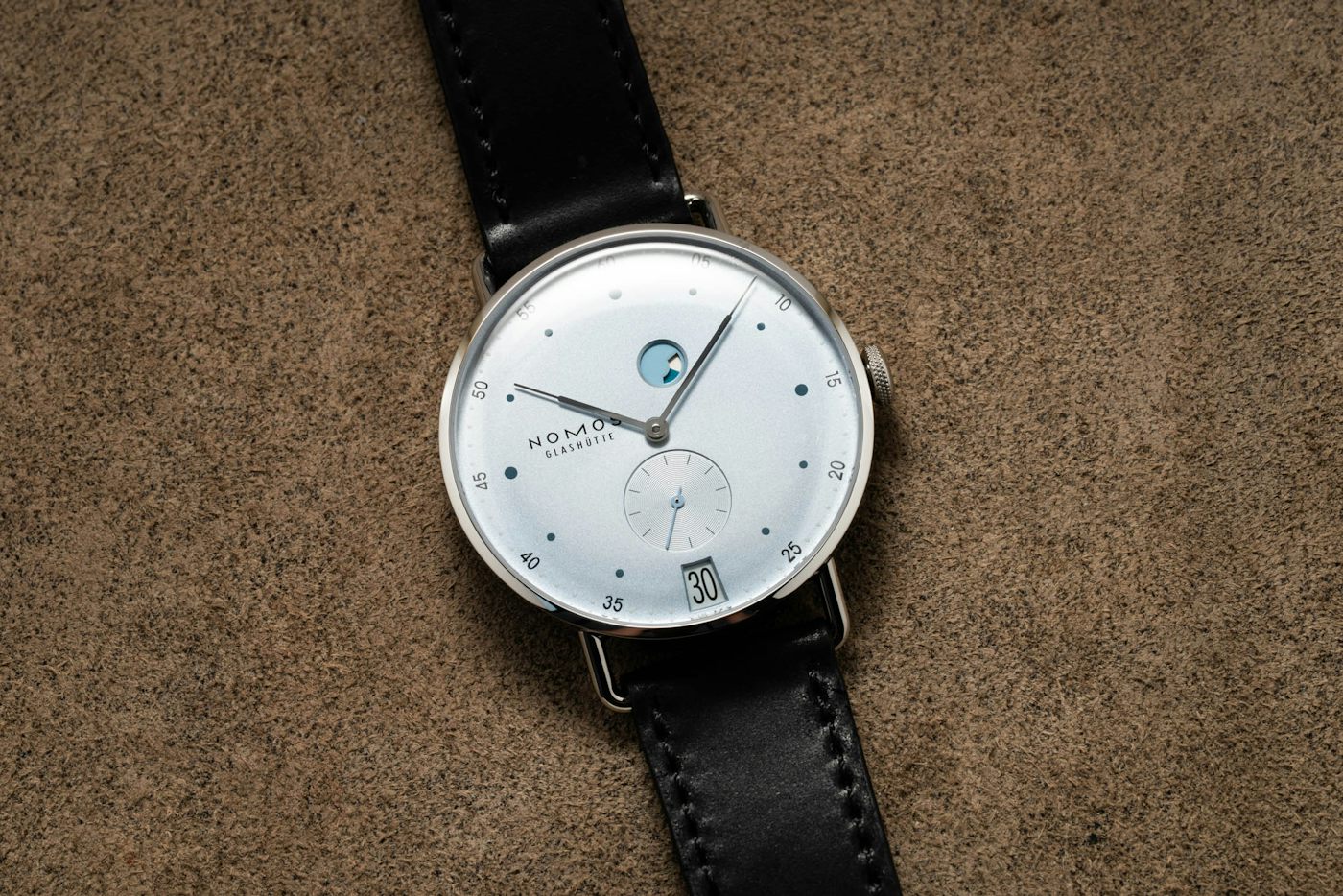
The aesthetic of the Metro line, originally conceived by Berlin-based designer Mark Braun, finds a unique means of expression in this glacier blue hue. The dial’s surface, which features a galvanized finish, has the distinctive quality of reacting intensely to its lighting environment. Depending on the angle of the wrist and the light source, the watch’s face shifts between a very distinct pale azure and an almost clinical whiteness. This color variation deliberately contrasts with the absolute precision of the time display.
Braun has always cited the influence of underground public transit maps in the design of this model. This connection is immediately apparent. Blue-green accents punctuate the space, acting like stations on a subway line, while the minute markers—rigorously spaced in increments of five—structure the display. The round, minimalist hour markers reinforce the sensation of looking at an abstract topographic map rather than a traditional watch dial. The overall design feels open and airy, allowing the eye to wander without ever stumbling upon superfluous elements.

The asymmetrical layout of the complications contributes to this deceptively casual balance. The off-center power reserve indicator interacts with the small seconds sub-dial and a trapezoidal date window positioned at six o’clock. The space is filled with surgical precision. No overlapping elements or intrusive typography disrupt the object’s primary function: to deliver immediate and clear information. Here, Nomos demonstrates its mastery of proportions, proving that a utilitarian design in no way precludes sophisticated graphic design.
A design tailored to the body
The case itself eschews the excessive size that still characterizes many men’s models. With a modest diameter of 37 mm, coupled with a remarkably slim profile of 8 mm, the steel case is almost imperceptible when worn. Its lug-to-lug width, measured at 43.6 mm, ensures a perfect fit on the vast majority of wrists. These dimensions define the watch’s fundamentally urban character: it is designed to slide seamlessly under the sleeve of a fitted shirt, accompanying movement rather than hindering it.
The most striking and distinctive architectural element of this silhouette remains its clasp system. The wire lugs are a direct historical reference to the early days of the wristwatch in the early 20th century, when watchmakers would solder simple loops onto pocket watch cases to thread a leather strap through. Mark Braun reimagines this heritage to lighten the Metro’s structure. By eliminating the visual bulk of massive, solid lugs, the case appears to float above the strap.
The strap, crafted from classic black leather and fastened with a traditional pin buckle, firmly anchors the watch in an urban and formal style. While the brand has incorporated a mechanism that allows the strap to be removed without any watchmaking tools, the very specific design of these metal lugs effectively limits experimentation with third-party straps. The owner is subtly encouraged to draw from the manufacturer’s extensive catalog of accessories to accessorize their timepiece.

The Heart of the Reactor: A Tangible Evolution
The true break from the previous generation isn’t just visible—it’s felt. Turning over the case of the version with a sapphire crystal caseback reveals the DUW 4701 caliber. This new hand-wound movement replaces the previous DUW 4401. While the oscillation frequency remains at the classic rate of 3 Hertz—or 21,600 vibrations per hour—the power reserve takes a significant leap forward. The power reserve has increased from 42 to 52 hours. This ten-hour gain transforms how the watch is used: it can now sit on a nightstand all weekend and continue to keep time until Monday morning.
However, the most significant improvement for the wearer concerns date adjustment. Owners of earlier versions were all too familiar with the sometimes tedious steps required by the old date-setting mechanism. The DUW 4701 caliber eliminates this constraint by incorporating a quick-set system that is infinitely more flexible and direct. For an object intended to be wound and handled regularly by human hands, streamlining this mechanical interaction reflects a true understanding of contemporary expectations.
Aesthetically, the movement also reflects an evolution in the brand’s design language. The traditional plate covering three-quarters of the mechanism—an unmistakable hallmark of Saxon haute horlogerie—has abandoned the old vertical ribbing. Nomos has opted here for a textured, radiating pattern that radiates from the exclusive in-house escapement system. This new decoration captures light with greater dynamism and modernizes the appearance of the caliber while remaining true to the rigorous spirit of Glashütte.
The Precision of Urban Measurement
Fully embracing its purpose, this new Metro makes no pretense of being anything it is not. Its certified water resistance to 50 meters clearly defines its intended use. It will withstand the elements of a bike ride in the rain or everyday splashes, but it eschews imagery of the deep sea and extreme sports. This technical modesty is refreshing in an industry that often goes out of its way to equip city watches with professional diving specifications that are completely unnecessary for their buyers.
By modernizing the mechanical heart of its flagship model while preserving its familiar case, Nomos exemplifies a strategy of slow, mature evolution that respects its customers. The brand proves that it is possible to make a concrete improvement to an existing product without disrupting its visual essence or artificially inflating its proportions. The Ice Blue version of the Metro Date Power Reserve is ultimately not just about color. It is an affirmation of a philosophy in which the readability of a dial must find its perfect counterpart in the fluidity of its mechanical operation.