Make Texture a preferred source on Google to support us
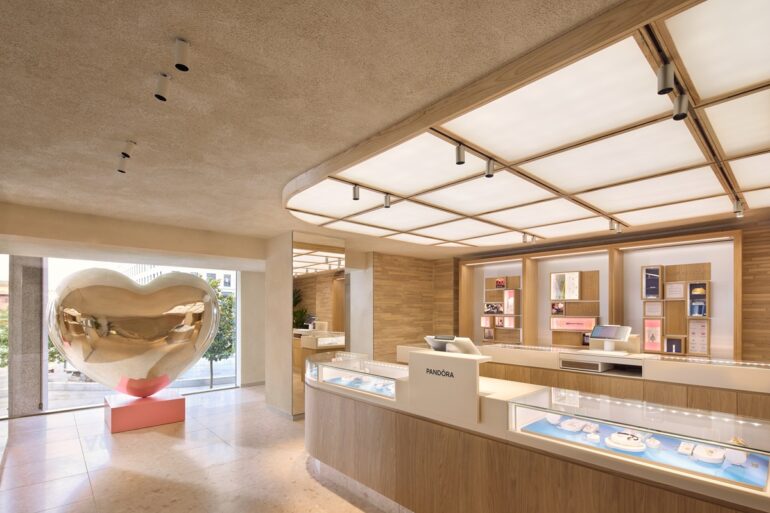
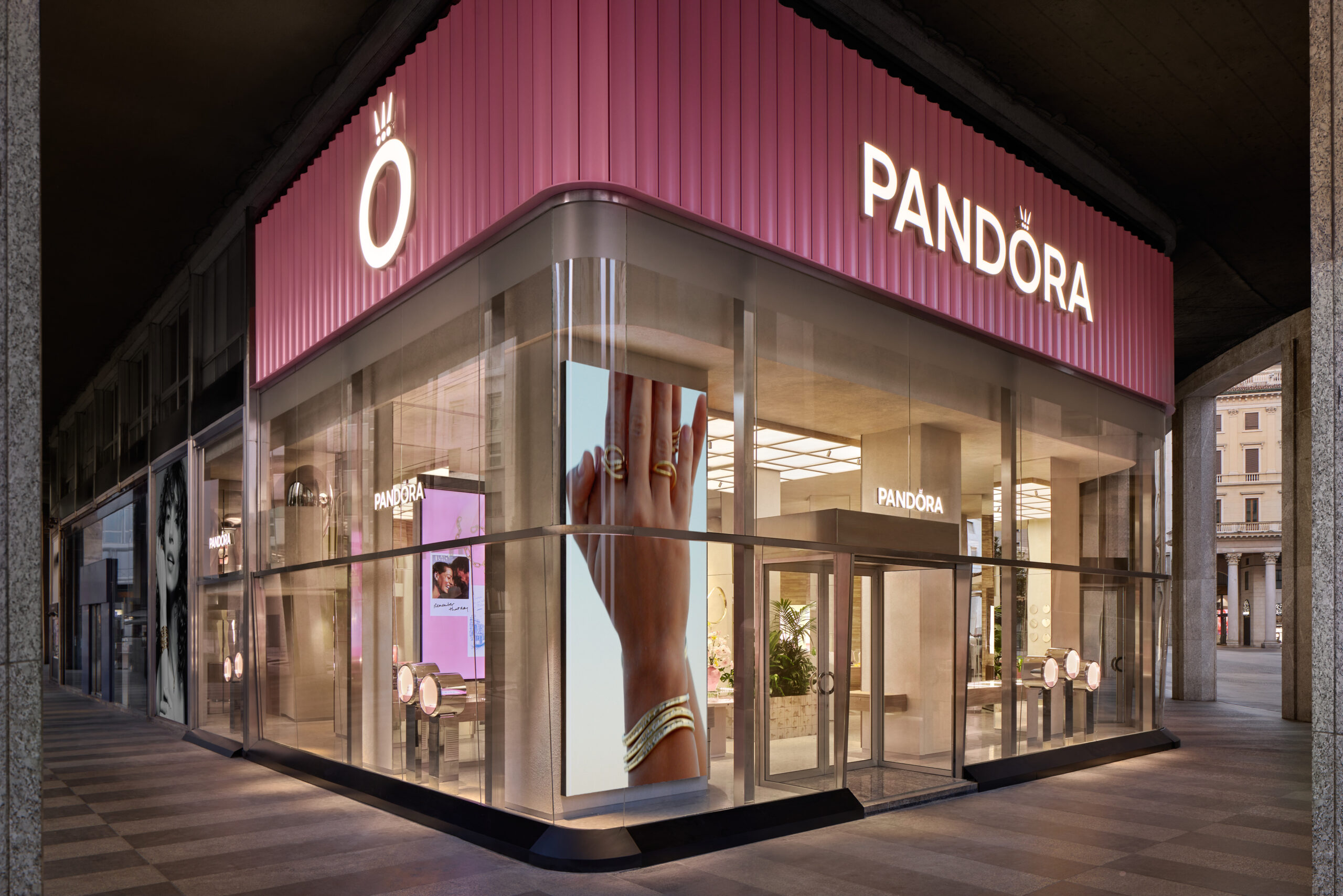
Add Texture to GoogleIn Milan, 250 square meters are enough to pose the question that’s on Pandora’s mind: how can you keep growing when almost everyone already knows your name? Opened in June 2026 at the corner of Corso Vittorio Emanuele II and Piazza San Babila, the Danish group’s first Italian flagship store features a new experiential retail concept spread across two levels. The location addresses a specific challenge. In its third-largest global market, where growth has leveled off in recent years, Pandora must provide new reasons to buy. This Italian venture highlights the group’s ambition: to push the boundaries of its own success.
Enormous brand recognition, yet a limited market presence
The contrast is striking. According to Massimo Basei, Pandora’s commercial director, the brand ranks first globally in the jewelry sector in terms of both volume and brand awareness. Yet its share of the global market is only around 2%. During his speech at the Palazzo Mezzanotte, headquarters of the Italian Stock Exchange, the executive highlighted this disconnect between the brand’s strength and its actual market share in jewelry sales.
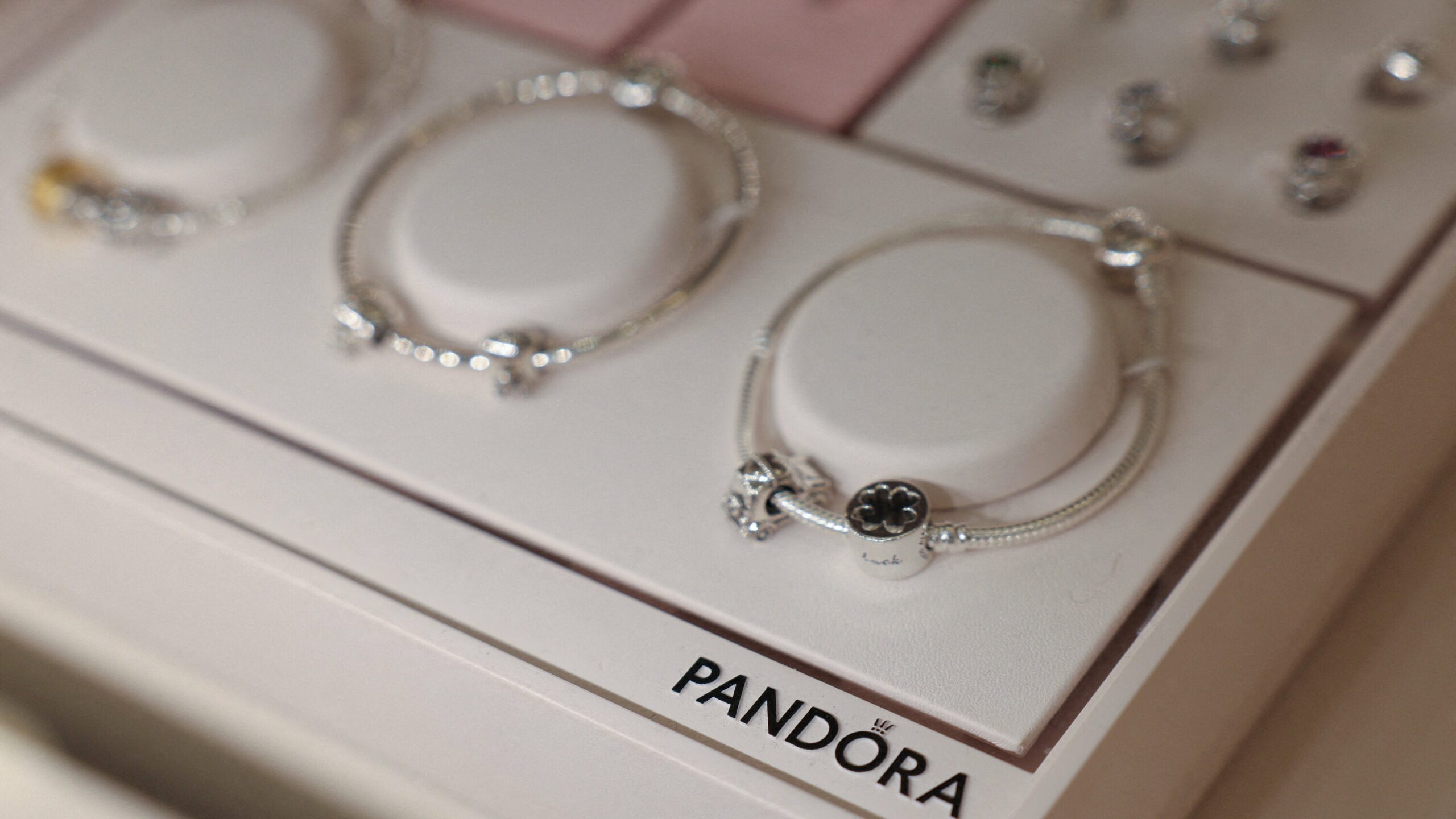
The potential for growth is evident in the sales mix. Silver accounts for 70% of revenue, while gold commands a large share of the market, particularly in certain regions. Wrist jewelry accounts for about 60% of revenue. Pandora thus benefits from a clear brand identity, but its business remains largely tied to a single material and product category. Expanding the product range without blurring this identity is one of the key challenges for the next phase.
For now, there are no plans to pursue this expansion into watches or eyewear. Basei, who himself came from the eyewear industry in the early 2010s, does not rule anything out on principle, but prioritizes jewelry. He believes the sector is growing, on average, faster than gross domestic product and that purchases are becoming increasingly brand-driven. From this perspective, Pandora does not need to change its business model to find new opportunities.
Asia: A Counterpoint to the Western Market
The concentration is also geographic: more than 80% of revenue comes from Europe, the Middle East, and Africa—collectively known as EMEA—and from North America. EMEA alone accounts for about half of sales. The United States, the group’s largest single market, accounts for nearly one-third of revenue. While these positions provide a strong commercial foundation, they leave Pandora with a limited presence in certain parts of the world.
Asia offers the sharpest contrast. Basei acknowledges that the company’s presence there is still modest, while the Asia-Pacific region posted 20% growth in the third quarter of 2026. This increase signals potential, though it does not eliminate the current imbalance. The challenge lies in giving these markets greater weight within a group whose revenues remain heavily weighted toward the West.
However, expansion does not mean neglecting the United States. Pandora’s market share there is also around 2%, despite the country’s significance in its financials. Being the top market does not, therefore, mean the market is saturated. The group intends to continue growing in countries where it already has a presence, while expanding into those where its presence remains limited.
In Vietnam, the industrial resources to support its ambitions
This quest for new customers has a less visible aspect than the storefronts: manufacturing. In early October 2026, Pandora inaugurated its first manufacturing facility outside of Thailand in Ho Chi Minh City. The investment totals approximately $150 million. Billed as the world’s largest fine jewelry factory, this Vietnamese facility is expected to produce 60 million pieces at full capacity and increase the group’s production capacity by 50 percent.
This scale-up builds on an integrated model: Pandora manufactures everything it sells. At the other end of the chain, approximately 90% of sales are now directly controlled. In between, the group has gradually regained control over its distribution, buying out its distributors and transitioning from multi-brand stores to single-brand franchise boutiques, before embarking on a new transformation of its network starting in 2020.
Since its IPO in late 2010 and the subsequent international expansion, Pandora has thus built more than just a commercial presence. According to Basei, control over production and sales channels allows the company to influence quality, lead times, and margins. It also provides direct oversight of the ethical and environmental conditions in the supply chain—an issue the CEO links to the very structure of the company.
Commitments Put to the Test by Scale
The data provided by Pandora clarifies this policy: all the gold and silver used is recycled, and all diamonds are lab-grown. Electricity is not the only area addressed by the group, which reports that its stores, factories, and offices run entirely on renewable energy. Its industrial scale is reflected in another figure: Pandora purchases 5% of the recycled silver available worldwide.

On this scale, material choices are not limited to a single collection; they apply to the entire production process. Basei highlights two trends since 2019: revenue up by approximately 50% and emissions reduced by 17%. These results now accompany an announced increase in industrial capacity. The expansion of the Vietnamese facility will add a new dimension to the relationship between production volumes and environmental performance.
Growth that must also preserve profitability
The third-quarter 2026 financial results provide initial encouraging signs for this strategy. Revenue reached 6.7 billion Danish kroner, or approximately 897 million euros, compared to 6.3 billion a year earlier. Organic growth stood at 6%, while like-for-like sales rose 4%, with positive performance across all regions. Operating income reached 1.06 billion kroner, bringing the margin to 15.9%, compared to 14% in the third quarter of 2025.
For the first nine months, revenue totaled 21.02 billion kroner—approximately 2.8 billion euros—representing organic growth of 3%. The full-year outlook, which was initially more conservative, was raised when the second-quarter results were announced and then adjusted upward once again. Basei sees this acceleration as the first signs of the recently implemented growth drivers, while emphasizing that their rollout is far from complete.
The historical decline, however, calls for a distinction between sales growth and profitability. Revenue rose from 3.8 billion euros in 2023 to 4.2 billion in 2024, then to 4.4 billion in 2025. In 2025, EBITDA edged down slightly to 1.38 billion euros from 1.39 billion, and the EBITDA margin fell from 32.6% to 31.7%. The recovery in the quarterly operating margin is therefore a useful indicator, though it should not be confused with these annual metrics.
In Italy, moving from visibility to relevance
The challenge now is to translate these resources into a desire to purchase. Italy, which accounts for approximately 7% of global revenue, will be one of the key markets for this evolution. Following Copenhagen, Las Vegas, and Barcelona, Milan is set to host the fourth space designed according to the new global experiential concept. The diamond collections are also set to launch on the Italian market.
The change will also extend to communications. Pandora aims to complement its focus on audience reach with a focus on relevance, by revising its media selection and the way it markets its offerings. For a brand that already boasts leading global brand awareness, the nuance matters: simply being recognized is not enough to boost sales. In Italy, the next phase of the initiative will play out as much in local campaigns as in the storefronts along Corso Vittorio Emanuele II.