Make Texture a preferred source on Google to support us
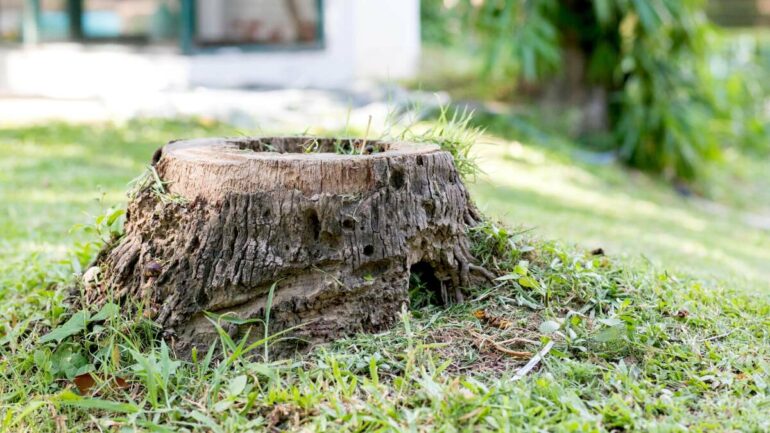
Add Texture to GoogleThe felling of a majestic tree often marks the end of a chapter in the landscape, but the stump that remains at ground level is more than just an aesthetic remnant. For the balance of an exceptional garden, this woody remnant represents an active biological entity whose management requires both precision and foresight. Far from being an inert element, a neglected stump quickly becomes the focal point of complex underground dynamics capable of compromising the health of surrounding plants and the integrity of nearby architectural structures.
The Invisible Threat of Crown Rot
The main danger associated with leaving a stump in place lies in the proliferation of fungal root diseases. The honey fungus (Armillaria spp.), better known as “honey fungus,” finds an ideal substrate in dead wood. This formidable fungus does more than just decompose wood; it spreads rhizomorphs—thin, black underground filaments capable of traveling one meter per year through the soil. These structures can spread up to 30 meters from the original source to colonize and infect the root systems of perfectly healthy trees and shrubs. The Royal Horticultural Society (RHS) emphasizes a strict technical reality: no chemical fungicide is currently effective against this scourge. The only recourse for protecting a property’s plant life remains the complete physical eradication of the stump and its main infected branches.
Beyond mycology, the stump serves as a reservoir for wood-boring insects. Decaying wood inevitably attracts colonies of isoptera, such as termites, as well as carpenter ants (Camponotus) and various wood-boring beetles. These populations nest deep within the dead wood before expanding their foraging range. This proximity then poses a direct risk to healthy plants, but especially to the wooden frames and structures of nearby homes.
Nutritional Balance and the Phenomenon of Nitrogen Starvation
An often-overlooked aspect of stump conservation concerns soil chemistry. When a stump is chipped, burying large quantities of sawdust and wood chips in the cavity can cause a biological imbalance known as “nitrogen lock-up.” The microorganisms responsible for wood decomposition consume vast amounts of available nitrogen to break down lignin. This competition for nutrients literally suffocates the grass or new plantings established on the tree’s former site. According to the RHS’s technical recommendations, this deficiency can persist for up to two years, rendering any attempt at aesthetic turf establishment futile if the planing residues have not been thoroughly removed.
Furthermore, as long as the collar and roots remain alive, the stump can continue to draw moisture and nutrients from the soil through sprouts or suckers. This depletion of water resources is detrimental to the surrounding grass, creating patches of sparse or yellowed turf. From a practical standpoint, a stump protruding above ground level also poses a major obstacle to maintenance, posing a risk of serious damage to the blades and casings of mowing equipment, not to mention the risk of falls for garden users.
Mechanical strategies: grinding and excavation
To permanently eliminate these risks, two mechanical methods are recommended, depending on the landscaping goals. Stump grinding is the most common solution for preserving the aesthetic appeal of a lawn. A rotating disc equipped with carbide teeth grinds the stump collar and root system below ground level. The depth of the operation is crucial here: a depth of 20 to 25 centimeters is required for simple reseeding, while a minimum depth of 30 centimeters is essential if you plan to replant shrubs or a new tree. The peripheral roots not affected by the disc die and decompose naturally over time. An essential step is to replace the shavings produced by the planing process with topsoil before any seeding.
Manual removal or complete excavation with a skid steer loader is the most radical option and the only one recommended if contamination by the honey fungus is suspected. This method guarantees 100% removal of woody tissue and roots, thereby eliminating any potential source of infection for neighboring plants. It is a precision task that thoroughly sanitizes the soil, although it is more disruptive to the immediate soil structure.

The Chemical Approach and Its Legal Limitations
Chemical devitalization, while effective at stopping regrowth, is subject to strict application guidelines. The application of a systemic herbicide (triclopyr or concentrated glyphosate) to the living sapwood must take place within 30 minutes of cutting the trunk. This extremely short window is due to the tree’s vascular system’s ability to seal the wound, thereby blocking the herbicide’s descent to the roots. While this method prevents regrowth, it does nothing to accelerate the physical decomposition of dead wood.
It is essential to note that legislation in France has changed significantly: since the Labbé Law of 2019, the sale and use of these synthetic herbicides have been prohibited for amateur gardeners. For those who prefer accelerated decomposition without resorting to banned systemic products, the use of potassium nitrate or sodium metabisulfite granules is a technical alternative. These substances, applied to holes drilled 20 to 25 cm deep at a 45° angle, provide the nitrogen needed by bacterial flora to break down lignin while promoting the drying of the wood. Research conducted by Dr. Coder and the University of Illinois indicates that this treatment accelerates decay by approximately 25%. An approach combining compost, aeration, and regular application of organic nitrogen can increase this time savings to as much as 50%. Despite these biochemical aids, the entire decomposition process requires considerable patience, generally taking 12 to 24 months.
Investment and Service Costs
Hiring a professional to grind a stump represents an investment that varies depending on the location and the complexity of the site. For the 2025–2026 period, rates observed in the European Union and Ireland generally range from €100 to €300 for a typical, medium-sized stump. However, this amount can rise to between €500 and €1,000 when access to the site requires specialized equipment or extensive logistics. By way of comparison, rates in the UK range from £85 to £300, while in the United States, average quotes range from $150 to $500 per tree.
For minor treatments where permitted by law (excluding France for private individuals), over-the-counter tree-killing products such as triclopyr or glyphosate gel are available at modest prices, ranging from €12 to €25 per bottle. However, given the health risks to the rest of the property, the expertise of a professional arborist remains the best guarantee of safe and lasting eradication, preventing the recurrence of diseases or silent infestations beneath the surface of your yard.