Make Texture a preferred source on Google to support us
Add Texture to GoogleOnly one fireplace remained. In this Georgian apartment in London, successive layers of thoughtless renovations had erased all traces of the original architectural vocabulary. The moldings were gone. The doors had been torn out. The parquet floors, weathered by the centuries, had been forgotten. Faced with this disfigured shell, interior architect Claudia F. Kalur—trained in Europe but practicing in the United States—had to completely rethink the space for her American clients. This radical renovation—which required stripping the structure down to the brick before incorporating private bathrooms and rethinking the layout of storage spaces—goes beyond a mere construction anecdote. It single-handedly crystallizes a much broader phenomenon: the complex transformation of transatlantic exchanges in the world of home design, where the clash of decorative cultures is gradually giving way to a quest for absolute roots.
For decades, the export of taste operated on the principle of imitation. American aesthetics prevailed through their pragmatism, while British style was exported as a label of slightly eccentric classicism. Today, the hierarchy of customs and cultural habits clash on a much more nuanced playing field. Professionals navigate between two shores that do not share exactly the same relationship to time, nor the same definition of interior luxury.
Submission to architecture in the face of the urgency of impact
The case of the Georgian apartment renovated by Claudia F. Kalur illustrates this temporal friction. According to the designer, the fundamental difference between American expectations and British reality lies in the management of frustration and anticipation. Across the Atlantic, interior design culture frequently values dazzling results, speed of execution, and the pursuit of immediate visual impact. The result must catch the eye and fit into a logic of efficiency often dictated by the pace of publications and social media.
Conversely, the British approach demands a certain humility toward the built environment. Accepting delays, working around the irregularities of a century-old cornice, or dealing with the quirks of a floor that sags slightly is part of a philosophy where patina takes precedence over sterile perfection. To breathe new life into her London project, the designer turned to a local resource she considers exceptional: a network of suppliers and artisans capable of recreating precise historical details without ever resorting to haphazard improvisation. From the ironwork to the woodwork, right down to the scrupulous adherence to Georgian proportions, every intervention was designed to blend seamlessly into the property. The acquisition of antique furniture and works of art was, moreover, focused on the United Kingdom. The goal was not to freeze the space in a stifling museum-like reconstruction, nor to impose an international standard of comfort, but to design an interior with enough authenticity to age alongside the building that houses it.
Materials as a Connecting Thread
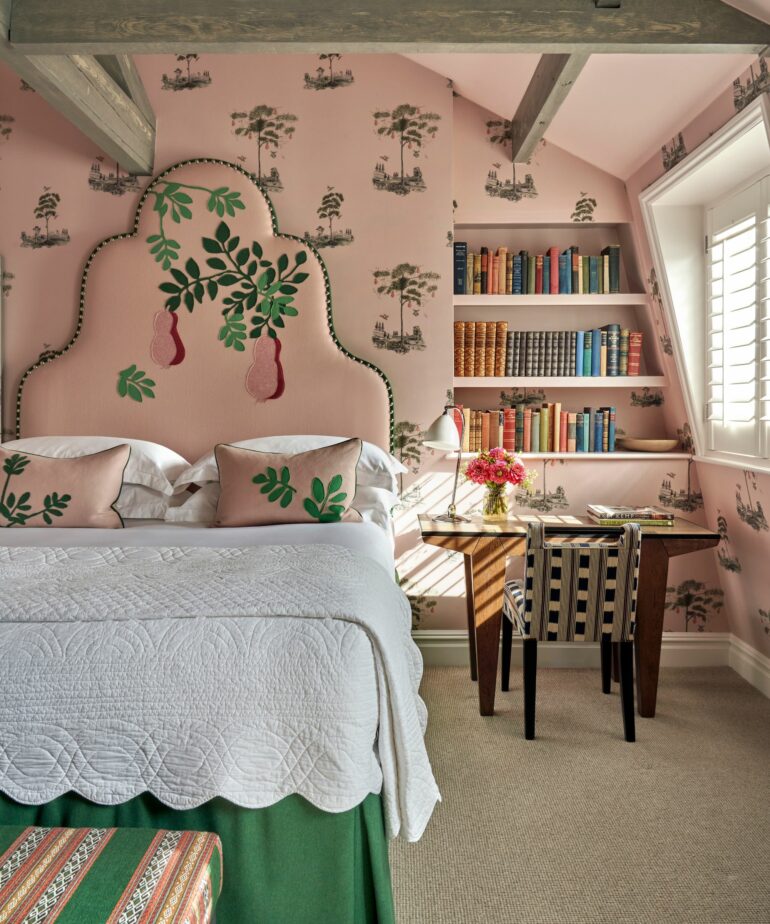
This desire for a sense of rootedness is not achieved solely through plaster and wood; it finds its natural extension in textiles. In the great decorative tradition across the Channel, fabric and wallpaper have never been relegated to the status of mere accessories. They structure the spaces, absorb light, and correct a room’s imperfections. They build the space while adorning it.
It is precisely on this fine line that Rosemary Hallgarten’s brand positions itself. Since its founding in 2001, the company has built its identity on the enduring quality of materials. From its headquarters in Norwalk, and bolstered by its strategic showrooms—one in New York, the other housed at Worlds End Studios in London’s Chelsea neighborhood—the company physically embodies this dialogue between the American continent and the British capital.
The designer’s approach is rooted in ongoing support for the techniques of indigenous artisans, drawing on ancestral craftsmanship in Peru, Brazil, and Nepal, with a clear commitment to sustainability. This obsessive attention to texture and the way natural light catches on a surface is evident in her recent wallpaper collections, named Ombré, Nara, and Tottori. The Tottori design, for example, takes tactile sophistication to its peak: born from the reinterpretation of an archival sketch, it intertwines the natural roughness of raffia with the extreme softness of curly alpaca, all enhanced by extremely fine gold threads that catch the eye and add depth to the wall. Offered for sale by the yard and subject to minimum order quantities, this type of product serves as a reminder that material poetry is always accompanied by its own administrative and logistical constraints. Natural fibers—whether used to adorn historic walls or radical contemporary architecture—require an intimate understanding of how they behave in space.

A New Geography of Professional Exchanges
While materials and architecture weave the threads of this transatlantic dialogue, ideas, for their part, need platforms to circulate. Unlike in an era when everything was decided behind closed doors in the hushed circles of Mayfair and the Upper East Side, the market’s geography has expanded considerably, shifting its centers of gravity toward sometimes unexpected crossroads.
The buzz surrounding Texas Design Week Dallas demonstrates just how uninhibited the conversation between British and American design elites has become. Texas has become a major hub, a place where commerce, hospitality, and publishing intertwine without any awkwardness. The event’s official program reads like a barometer of current influences: it features leading figures such as Kit Kemp, the future of the decorative arts is debated in in-depth panel discussions, and attendees gather for book signings or deliberately laid-back networking mornings, punctuated by the famous “Morning Mimosas.”
The announced presence of Claire German, who heads the Design Centre at Chelsea Harbour in London, as well as the closing address entrusted to Alidad, confirm that British institutions are now seeking out their partners right in the heart of the American market. The organization itself embraces a certain flexibility: as the program notes, the schedules are subject to change at any time. An almost amusing caveat, revealing a microcosm where the art of presentation, the importance of hallway encounters, and the demands of prestige very often take precedence over strict punctuality.
Ultimately, the intensification of this back-and-forth between the two cultures is shaping a new demand. Whether discussing trends over a drink in Dallas, weaving threads of gold and alpaca between Peru and Chelsea, or scraping the walls of a Georgian residence to rediscover its original spirit, the ultimate goal is the same. The splendor of accumulation, long prized, is slowly fading. The current era now favors a form of intellectual and aesthetic integrity: one that seamlessly aligns the history of a place, the artisan’s craft, and the reality of those who inhabit it.