Make Texture a preferred source on Google to support us
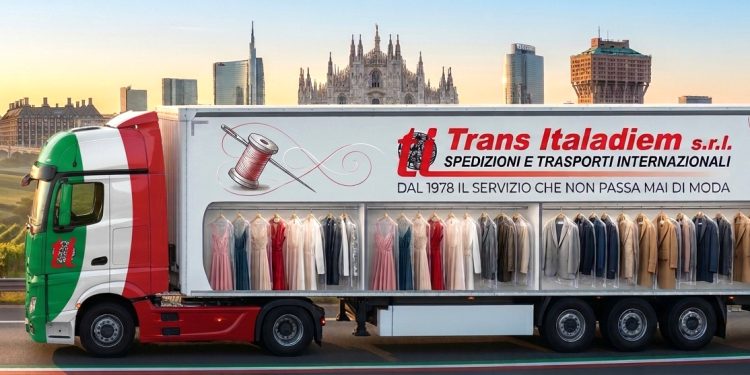
Add Texture to GoogleOne million garments transported on hangers: this figure reveals a side of the fashion industry that runways rarely show. Before reaching a store, each piece must travel without the shipping process compromising the work done earlier in the process. This attention to the garment’s condition is one of Trans Italadiem’s long-standing specialties. The Milan-based company reports having shipped more than five million luxury items worldwide, including this million hanging garments. Behind these volumes lies a specialized craft, at the intersection of the product and its commercial presentation.
The Hanger: A Professional Choice
It would be tempting to focus solely on the truck. The real focus, however, is what it contains—and how these goods must reach their destination. A garment on a hanger requires a different approach than a product where only the physical movement matters. At Trans Italadiem, this delivery method is rooted in time-honored expertise. It reflects an operational conviction: the characteristics of the item must guide the organization of transport, rather than taking a back seat to it.
This commitment extends throughout the entire supply chain. The material, the quality of craftsmanship, and a brand’s identity all contribute to an item’s value; price alone is not enough to describe it. For the carrier, understanding this value means taking the product’s requirements into account all the way until it reaches the retail channel. Logistics thus becomes one of the industries that enables the fashion sector to maintain consistency between manufacturing and distribution.
Trans Italadiem has chosen to limit its operations to fashion and cosmetics, specializing in accessories and fragrances. This deliberately narrow scope defines its services: they are designed to meet the specific needs of these sectors, rather than as a generic, undifferentiated offering. The company has built its growth on this expertise since its founding in Milan in 1978.
From Milan to the French boutique
The company’s geographic footprint illustrates the practical scope of this positioning. Its operational network directly serves twenty European countries. In France, it relies on its subsidiary Trans Fashion, which has offices and logistics hubs in Chambéry, Paris, and Nice. Other European markets are covered through qualified partners. The company’s international presence thus relies on various organizational structures, depending on the region.
But a map tells only part of the story. Delivering to an international department store, a boutique, or a trade show requires an understanding of how each distribution channel operates. Trans Italadiem also serves showrooms. While these destinations all belong to the fashion world, they do not form a uniform whole: delivery must be tailored to the location receiving the goods and to the customer’s needs.
This is where specialization comes into play. It applies as much to the recipients as to the products. Between a factory and a retail location, door-to-door service must ensure continuity while taking into account the specific characteristics of the distribution process. A carrier’s competence is therefore judged by its ability to navigate these constraints, not just by the size of its network.
Delivery doesn’t end with unloading
The scope of services extends far beyond the journey between two addresses. Trans Italadiem handles the transport of raw materials to manufacturing facilities and manages customs formalities in-house. The company is thus involved at various stages of a product’s journey, both before and after its manufacture. This breadth of service ensures that its role is not limited solely to the shipment of finished goods.
At the other end of the chain are repackaging and window-display setup services. This last point deserves attention: it brings an activity typically associated with warehouses closer to the space where a brand presents itself to the public. Transportation and presentation remain two distinct professions, but the company’s services establish a practical continuity between them. The delivered product must also be able to fit seamlessly into the retail setting for which it is intended.
Returns management rounds out this package. The process is therefore not viewed solely as a one-way journey from shipment to sale. For tracking, the company uses dedicated software and offers online management of proofs of delivery. Comprehensive insurance is also part of its services. These administrative and contractual tools are less visible than a vehicle, but they contribute to the quality of the service provided.
Protecting Without Confusing Resources and Promises
Within this organization, security has its own dedicated equipment. Vehicles are equipped with anti-intrusion devices and satellite tracking systems. Trans Italadiem also announces the arrival of new vehicles whose trailers will be equipped with interior cameras. It is important to distinguish between what has already been deployed and what is planned: onboard surveillance has yet to be enhanced with this additional capability.

These systems address a key challenge in the transport of luxury goods: safeguarding the merchandise during transit. Insurance falls under a different category—that of risk coverage. The two approaches complement each other without replacing one another. Combining them into a single offering demonstrates just how many dimensions delivery encompasses, beyond its physical execution.
Security is one of the four principles championed by the company, along with specialization, the quality of customer service—summarized by a smile—and sustainability. Behind this corporate rhetoric, the most telling elements remain the verifiable measures: an anti-intrusion system, a tracking tool, and customs formalities handled in-house. It is on this concrete ground that an organization is measured.
A family-owned business, a direct relationship
The Piscitilli family has been with Trans Italadiem since its inception. Luca Piscitilli is currently the CEO; he also chairs Trans Fashion in France. This family continuity is part of the company’s identity, which combines its service model with attentiveness and flexibility in its interactions with clients.
The value of this approach lies in the ability it provides to tailor solutions. A brand has specific distribution needs and expectations; the service provider must build its response around them. The direct contact emphasized by Trans Italadiem is part of this philosophy. It provides a single point of contact for a chain of operations that involves transportation, documentation, insurance, and complementary services.
The transition is also reflected in the documentation
On the environmental front, the company highlights several distinct initiatives. Part of its fleet uses alternative fuels. Electric vehicles are used for urban deliveries. In addition to these transportation developments, a new management system has been implemented for the digital archiving of documents, with the goal of eliminating paper.
This information describes the measures that have been implemented, without providing quantified data on their impact. It therefore does not allow us to conclude that the business transformation is complete. Its value lies instead in its diversity: vehicles are not the only lever being used; office procedures are also part of the initiative.
The proof of delivery, which can be viewed online, and digital archiving thus highlight a less visible aspect of the business. Documentation accompanies every product. After organizing the journey of the garment on its hanger, the next step is to streamline the flow of the accompanying paperwork.