Make Texture a preferred source on Google to support us
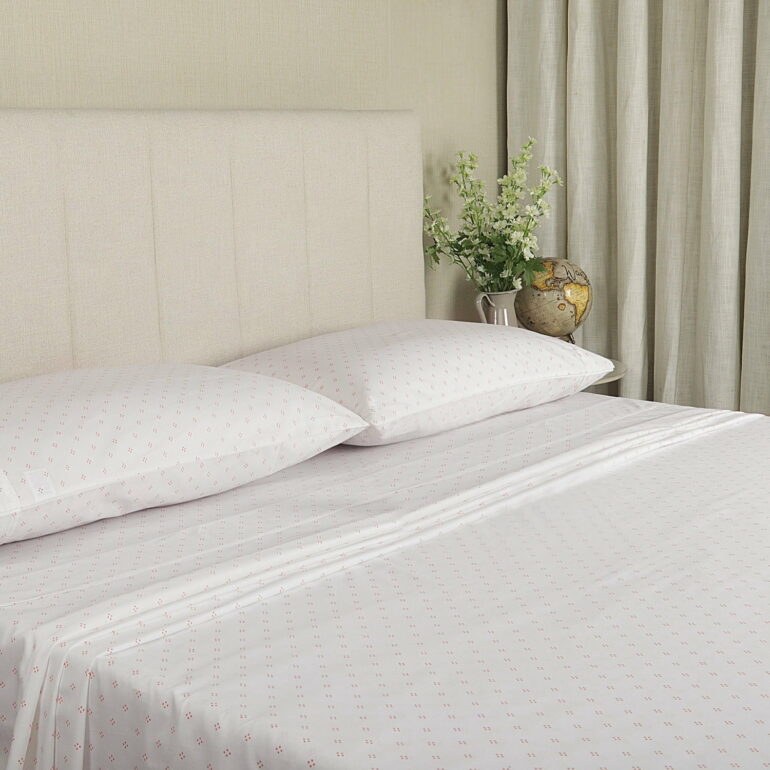
Add Texture to GoogleIn the hushed world of luxury hospitality, perfection has a color: a surgical white—ethereal, almost intimidating. Yet behind the prestige of the five-star rating lies a far less glorious material reality—that of obsolescence brought on by touch and sight. When a sheet loses a hint of its original softness or a bath towel can no longer claim absolute whiteness after repeated wash cycles, these textiles—though once luxurious—are taken out of circulation. It was this realization—born of direct observation in the field—that prompted Emma Efmorfidi, a 33-year-old entrepreneur well-versed in the inner workings of the hospitality industry, to question the final destination of these mountains of cotton and linen. The conclusion was clear: astronomical quantities of linens were being discarded simply because they no longer met the aesthetic standards of a high-end clientele.
This question found a concrete answer in 2023 in Athens with the launch of This Was a Sheet. Founded by Emma Efmorfidi and her husband, Odysseas Ioannidis—an environmental engineer by training—the company has made it its mission to break the cycle of hotel waste. By combining one’s technical expertise with the other’s industry insight, the duo transformed a logistical challenge into a circular design project. The idea is no longer to hide waste, but to repurpose it publicly, turning old bed linens into the raw material for new textile pieces intended for everyday use in luxury establishments.
An artisanal workshop in northern Athens
It is in the Kifissia neighborhood, north of the Greek capital, that the venture takes physical shape. Far from industrial, standardized production lines, This Was a Sheet operates out of a small-scale workshop where eight artisans work. Here, the slow pace of life takes center stage: the entire process, from receiving the raw material to delivering the finished product, takes three to four weeks. This timeframe isn’t the result of sluggishness, but rather of the meticulous care essential to transforming materials that have already served their purpose.
The work begins with collection. The startup has built an impressive network, collaborating with more than 120 hotels throughout Greece, as well as with select industrial laundries. Some hotels send their decommissioned linens directly, while others rely on cleaning intermediaries to transport these tons of textiles to Kifissia. Once there, the linens are sorted, cut, sewn, and dyed. Production is done exclusively on a made-to-order basis, transforming old sheets into staff uniforms, room slippers, or laundry bags. This custom approach allows the company to precisely meet the needs of each establishment while avoiding overproduction.
The Challenge of Dyeing and the Aesthetics of the Unique
One of the most complex aspects of this transformation lies in the dyeing process. Unlike conventional ready-to-wear clothing, which uses rolls of new, uniform fabric, Emma Efmorfidi and her team work with fibers that have undergone hundreds of washes. This uneven wear alters how pigments are absorbed. The very composition of the sheets varies from one hotel to another, blending cotton, linen, or synthetic fibers in different proportions. The result is a collection in which no two pieces are exactly alike. The color shades vary subtly from one garment to the next, creating an aesthetic of variation rather than repetition.
Accepting—and, better yet, celebrating—this imperfection has been one of the greatest challenges for luxury hoteliers, who are accustomed to total control over their brand image. Emma Efmorfidi fully embraces this approach: the goal is not to compete with the impeccable, seamless uniforms from traditional channels, but to offer a narrative alternative. By connecting two of the world’s most polluting industries—fashion and hospitality—This Was a Sheet redefines luxury, prioritizing traceability and environmental impact over visual uniformity.

Education Through Objects
The company’s name is not just a brand identity; it’s a political and educational message. To ensure the initiative isn’t confined to corporate social responsibility (CSR) reports buried deep within hotel websites, the brand has opted for radical visibility. The phrase “This Was a Sheet” is prominently printed on the backs of the uniforms worn by hotel employees. This choice transforms every staff member into an ambassador for the circular economy.
The effect on guests is immediate. Upon reading this message, guests ask questions, strike up conversations, and discover the origin of what they see. This transparency transforms a simple work uniform into a topic of discussion, making a sustainability policy tangible—one that might otherwise seem abstract or purely a marketing ploy. For hotel owners, it’s a way to demonstrate a genuine and measurable commitment, far removed from superficial “greenwashing.” The fabric becomes a living communication tool, bearing witness to the second life given to an item that, just a few weeks earlier, was still wrapping travelers in comfort as they slept.
A Nationwide Environmental Equation
To understand the scale of the task, we must examine the figures underlying the Greek tourism industry. In 2024, an estimated 305,800 towels were discarded across the country. The average lifespan of a hotel sheet in Greece is approximately 250 washes. Beyond this threshold, the fabric’s mechanical and visual properties are deemed insufficient for direct use by guests. This Was a Sheet steps in precisely at this breaking point. To date, the startup has already managed to save 30,000 towels and 10,000 sheets from landfills or incineration.
These statistics are not merely indicators of success for a young company; they highlight a profound shift in resource management within a major tourist destination. By diverting these significant volumes from the waste stream and reintroducing them into the local economy as high-value-added products, the initiative offers a model of resilience. The success of This Was a Sheet rests on its ability to demonstrate that waste is simply a resource that has not yet found its new purpose. By giving new purpose to the hotel industry’s waste, Emma Efmorfidi and Odysseas Ioannidis prove that the luxury of tomorrow may no longer be defined by what is new, but by what has been preserved with intelligence and style.