Make Texture a preferred source on Google to support us
Add Texture to GoogleIn the summer of 2026, on the sidelines of Paris Haute Couture Week, the Buccellati house unveiled its new fine jewelry collection, named Serenissima. This name, a direct homage to the former Republic of Venice, is more than just a geographical reference. It signifies a specific intention: to translate the extreme delicacy of Venetian lace—and more specifically, that of Burano lace—into the solidity of gold. On this island in the lagoon, needle lace is traditionally crafted with a patience bordering on asceticism—a philosophy that the Milanese workshop, founded in 1919 and now part of the Richemont Group, has cultivated since its inception under the guidance of Mario Buccellati.
The Geometry of Emptiness and the Honeycomb
The beating heart of the collection lies in the openwork technique, also known as “honeycomb” or tulle. The goal is to transform a sheet of 18-karat gold into a polygonal mesh of absolute regularity. To achieve this, the artisan pierces the metal by hand using a bocfil, a miniature saw. Each cell thus created undergoes meticulous treatment: it is manually reworked with the saw at least five times to perfect its geometry. This process of removal renders the metal almost immaterial, leaving only a gold skeleton capable of supporting the gemstones without weighing down the design.
This mastery is enhanced by a historical variation introduced by Gianmaria Buccellati: the Radial Honeycomb. Inspired by the rose windows of Italian Renaissance churches, notably those of Santa Maria Novella and Santa Maria del Fiore, this technique arranges the openings in stylized rays. This centrifugal arrangement of negative space lends an architectural dynamism to the pieces, serving as a reminder that the house’s jewelry draws its roots from a classical visual culture where symmetry and proportion dictate beauty.
The Art of Renaissance Engraving
While the structure of the jewelry is based on negative space, its surface is the canvas for engraving work that seeks to mimic the texture of fabric. The entire visible surface of the pieces is hand-engraved; only the reverse side is given a traditional high polish. Several signature techniques are employed here. The Rigato technique involves incising parallel micro-grooves using a chisel. This treatment creates a satin-like effect that diffuses light, reminiscent of the grain of a silk thread.
To create relief, the artisans use Modellato, a three-dimensional chiseling technique that allows them to depict botanical motifs—such as foliage or catkin borders—with naturalistic precision. These finishes are complemented by the techniques of “colpi di lucido,” “segrinato,” and “telato,” which play on the contrasts between matte areas and polished surfaces. Yellow gold and white gold, often used in a two-tone design, thus serve as the canvas for an ornamental narrative in which every square millimeter is textured.
An Architecture of Stones and Modularity
The Serenissima collection features necklaces, flexible bracelets, bangles, and earrings. Some of these pieces feature a modular design, allowing certain elements to be detached to create different looks. Among the standout pieces is an exceptional tiara that showcases the intricacy of the craftsmanship: it features 512 brilliant-cut diamonds and 11 pear-shaped (drop-cut) diamonds, set in a structure that appears to float above the face.

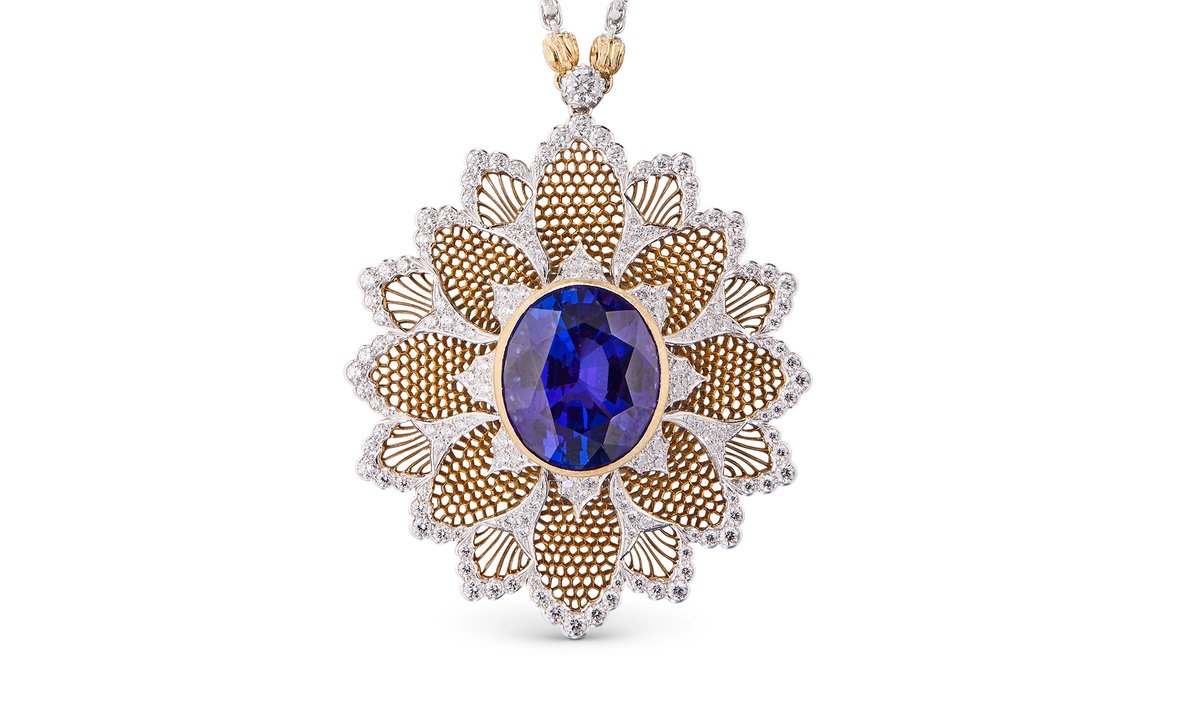
Another focal point of the collection is an articulated necklace whose central pendant is adorned with a tanzanite. This stone, surrounded by two-tone gold and a constellation of brilliant-cut and rose-cut diamonds, is arranged in garlands and floral motifs. The use of the rose cut—older and more understated than the modern brilliant cut—reinforces the collection’s historical aesthetic by offering softer reflections that complement the engraved surfaces of the gold.
The Timeless Nature of Artistic Craftsmanship
The creation of such pieces demands a pace radically different from that of industrial jewelry production. At Buccellati, the design and manufacturing cycle for a high jewelry collection spans a period of at least two years. This slow pace is dictated by the rarity of the skills required. Future artisans are selected upon graduation from Italian art and design schools, but they are not considered fully qualified until after a period of in-house training lasting approximately eight years.
The amount of labor required to create a single section of dense tulle illustrates this exacting standard: it takes approximately 40 hours of chiseling with a chisel alone to complete a small panel. It is this technical intensity that explains the distribution model chosen by the house. The pieces in the Serenissima collection are one-of-a-kind or made to special order. They are not sold online and are presented exclusively in the brand’s private salons and boutiques, with prices provided only upon request.
Behind the sparkle of the diamonds, the collection embodies the memory of a Venetian tradition whose origins, according to oral tradition, date back to the fishermen’s wives of Burano, who are said to have invented needlework while seeking to reproduce the fineness of the mesh in their fishing nets. Whether this anecdote is folklore or historical fact, it finds a concrete expression in contemporary goldsmithing, where the metal ultimately transcends its own rigidity.