Make Texture a preferred source on Google to support us
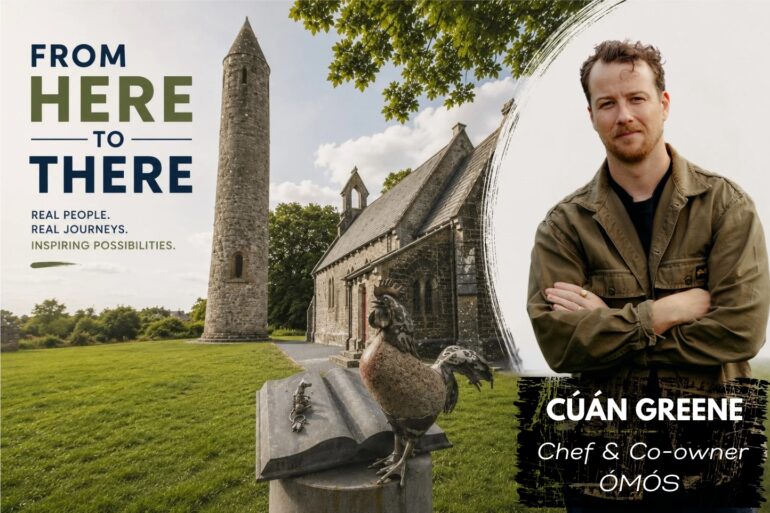
Add Texture to GoogleJust a stone’s throw from the small town of Abbeyleix, in County Laois, the Irish landscape is enriched by an experience that defies hasty labels. Ómós—a Gaelic term meaning “homage” or “respect”—opened its doors last July, not merely as a hotel, but as a manifesto for an Ireland that is reinventing its hospitality. At the helm is Cúán Greene, 34, who honed his skills in the demanding kitchens of Noma in Copenhagen and has traded the hustle and bustle of capital cities for the depth of the countryside of his childhood. This project, which combines sixteen guest rooms and a restaurant seating forty, was born out of a desire to restore the prestige of the traditional “guesthouse,” a type of lodging that was once a mainstay of rural life but is now threatened with extinction in favor of more standardized accommodations.
It’s a complete leap into the unknown for the young chef. While the project may seem bold, it is backed by a solid financial structure and a radical aesthetic vision. Among the seven investors who made this venture possible are John Collison, co-founder of the fintech company Stripe, and Sam Dennigan, creator of the food brand Strong Roots. This marriage of tech, the food industry, and haute cuisine could have resulted in a soulless place; but the exact opposite has happened. Under Greene’s leadership, Ómós has established itself as a long-term laboratory, far removed from the fleeting trends of international design, and rooted in a raw and sincere materiality.
Architecture of Endurance
The beating heart of the establishment lies in Millbrook House, a former Victorian residence once intended for the steward of the Abbeyleix estate. Left to decay for decades, this 18th-century mansion required three years of titanic restoration work to regain its former splendor. The challenge was immense: to transform a listed ruin into a discreet luxury sanctuary while constructing a new building to house the kitchens and dining room. To orchestrate this transformation, Greene brought together an unconventional creative trio: Dublin-based architect Ryan W. Kennihan and the Danish interior design studios Asca Studio and Relief Gallery.
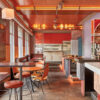
Ryan Kennihan drew on the vernacular language of Irish rural architecture to design an extension that seems as though it has always been there. The guiding principle was not to copy the past, but to build for the next two centuries. This quest for permanence is evident in every material choice. On the floor, Kilkenny limestone brings a mineral freshness, while the ceilings reveal a fascinating technical detail: acoustic panels designed by the Danish firm Søuld, made from eelgrass. This organic material creates a hushed atmosphere—essential to the serenity of the space—while establishing a tactile connection with the natural environment.
The artisan’s touch as a unifying theme
What sets Ómós apart from a conventional luxury hotel is the omnipresence of the artisan’s touch. No fewer than one hundred local designers and artisans were commissioned to furnish the spaces. You won’t find any off-the-shelf furniture here. Every chair, every textile, and every work of art tells a story of the region. The dining room tables were crafted from oak sourced directly from the estate’s woods, while the tableware is the work of Fermoyle Pottery, a renowned workshop in County Kerry. This attention to detail borders on the personal: the bedside glasses in the rooms were mouth-blown by Róisín de Buitléar, a renowned glass artist who is none other than the chef’s mother.
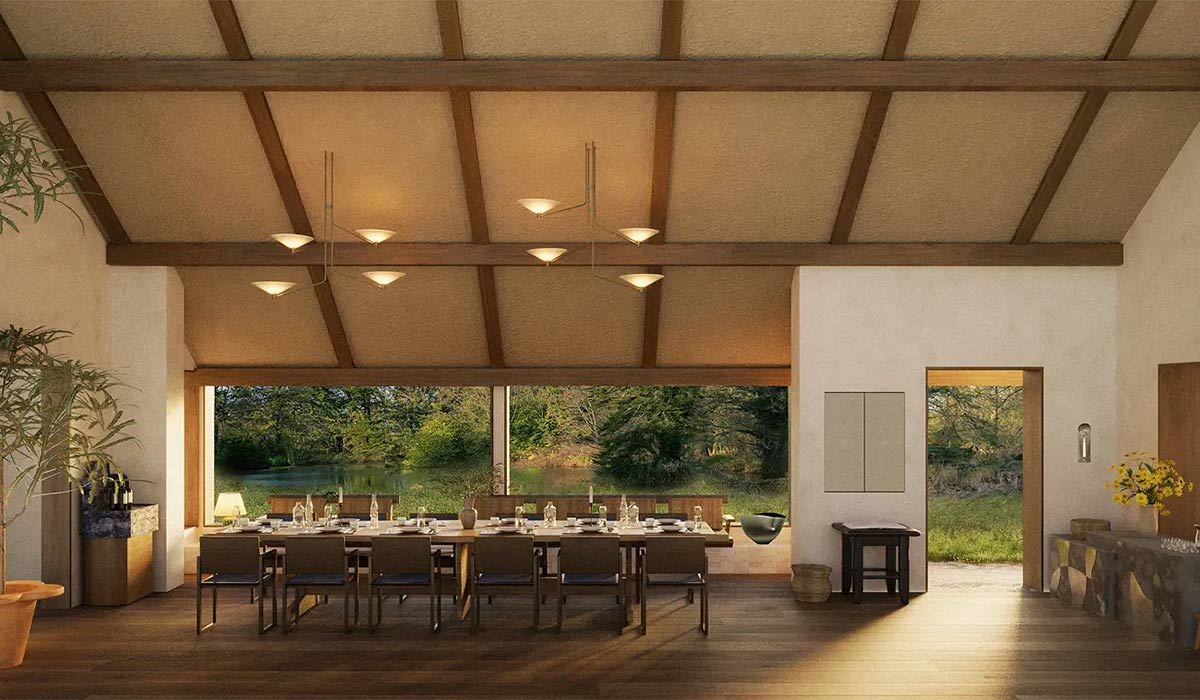
The aesthetic experience extends into the house’s library, where two thousand books have been arranged throughout the bedrooms and living rooms. There’s no impersonal selection here: each title was recommended by a member of the staff, creating a silent conversation between the guests and those who bring the house to life every day. The rooms themselves embody a warm, uncluttered style, where the precision of Scandinavian design meets the softness of Irish wool. Upon leaving Millbrook House, guests pass through a series of inner courtyards with exposed stone walls, linking the Victorian past to the modernity of the dining room, which opens generously onto a peaceful pond and a vegetable garden.
A Cuisine Rooted in the Moment and the Place
Cúán Greene’s journey is inextricably linked to the origins of Ómós. Upon his return to Ireland in 2019, even before laying the restaurant’s foundation stone, he launched a weekly newsletter that has become a go-to resource for food culture enthusiasts. This theoretical exploration of ingredients and culinary ethics has now taken physical form. The tasting menu is an exploration of local resources, but filtered through techniques gleaned during his travels, from Mexico to Thailand. The exoticism lies not in the ingredients—most of which are sourced locally or from the immediate vicinity—but in the way they are elevated.
The bread is made from heirloom grains and served with local butter that evokes the richness of the pastures of Laois. Meats are smoked, aged, or dried on-site, while produce from the garden sets the pace for each course. For dessert, Greene enjoys reinterpreting childhood memories, such as this variation on the famous Viennetta ice cream, where fig leaves, meadowsweet, and wild blueberries replace artificial flavors. For guests staying at the guesthouse, the experience continues at breakfast, a moment of absolute tranquility overlooking the reflecting pool of the old mill.
The Impact on a Village
The opening of Ómós is not limited to creating a destination for discerning foodies; it marks the beginning of a new dynamic for Abbeyleix. The town, once merely a stop along the way, is now welcoming a new generation of visitors drawn to this modern vision of Ireland. Sam Dennigan, one of the investors, points out that the country’s overall image remains too often trapped in outdated clichés. With Ómós, the goal is to prove that rural excellence can be both economically viable and culturally cutting-edge.
The project is already boosting the local economy, both through job creation and increased tourism. Guests are encouraged to explore the surrounding area, stroll along the estate’s forest trails, or stop by Morrissey’s—a historic pub that also serves as a grocery store—to enjoy a pint of Guinness in an atmosphere that has remained unchanged. Cúán Greene, who now lives nearby, makes no secret of his future ambitions: plans to open a wine bar or a fine-food shop in the village are already under consideration. For now, the chef is focused on ensuring the long-term success of his restaurant, aware that the success of such a venture depends as much on the quality of his cuisine as on his integration into the community. As he himself points out, while Abbeyleix technically has the status of a town, the success of such a venture rests above all on a village spirit.
Discover more about the project at omos.co.