
Make Texture a preferred source on Google to support us
Add Texture to GoogleAt Heuer, the sea came before the racetrack. Long before the Carrera and the Monaco established the brand’s image as one dedicated to racing chronometers and instrument panels, a watch sought to make the combined movements of the sun and the moon easy to read. Its name, Solunar, evokes not so much speed as the best times for fishing, hunting, and setting out to sea. It is a discreet chapter in the brand’s history, but one that reveals a particularly fitting facet of the company: that of a family-run business capable of transforming a very practical problem into a wristwatch mechanism.
A Watch Born from an American Question
The story begins in 1947 with a request made by Walter Haynes, president of Abercrombie & Fitch. At that time, the American brand was not yet the mass-market clothing retailer it would become. It catered to a clientele accustomed to the great outdoors, including Charles Lindbergh, Ernest Hemingway, and Theodore Roosevelt. A watch that tracked tidal rhythms was therefore no mere technical whim: it served a specific purpose—that of people who actually went fishing, sailing, or hunting.
Charles-Edouard Heuer received this unusual commission without having in-depth knowledge of the tides. The watchmaker was an expert in chronographs, but the phenomenon he was asked to capture went beyond time measured in seconds and minutes. His son Jack, then 15 years old, entered the picture. He sought the help of his physics teacher, Dr. Heinz Schilt. The calculations, gear ratios, and mechanics required for this function were developed from there.
The Solunar was launched in 1949. For Jack Heuer, this marked his first documented contribution to the company he would go on to lead for two decades. This episode stands in stark contrast to the brand’s usual narrative, which is often reduced to paddocks, rallies, and drivers. Before forging an identity tied to motorsports, Heuer addressed another form of precision: that demanded by natural cycles.
The Sun, the Moon, and the Time When the Fish Bite
The Solunar does not claim to provide a tide table in the nautical sense of the term. It stems from a theory developed in 1926 by the American John Alden Knight, who published his Solunar Tables ten years later. His idea is based on the combined influence of the positions of the sun and the moon: at certain times, fish and game are said to be more active and therefore easier to find.
Before the watch was invented, this system was consulted in lengthy written tables. Heuer condenses this information into a device just a few centimeters in size. Beneath an opening at the 6 o’clock position, a colored disc rotates and adjusts according to the wearer’s local coastline. The goal was not to replace all knowledge of the sea, but to eliminate the need to carry a manual and make the information immediately available on the wrist.
This streamlining of movement foreshadows, in an unexpected form, the brand’s future innovations. Placing useful information right before the eyes, eliminating the need for a notebook or mental calculations, and providing a quick read in the heat of the moment: the logic is already there. It would later find expression on rally dashboards with timing instruments, but it first served fishermen.
The Solunar’s current rarity contributes to its unique status. Production volumes are not known with certainty. Well-preserved examples appear to be few and far between, and the watch has long been overshadowed by the aura of models associated with the automotive world. Yet it captures the reality of Heuer in 1949 better than many other models: a company still run as a family business, willing to solve complex measurement problems whenever a customer had a need for them.
From the Fisherman to the Deck of a Sailboat
The first Solunar did not remain alone for long. In the early 1950s, Heuer expanded on the concept with the Seafarer, initially marketed in the United States. In Europe, the watch was named the Mareograph. This was a decisive change: the Solunar function was now accompanied by a chronograph and a direct readout of two high tides and two low tides via the counters.
This evolution also expanded the watch’s scope. It was no longer just about identifying a favorable window for fishing or hunting, but about meeting the needs of recreational boating and regattas. The 30-minute counter is divided into five-minute segments to track the countdown leading up to the start of a sailing race. This detail alone makes it clear that the chronograph is not merely an aesthetic enhancement: its scale was designed with the crew’s needs in mind.
Within this lineage, the Seafarer bridges two worlds that are often presented as separate. On the one hand, the cyclical information related to the coastline and the moon; on the other, sports timing, the tension of the final minutes before the starting gun, and the organization of a regatta start. Heuer finds here a realm where watchmaking technology serves neither to decorate a dial nor to accumulate complications, but to keep pace with a precise rhythm.
The Journey of a Collector’s Piece
For collectors, the original Solunar requires patience. Its value starts at around 4,000 British pounds, depending on its condition. Exemplars offered by specialists, when in particularly pristine condition, generally exceed the 6,000-pound mark. The market therefore demands particular attention to detail, especially since the name “Solunar” was reused in the 1970s.
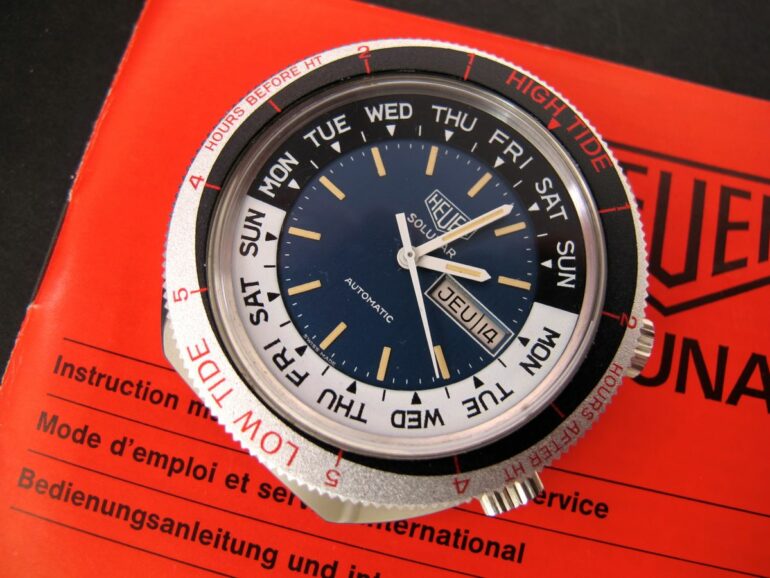
This second Solunar, reference number 279.603, does not share the same historical lineage. It is an automatic watch with a day-date display and a rotating bezel designed for tracking the tides. It appears more frequently on collector platforms and specialized forums, with prices around 3,000 pounds. Confusing the two generations would mean losing sight of what gives the first its cultural value: its unique place in the postwar era and its direct link to the calculations of Jack Heuer and Dr. Heinz Schilt.
The value of the Solunar, therefore, does not stem solely from its rarity. It lies in a way of conceiving watchmaking as a context-specific instrument. A diving watch evokes immersion; a racing chronograph speaks of speed; the Solunar, however, implies a shoreline, local time, and the observation of an activity dependent on the sky. Its dial conveys a sense of the outdoors that is anything but decorative.
The Return of the Tide in the Carrera
Functionality isn’t confined to display cases. In 2024, TAG Heuer relaunched the Seafarer as a limited edition of 968 pieces—a number chosen in reference to the 1968 2446C model that inspired it. Two years later, in 2026, it became a permanent part of the Carrera collection in a version that is no longer limited.
The tide indicator returns to its traditional position at nine o’clock. The teal shade chosen for this interpretation is named “Intrepid,” after the sailboat that won the America’s Cup in 1967 and again in 1970. During its victorious 1967 campaign, its times were measured using Heuer chronometers. The circle is nearly complete: from the early solar-lunar watches to the regattas, and then to the contemporary Carrera.
Nearly eight decades after the first calculations of gear ratios, the principle remains the same: to provide the wearer with a time indication derived from the movement of the stars, this time integrated into a movement specifically designed to accommodate it. In the history of a brand celebrated for the roar of engines, the Solunar thus retains its quiet strangeness. It serves as a reminder that before measuring speed, Heuer had learned to read the tides.