Make Texture a preferred source on Google to support us
Add Texture to GoogleThe global art market has its eyes fixed on New York this November 2026. At Christie’s Rockefeller Center, the opening night of the 20/21 Fall Marquee Week delivered a mixed verdict, blending historic records with obvious caution. While the total sales figure came in at $626,621,400 (approximately 594 million euros), this result falls at the lower end of the initial estimates, which ranged from $511 million to $743 million. Behind the dazzling figures, a more nuanced reality is emerging: that of an extremely selective market, where absolute masterpieces sell for sky-high prices while works by leading artists struggle to find buyers at premium prices.
Wassily Kandinsky’s Meteoric Rise
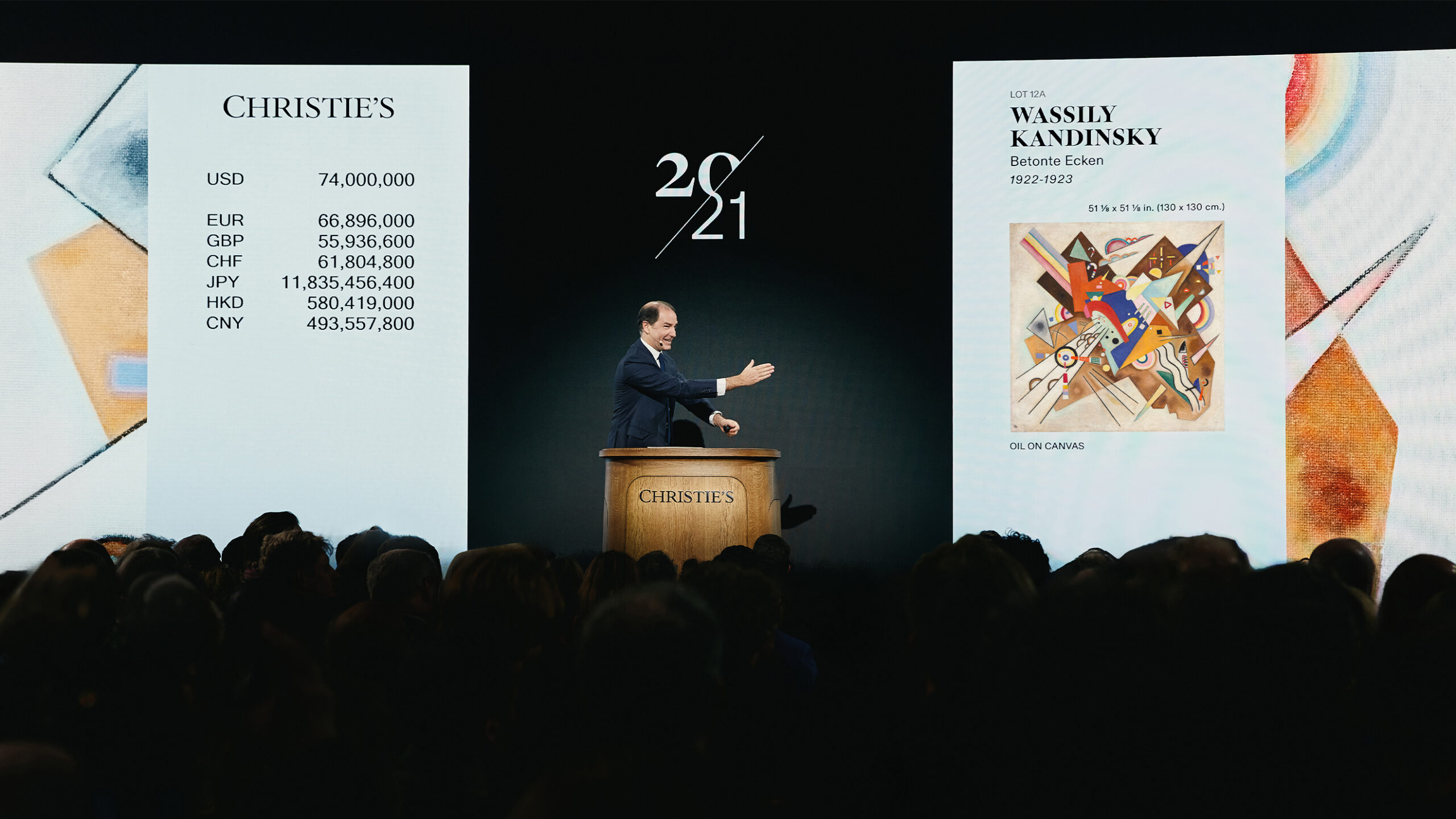
The highlight of the evening was undoubtedly the new record set by Wassily Kandinsky. His painting *Betonte Ecken* (*Accentuated Corners*), painted in Weimar between 1922 and 1923, sold for a final price of $85,780,000. This price, which includes fees, shatters the artist’s previous record, set at $44.8 million in 2023 by *Murnau mit Kirche II*. This square canvas, measuring 130 centimeters on each side and dating from the early Bauhaus period, embodies the maturity of the master’s geometric abstraction.
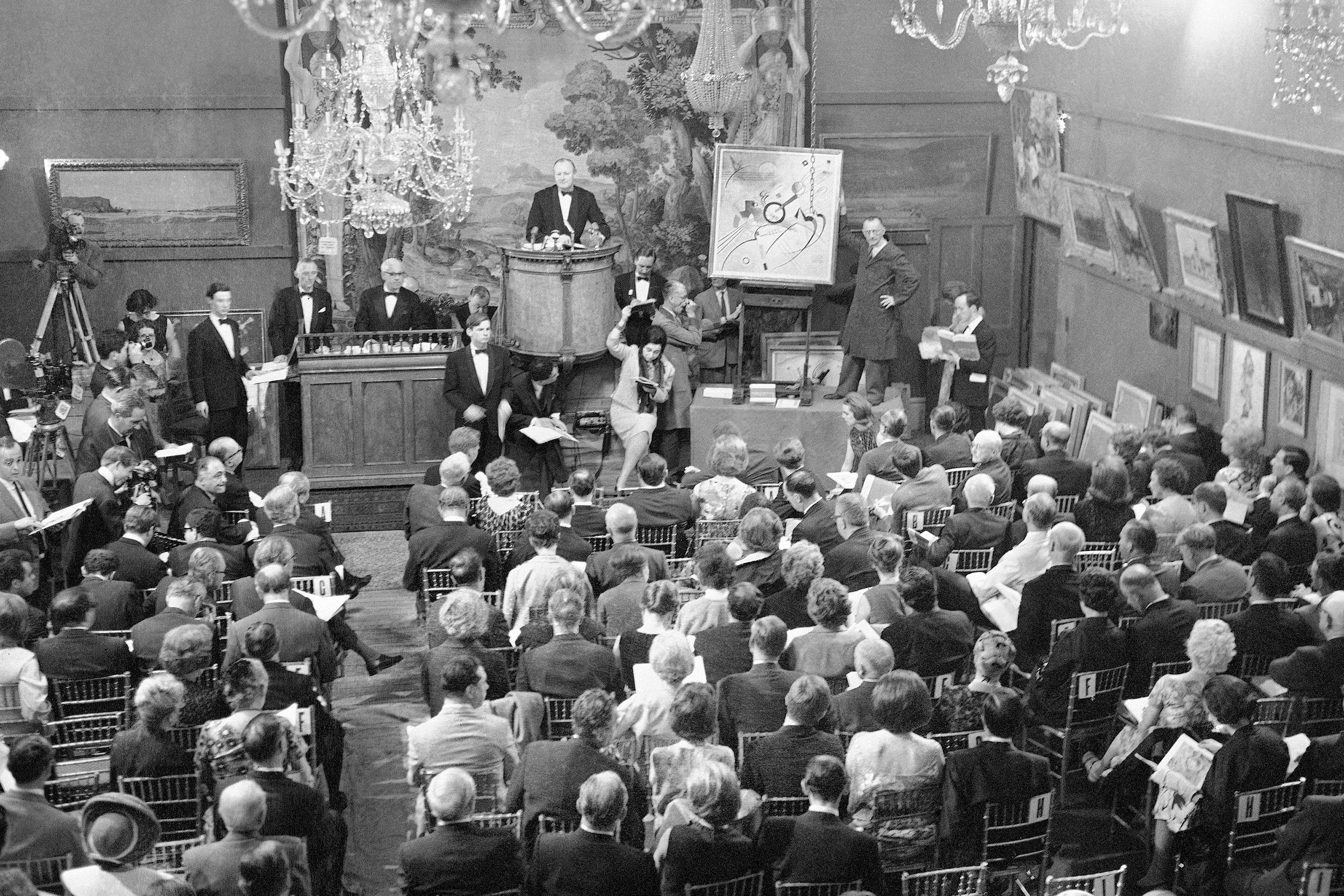
The history of this work is an odyssey through the major collections of the 20th century. Acquired in 1929 by Hilla Rebay, it was donated to the Solomon R. Guggenheim Foundation in 1941. In a notable turn in its provenance, the Guggenheim Museum parted with the work in 1964 for the paltry sum of 22,000 pounds sterling (approximately $62,000 at the time). After passing through the Stephen Hahn Gallery and the collection of Sandra and David Bakalar, the work reportedly entered the Nahmad family collection in 1986 for a hammer price of $1 million. Although this most recent ownership has not been officially confirmed by the auction house, the appreciation in value over the past forty years attests to the growing scarcity of major works from this period on the market. At the November 17 auction, following an opening bid of $54 million, three bidders competed before the painting was purchased by an anonymous telephone bidder, represented by Alex Rotter, the auction house’s global president.
Gustav Klimt and the Contemplation of the Attersee
Just a few minutes later, another masterpiece demonstrated remarkable strength. *Litzlbergkeller* (1915–1916), an oil on canvas by Gustav Klimt depicting the eponymous inn on the shores of Lake Attersee, sold for $82,330,000. True to his compositional style, Klimt used a telescope to capture the details of this architecture nestled in the Austrian countryside, creating a work that is both rich and dreamlike.
This landscape also boasts a prestigious pedigree, having been painted for Otto and Eugenia Primavesi. In 1997, during the auction of Serge Sabarsky’s estate, the painting had already set a record for the artist with a hammer price of $14.4 million. More recently, it had been on long-term loan to the Leopold Museum in Vienna. In New York, it took six minutes of bidding before the hammer fell at a price of $71 million (excluding fees), once again to an anonymous buyer whose identity remains confidential. You can view the artist’s history on the Gustav Klimt Database.
Greater Selectivity for the Great Masters
While Kandinsky and Klimt were the stars of the evening, together accounting for nearly 27% of the total sales, the rest of the catalog sometimes faced a lukewarm response from buyers. The most striking example is that of Pablo Picasso. His painting *The Kiss* (1969), from the personal collection of artist Jeff Koons, sold for $31.2 million. Although this figure is impressive, it remains well below the low estimate of $40 million. Jeweler Laurence Graff is cited by market observers as the likely buyer of this late work, although this information has not been officially confirmed.

Other notable results marked the sale, including a bronze by Alberto Giacometti, *Figure, Half-Size (No. 2)*, which sold without reserve for $26 million. Wifredo Lam also made history that evening with a new artist record for *Ogue Orisa*, which sold for $11.6 million. The Whitney Museum, for its part, took the opportunity to sell a work by Willem de Kooning, *Yellow River* (1958), which went for $11 million, including fees.
Signs of a Changing Market
The overall sell-through rate, at 92% of the lots, might suggest widespread euphoria. However, several “buy-ins” (unsold lots) cast a shadow over the auction. A set of seven small paintings by Jackson Pollock from the 1950s failed to find a buyer, as did a portrait of Beatrice Hastings by Amedeo Modigliani and a painting by Fernand Léger. These failures—rare for such artists—highlight that collectors are no longer satisfied with just a name but demand impeccable quality or a specific period.
Finally, logistics and regulatory constraints also played a role in the conduct of this auction. Several major works were withdrawn from the catalog shortly before the auction, notably pieces by Alexander Calder and Frank Stella. Even more notable was the withdrawal of Frida Kahlo’s *Congreso de los pueblos por la paz*, whose sale was suspended due to issues related to export permits. These last-minute adjustments underscore the growing complexity of cross-border trade for classified or sensitive works of art.
Ultimately, this evening at Rockefeller Center confirmed the resilience of the ultra-high-end market, capable of generating world records for historic works by Kandinsky or Klimt, while revealing bidders’ rigorous discipline in the face of auction houses’ sometimes overly ambitious estimates. The 20th-century art market is entering an era of discernment, where provenance and historical significance take precedence over opportunism.