Make Texture a preferred source on Google to support us
Add Texture to GoogleLondon’s monumental landscape, traditionally rooted in a martial and imperial celebration, is poised to undergo a major aesthetic and political transformation. In the fall of 2026, two major installations will challenge the dominance of male figures in the public space of the British capital’s city center. In Trafalgar Square, Tschabalala Self will unveil her *Lady in Blue* on the famous Fourth Plinth, while Nicole Eisenman will erect a vertiginous totemic structure within the prestigious Royal Academy of Arts. These interventions are not mere decorative additions; they serve as visual corrections in a city where public sculpture tells a singularly one-sided story.
A Structural Imbalance at the Heart of the City
To understand the significance of these new installations, one must examine London’s topography of memory. A survey conducted in October 2021 on the capital’s monuments reveals a startling statistic: of the approximately 1,500 monuments surveyed, only 4% depict women identified by name—a mere fifty or so statues. By comparison, named men account for 20.5% of all monuments and more than 79% of the statues dedicated to individuals. Even more troubling is the fact that London’s public spaces feature twice as many statues of animals (about 8%, or nearly 100 works) as of historical women. Representation is even lower for women of color, who account for only 0.2% of all statues, despite the presence of figures such as nurse Mary Seacole and resistance fighter Noor Inayat Khan.
In light of this, a political commitment to diversification has emerged. In June 2020, London Mayor Sadiq Khan established the Commission for Diversity in the Public Realm (Greater London Authority). Backed by a £1 million fund called “Untold Stories,” this initiative aims to support projects that better reflect the diversity of contemporary society and address the lack of visibility of historically marginalized communities.
Tschabalala Self: The Rise of the Ordinary Woman
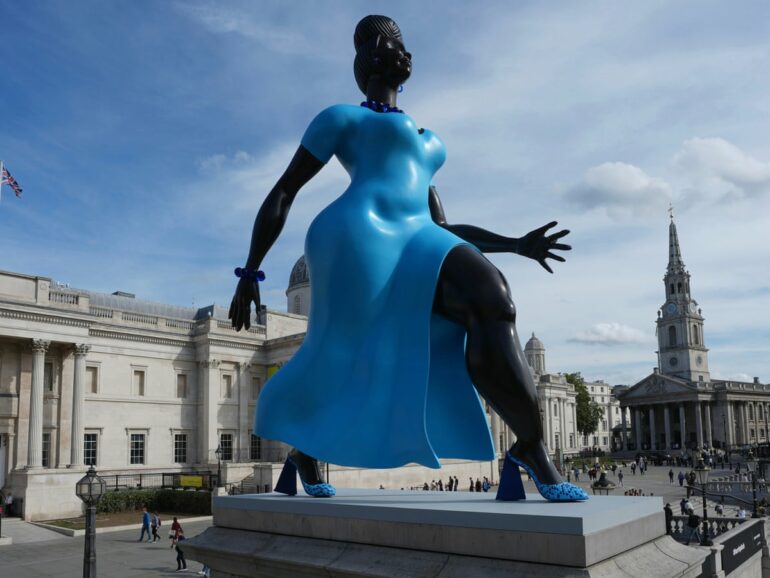
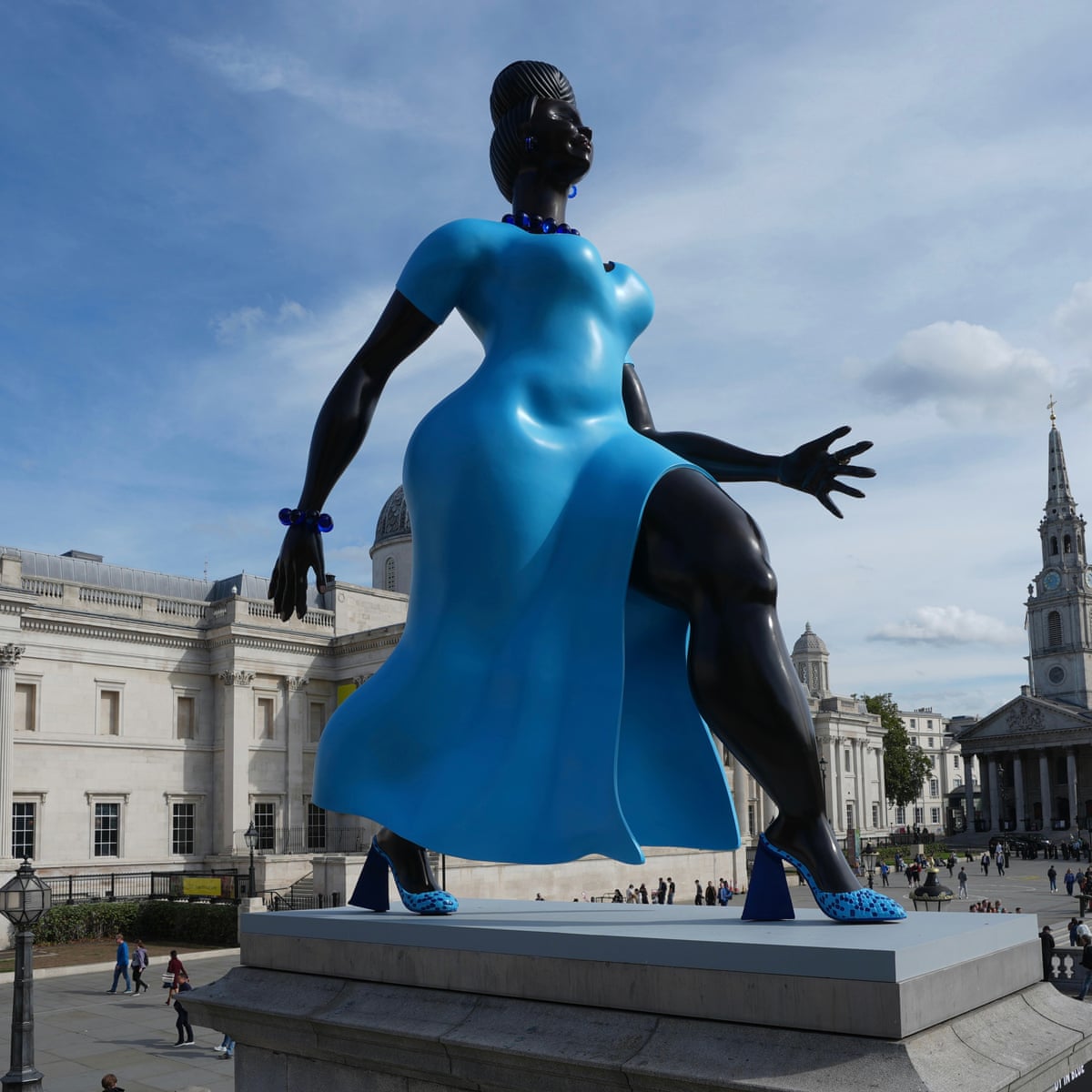
It is within this context of rebalancing that the Fourteenth Commission of the Fourth Plinth program takes place. Tschabalala Self, selected in March 2024 following a public consultation that gathered more than 10,000 responses, will unveil *Lady in Blue* on September 10, 2026. This monumental bronze sculpture, estimated to be approximately five meters tall, stands in stark contrast to the figures of admirals and monarchs that surround it. It depicts a young Black woman from the city, striding confidently in wedge heels and wearing a form-fitting dress. The work’s finish features a precious pigment: bronze patinated in lapis lazuli blue, a direct reference to the materials used in antiquity and to the masterpieces housed in the adjacent National Gallery.
The artist’s intention is clear: to celebrate an “everywoman,” an ordinary urban woman, by rejecting the conventions of traditional heroism or institutional power. This artistic choice carries strong symbolic weight in a square dominated by the 51-meter-tall Nelson’s Column. Tschabalala Self’s work will remain on display free of charge until fall 2028, before a possible transfer to Norway, although the exact details of its future installation in the Oslo area have yet to be confirmed. The issue of this visibility also involves security and social concerns: in 2022, another sculpture by the artist, titled *Seated*, was subjected to acts of racist vandalism, highlighting the persistence of tensions related to the presence of Black bodies in public spaces.
Nicole Eisenman: The Totem of Interdependence
A stone’s throw away, on Piccadilly, the Royal Academy of Arts (RA) is undergoing its own transformation. Founded in 1768, this institution has dedicated only two solo exhibitions to living female artists in its main galleries over the course of more than two and a half centuries. From September 22, 2026, to February 5, 2027, the main courtyard of Burlington House will host *Stack*, a monumental work by Nicole Eisenman standing over eight meters tall.
Conceived as an anti-heroic monument, *Stack* takes the form of a precarious stack of five figures and objects, loosely inspired by the Brothers Grimm fairy tale *The Bremen Town Musicians*. This eclectic structure, combining bronze, aluminum, oak, brass, steel, and acrylic resin, is arranged as follows: at the base stands a depiction of Nicole Eisenman herself, hunched over, wearing Birkenstock sandals and holding out an empty glass. Resting on her back is a wine barrel, topped by a giant potato—a symbol of sustenance—and then by her cat, Edie. At the top of this fragile structure sits a smiling effigy of the British sculptor Phyllida Barlow, a former member of the Royal Academy who passed away in 2023, who appears to be balancing a vase of flowers on her head.
This installation, funded with the support of the artist and the Hauser & Wirth gallery, offers an alternative to the solitary verticality of power. It celebrates artistic friendship, creative work, and interdependence. By placing the work directly opposite the classical statue of Joshua Reynolds, the first president of the RA, Stack engages in a critical dialogue with academic formalism and the historical hierarchies of art.
A fleeting yet necessary transformation
The simultaneous arrival of these two works in the fall of 2026 will mark a moment of unprecedented visibility for women artists in the beating heart of London. While access to these installations will remain free to the public, the production costs of these monumental projects remain partly confidential. The budget for *Lady in Blue*, in particular, is protected by trade secret in the municipality’s official documents.
Although these installations are temporary, they challenge the enduring statistical imbalance in the capital. While they do not yet fundamentally alter the 4% representation of permanent female statues, they do introduce new visual narratives. The program will be complemented by a series of events, including a conference on September 29, 2026, at the Royal Institution, providing an opportunity to further explore this necessary transformation of the public sphere.