Make Texture a preferred source on Google to support us
Add Texture to GoogleThe metal has lost its arrogance. In the light, the gold no longer reflects that aggressive brilliance characteristic of pieces fresh from contemporary workshops, but instead offers a matte glow, etched with thousands of micro-scratches invisible to the naked eye. This accidental polish has a technical name in the workshop, but in private, it reads like a map of time. The heirloom piece—the one that passes from one generation to the next, tucked away in a cracked leather pouch or a worn velvet case—demands a special physical connection. Wearing it is not a matter of morning vanity. Slipping an ancestor’s ring onto one’s finger, adjusting a complex clasp designed in another era, invokes a silent mechanism: that of continuity.
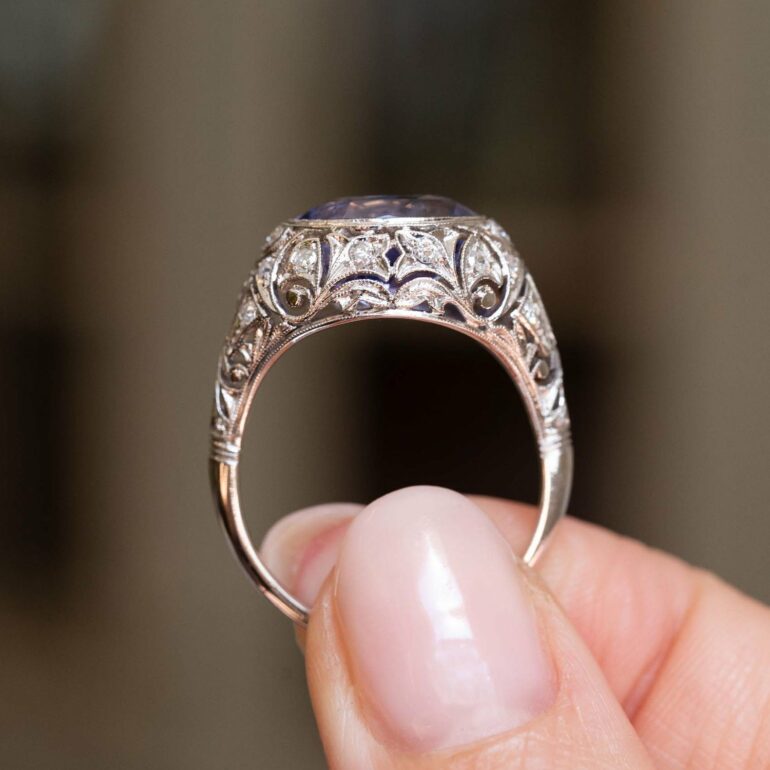
Unlike clothing that wears out, leather that loses its shape, or furniture that sags, jewelry possesses that mineral-like arrogance of imperishability. Gems do not age. They span decades with absolute indifference to the human dramas unfolding around them. The only thing that bears witness to the passage of time is the setting. The platinum prongs become rounded, the bracelet hinges develop a slight play, and the ring shank thins from rubbing against skin and fabrics. This wear and tear is the most definitive certificate of authenticity for a heirloom piece of jewelry. It proves that the object has lived, that it has accompanied everyday movements, that it has bumped against tables, and that it has been taken on and off thousands of times.
The Imperfect Geometry of Antique Cuts
The contemporary eye has grown accustomed to surgical precision. Today’s laser-cut diamonds adhere to strict mathematical calculations designed to maximize light refraction. They sparkle with a white, almost aggressive fire, tailored for the artificial lighting of our century. The stones set in antique jewelry tell a completely different technological and aesthetic story. Antique cushion cuts, rose cuts, and mine cuts reveal a fascinating asymmetry. Their hand-cut facets are fewer in number and often irregular. The culet—the small point at the base of the stone—is typically cut away, creating a dark hole in the center of the diamond when viewed from above.
These gems were not designed to sparkle under halogen spotlights, but to capture the flickering light of a candlelit chandelier or a kerosene lamp. They possess a subdued depth, an aquatic luster that shifts with the time of day. Recognizing an antique cut in a piece of heirloom jewelry means understanding that the artisan who cleaved this stone worked to the rhythm of his eye and wrist, accepting the inclusions and the rough stone’s original shape rather than forcing the material to conform to an industrial standard.
The Portable Registry of Lineages
The passing down of a set of jewelry is part of a complex sociological phenomenon. Historically, the jewelry box was one of the few assets that belonged solely to women. In societies where women’s access to real estate or financial assets was restricted, gold and gemstones served as a portable property register. In times of crisis, war, exile, or separation, this heritage could be sewn into a hem or slipped into a pocket. This concentration of value—the ability to encapsulate a fortune in an object weighing just a few grams—gives antique jewelry an aura of survival.
Today, inheriting a significant piece often feels overwhelming. There is the weight of the object, both literal and metaphorical. A massive Art Deco brooch, a draped necklace from the 1950s, or a signet ring bearing a coat of arms do not fit naturally into the wardrobe of an era that has elevated minimalism and speed to cardinal values. These pieces demand a certain poise. A heavy long necklace alters the way the neck is held; an imposing domed ring changes the way the hand moves, slows down its motion, and demands a certain caution. Antique jewelry refuses to be overlooked. It imposes its physical presence on whoever is tasked with wearing it.
The Dilemma of the Safe and the Temptation to Break Free
This raises the question of use. The fear of losing one’s grandmother’s earring or snagging one’s mother’s engagement bracelet condemns many pieces to the darkness of bank vaults. The process of passing down these pieces comes to a standstill. The jewelry reverts to being mere dormant capital, stripped of its primary function: to interact with the body. In the face of this paralysis, a new dynamic is emerging—from the jewelry workshops of Place Vendôme to the workbenches of independent designers—known as “dissection.”

Should one preserve an unwearable setting to respect the object’s historical integrity, or should one sacrifice the form to save the material? Many heirs are choosing to break with tradition. They knock on artisans’ doors to strip away the history. The approach is radical. The gold from the old setting is melted down to be reborn as a sleek ring. The stones, once clustered on a unwearable brooch, are separated to create three identical rings for siblings.
This act of creative destruction sometimes offends purists, but it follows an unyielding logic. The gemstone is eternal; the design is not. By freeing a Ceylon sapphire from its outdated platinum setting to mount it on a taut band with a contemporary, bold design, the heir does not betray the family legacy: he ensures that the stone will continue to catch the light. This is the ultimate paradox of the jewelry heritage. For the object to survive in essence, one must sometimes accept killing it in form.
Flesh and Mineral Immortality
Agreeing to wear a piece that has spanned decades ultimately means confronting our own biological finitude. Upon contact with the skin, the cold metal takes on body temperature in a matter of seconds. It becomes intimate, organic. Yet this fusion is an illusion. The woman who fastens a 1930s link bracelet to her wrist knows that she is merely one stage in the object’s journey.
Heritage jewelry puts the concept of ownership back in its proper place. We never truly own a ruby or a vintage-cut diamond. We keep it, protect it, clean it, and wear it to mark our own passage through time. When the hand that wears it today becomes wrinkled, the stone itself will not have aged a bit, nor lost a single micron of its substance. Antique jewelry reminds us with striking elegance that we are merely temporary custodians of a beauty that predates us and will, inevitably, outlive us.