Make Texture a preferred source on Google to support us
Add Texture to GoogleTranslating the kinetic power of an automotive legacy into the fluidity of ready-to-wear clothing requires much more than simply adding a logo. On November 12, far from the industrial rigor of Maranello, the Italian team tackled this delicate aesthetic equation on American soil. With the presentation of its Spring/Summer 2027 collection, the brand unveils an unexpected stylistic narrative. At the helm of this vision, Creative Director Rocco Iannone approaches the brand’s vocabulary not as an untouchable sanctuary, but as a living syntax. Under the title “Crafting Identities,” the designer presents twenty-six looks that move away from the literalism of the paddocks to embrace an infinitely more nuanced sartorial reality, rooted in movement and encounters.
The crux of this approach lies in a paradigm shift. A signature whose mythology was forged through sheet metal, aerodynamics, and the smell of burnt rubber must now contend with the tactile and silent demands of fashion. Iannone avoids the pitfall of mechanical nostalgia. Instead, he orchestrates a pas de deux between the millimeter-precise attention to detail inherent in the brand’s engineers and the diversity of contemporary styles. A deliberate tension emerges, seeking to prove that the garment can exist on its own terms while still bearing the shadow of its creator.
Manhattan as an Aesthetic Catalyst
Geography is by no means incidental. New York imposes its jerky rhythm and architectural density on the entire collection. This choice of physical location also accompanies a strategy of physical expansion, embodied by the opening of a vast retail space in the SoHo enclave—a move closely scrutinized by specialized platforms such as Hypebae and Design Scene. Yet the metropolis offers far more than just a prestigious address. It acts as a raw material, a chemical reagent that disrupts transalpine rigor. The eclecticism of New York City’s streets infuses the designs, fueling the idea that style is forged first and foremost through interaction with others.
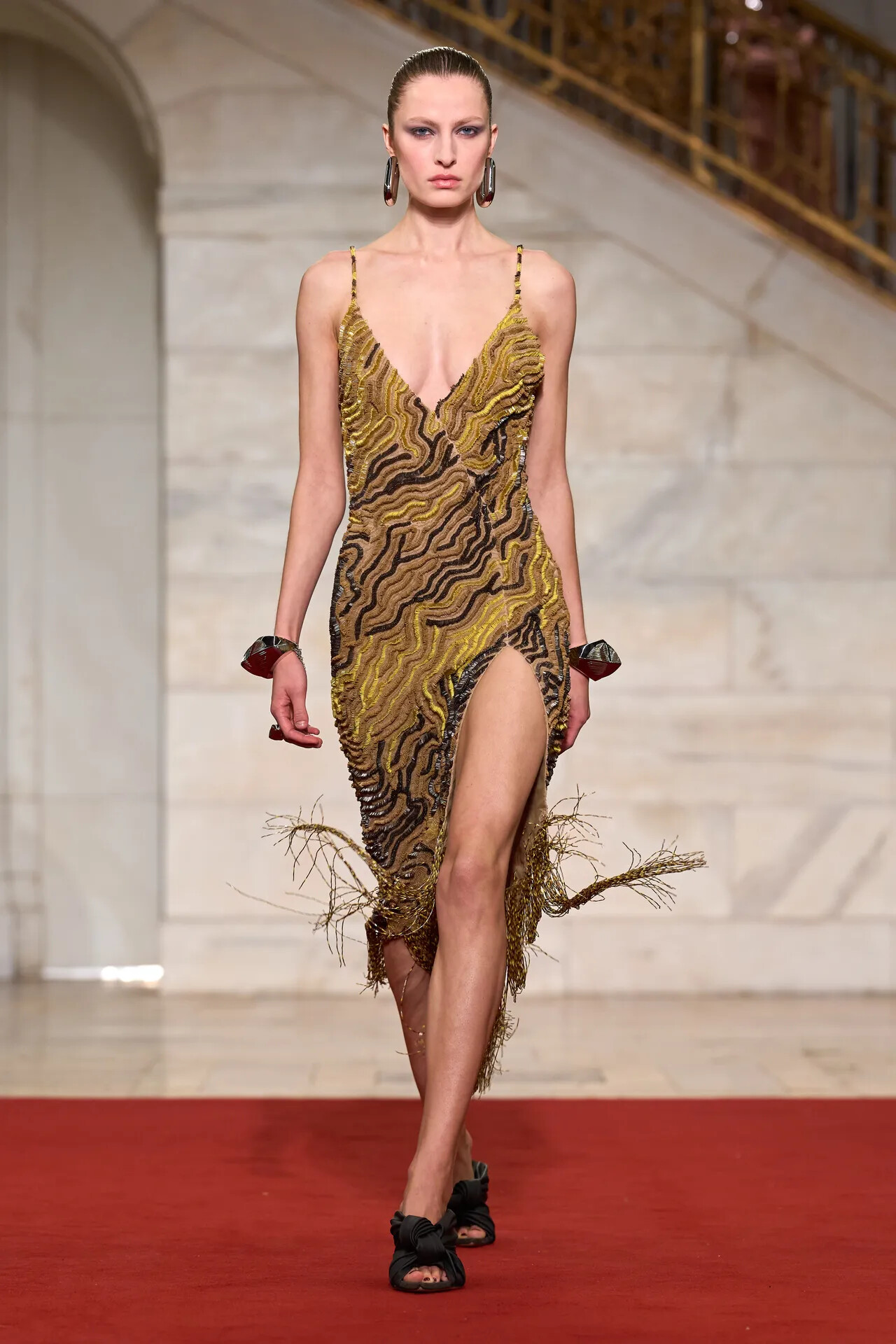
The shadow of the 1980s looms over the runway. Iannone draws directly from the cultural effervescence of that decade, evoking the expressive urgency and dazzling brilliance of Jean-Michel Basquiat, while flirting with the surgical framing and tension of Robert Mapplethorpe. On paper, injecting these iconic figures of the American art scene into the veins of a luxury automaker might seem abrupt. In reality, these references to the pop culture of the era never undermine the brand’s identity. Instead, they create a series of micro-fractures in Ferrari’s DNA, allowing a new attitude to emerge—one that is less polished and more rooted in the asphalt than in closed circuits.
From Ink to Warp and Weft
To physically anchor this clash of cultures, the event’s scenography transforms into an act of literal translation. Within the gallery hosting the fashion show, heavy woven pieces command the eye. This is where the archive comes into play, transformed. By partnering with the Italian textile house Rubelli, the studio has unearthed old covers from the company’s internal magazines to reinterpret them through thread.
The analysis provided by The Circuit Report highlights the significance of this shift: glossy paper gives way to the density of tapestry. This transition from a printed surface to an interwoven fabric embodies the dialogue the brand seeks to establish between its graphic heritage and the arts and crafts. By transforming a flat image into a textured object, the artistic director draws a silent parallel between the obsession with materials that governs the construction of a chassis and the deliberate slowness of the loom. Heritage is no longer merely on display; it can be touched and shapes the space, without ever relegating the art of craftsmanship to the role of a mere foil for the automobile.
Functional vocabulary and chromatic dissonances
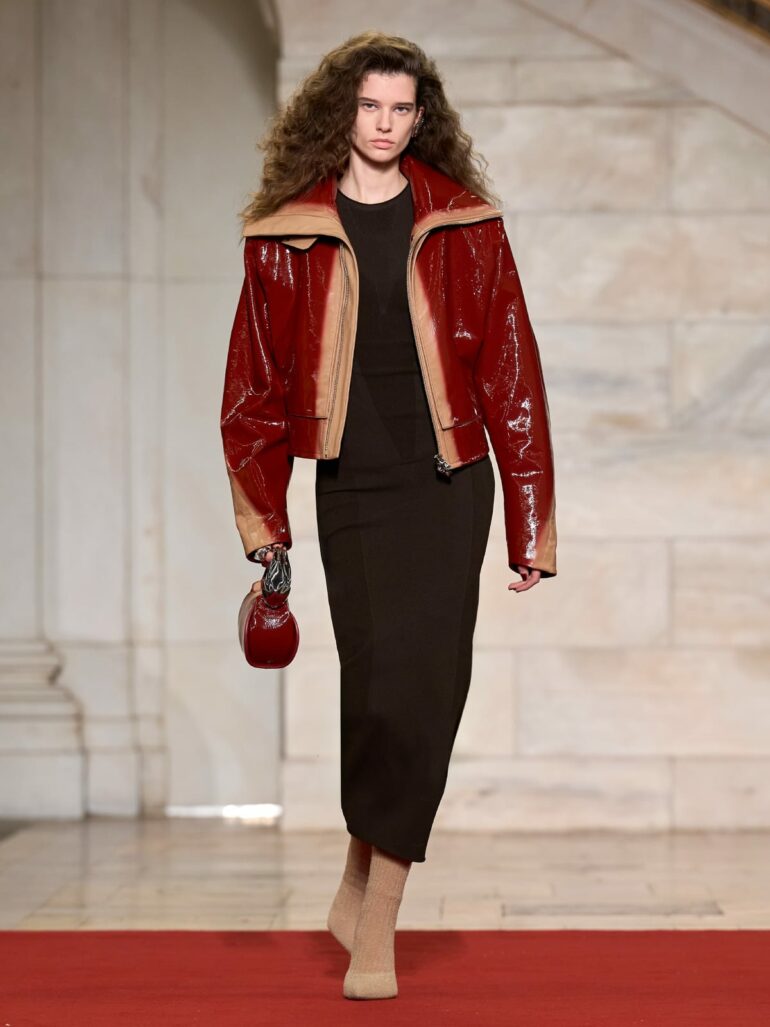
On the garments, the transformation continues. The Impression’s meticulous observation of silhouettes reveals a strong inclination toward structured volumes and unapologetic borrowings from the world of workwear. Utility pieces, designed for action, engage in a dialogue with cuts of extreme precision. The collection’s spectrum is vast, rejecting stylistic confinement. A sharply tailored suit transitions seamlessly into a flowing tracksuit; a bomber jacket with revised proportions meets form-fitting dresses that sculpt the body with an almost architectural severity. The accessories—massive and uncompromising—punch up this sartorial language.

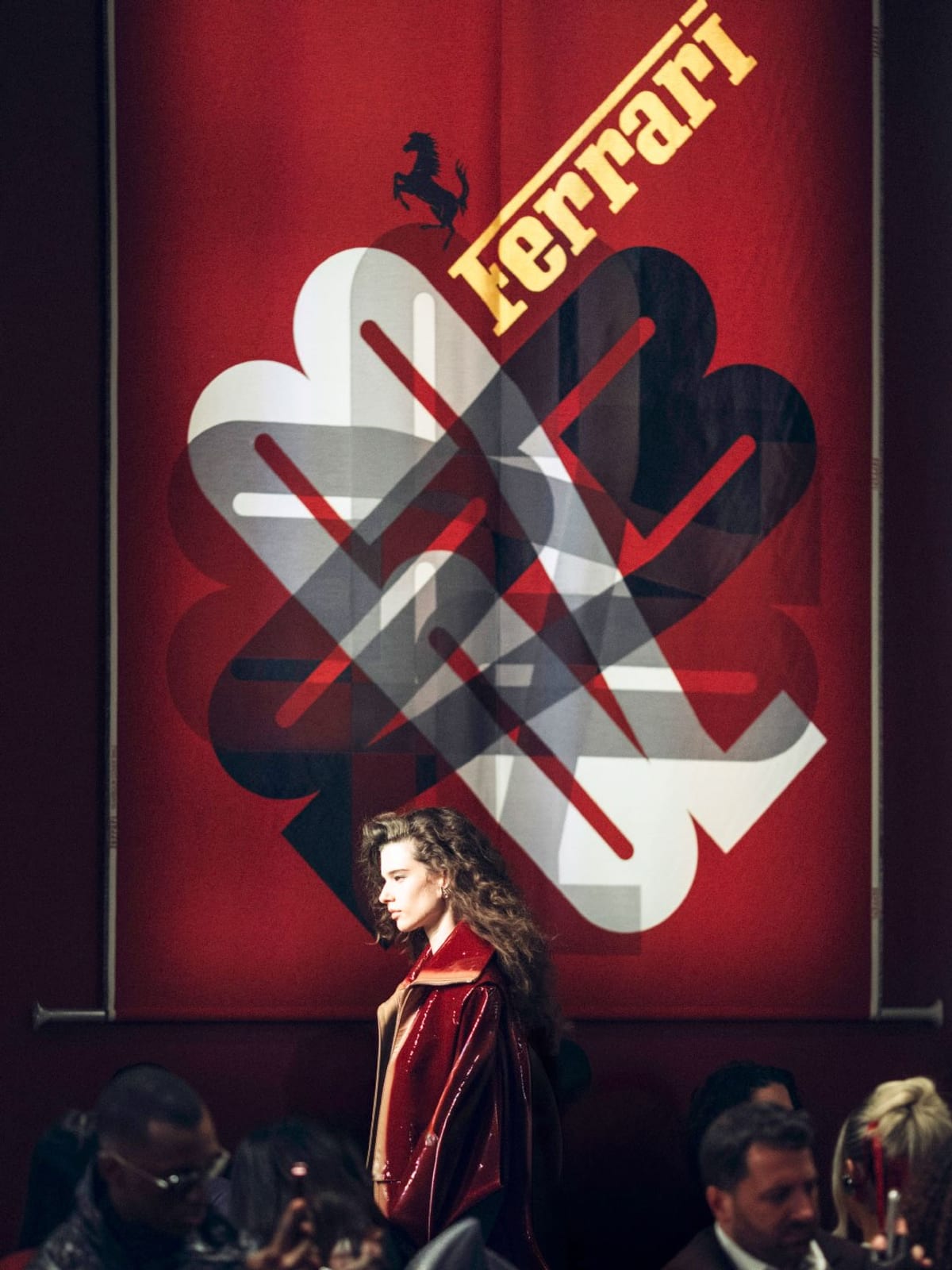
The color choices further blur the lines. While the dazzling flashes of historic red and Modena yellow—indelible hallmarks of the coat of arms—naturally illuminate the collection, they are immediately absorbed by a much more muted and organic color palette. METAL Magazine’s analysis highlights a subtle base palette where butter tones, an enveloping camel, solid ecru, and a deep chocolate clash, all anchored by deeply saturated blacks. Animal prints are woven into this composition, adding an unexpected visual texture.
This blending of materials and shades gives the garments a distinctive resonance. An athletic edge remains, recalling the brand’s motorsport origins, but it is constantly tempered by a very assertive urban sensuality. The looks thus avoid the trap of a one-dimensional wardrobe, favoring a variety of styles.
The Autonomy of a Signature
Ultimately, this foray into New York redefines the boundaries of what an entity rooted in mechanical engineering can legitimately claim on the ready-to-wear scene. The stated ambition goes far beyond simply capitalizing on an industrial aura. Iannone sets out to build an autonomous language. By filtering familiar silhouettes through the lens of East Coast American influences and transforming the archive into tangible raw material, the garment acquires a depth all its own.
The exercise required tightrope-walking precision. Too many urban references would have diluted the exclusive vision; too many nods to racing would have reduced it to a caricature. The balance achieved proves that a fashion house’s identity is never a monolith doomed to repeat itself, but rather a malleable material that takes shape according to its context. The lights go out on a collection liberated from its own myths, leaving behind a collection capable of standing on its own through the sheer precision of its forms.