
Make Texture a preferred source on Google to support us
Add Texture to GoogleIn Bengaluru, the exhibition “Mapping Periphery & Center” explores the diversity of contemporary Indian art by highlighting practices from various regions. By fostering dialogue between regions and traditions, the event examines a cultural ecosystem in which spaces for convergence remain far too limited.
Bengaluru: A Crossroads Between Periphery and Center
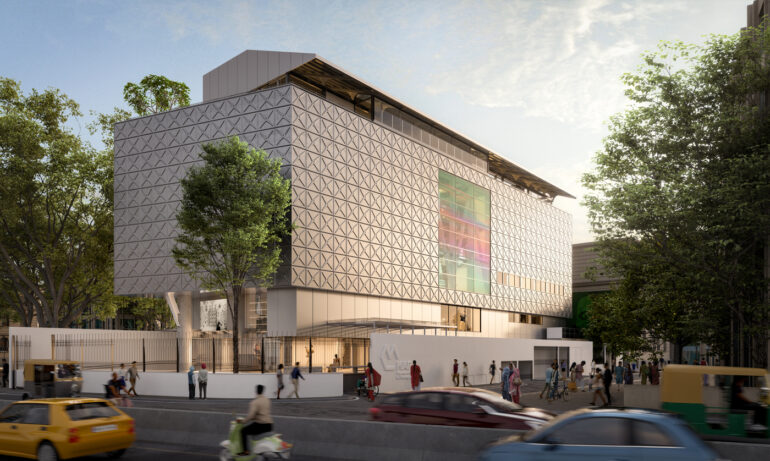
In the heart of Karnataka, the Chitrakala Parishath has established itself as a true gathering place, striking the right balance between cultural institution and public space. It was in this setting that the second edition of the national Namma Art Bengaluru festival recently hosted the exhibition “Mapping Periphery & Centre” — A Pan-Indian Dialogue. Conceived by art historian and curator Lina Vincent, this project brings together more than sixty visual artists from diverse backgrounds, working in mediums ranging from painting to monumental installations, including sculpture and mixed media. This rare creative breadth offers a striking panorama of the contemporary art scene.
An organic curatorial approach conceived as a dialogue
Here, Lina Vincent favors a flexible approach, informed by in-depth research and intimate conversations with the artists. Far from rigid curatorial approaches that often devolve into ceremonial showcases at the expense of dialogue, the coherence of the exhibition arises from contrast. It is through the interplay of aesthetics and artistic worlds that a map of a resolutely modern India emerges, where personal narratives intersect with universal themes such as collective memory, migration, ecology, and identity.
The selection aims to be a faithful reflection of this rich diversity: Arunkumar H.G., Balaji Ponna, Bhartti Verma, Chippa Sudhakar, Girish Kulkarni, Harsha Durugadda, Kanchan Chander, Manveer Singh, Nikhileswar Baruah, Prashant Pandey, Rani Rekha, Ruchita Madhok, Shanker Kumawat, Shweta Raina, Venugopal VG, Shyam Pahapalkar, Venkat Raman Singh Shyam, Harsha Kancharla, not to mention Mayur and Tushar Vayeda. Far from being a mere stylistic exercise, this diversity underscores the independence of the Indian film scene, which refuses to be subsumed under a single school or a centralized geographical framework.
Regional Roots and Evolving Expressions
Many artists revisit vernacular traditions in order to better break free from them. Venkat Raman Singh Shyam, for example, revitalizes the centuries-old Gond heritage through forms of absolute modernity. At the same time, brothers Mayur and Tushar Vayeda, from the Warli community in Maharashtra, transcend their tribal visual vocabulary to address contemporary issues such as environmental preservation. Others, such as Chippa Sudhakar and Shanker Kumawat, draw their inspiration from rural life, craftsmanship, and the simplicity of daily rhythms.
The exhibition’s greatest strength lies in this palpable tension between continuity and rupture. The curation skillfully avoids the pitfall of decorative folklore, which all too often tends to smooth over this richness in favor of a spectacular but disembodied presentation. Here, motifs, bodies, architecture, and materials become both layers of memory and critical tools for deciphering Indian society.

The Urgent Need for New Spaces for Exhibition
Beyond the artworks themselves, Lina Vincent emphasizes the urgent need to increase the number of venues open to such experiments, particularly in Bengaluru. As a counterpoint to the traditional “white cubes”—those institutional galleries that are sometimes too impersonal or elitist—India’s cultural ecosystem suffers from a glaring lack of intermediate spaces. Yet these hybrid venues are essential for experimentation, debate, and engaging a broader audience. Paradoxically, the city’s rapid economic growth is not always accompanied by a policy of developing flexible and accessible arts infrastructure.
Continuing this commitment, the curator will soon take over as head of the visual arts section at Abhivyakti City Arts in Ahmedabad. The program, scheduled for November 27 through December 13, aims to break down barriers between artistic practices, democratize access to art, and deconstruct the notion that an exhibition is merely a simple juxtaposition of works.
The project, led by the Karnataka Chitrakala Parishath, ultimately fits into a tradition cherished by the country’s cultural institutions: that of combining knowledge transmission, critical rigor, and visibility. As visitors explore “Mapping Periphery & Center,” they find no dogmatic answers, but instead traverse a series of sensory pathways. This is the finest tribute to Indian contemporary art: refusing to fix an illusory center in place, in order to better reveal how its many peripheries tirelessly redraw its contours.