
Make Texture a preferred source on Google to support us
Add Texture to GoogleAt Thor Motor Coach, the “+” sign has a curious property: it adds space and saves money. The Rize+, unveiled to North American dealers in late September 2026 at the Thor Industries Open House, starts at $130,340. The classic Rize—the camper van from which it takes its name—starts at around $146,000. That’s a price difference of more than $15,000 for a vehicle that promises more living space. This paradox stems from a design choice: forgoing the sheet metal of a commercial van to mount a living unit directly onto a bare chassis.
From Van to Living Unit
The standard Rize falls into the American Class B category. It is a RAM ProMaster that has been fitted out internally, without any modifications to the body. The Rize+ is built on a different platform: a Ford E-Series Cutaway chassis-cab, in the E-350 Super Duty version. Thor Motor Coach, a subsidiary of Thor Industries, mounts a living unit on it that is wider than a van’s body, and that’s where the extra space comes from. This living unit combines vacuum-bonded composite panels with an aluminum tubular frame.
That leaves the question of the name. The manufacturer officially classifies it as a Class C, the category for motorhomes built on a chassis-cab. The market tends to refer to it as a Class B+—or even a mini-motorhome—because its length remains under six meters. This “B+” designation is part of marketing jargon. The vehicle is certified and registered by Thor under the Class C label. The debate over its category sums up the intention quite well: a motorhome designed to drive like a van.
Six meters, no more
The overall length is 19 feet 8 inches, or 5.99 m. The width is 2.16 m excluding side mirrors, the height is 2.95 m including the air conditioner, and the wheelbase measures 3.51 m. These dimensions aren’t those of a behemoth—at least by North American standards. They explain why Thor is targeting couples, first-time buyers, and travelers who are hesitant to move away from the van format but feel cramped in it.
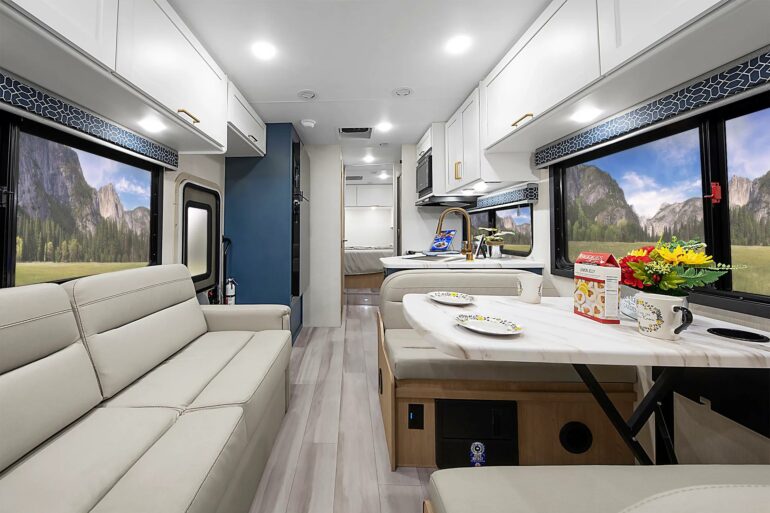
The key figure is found inside: 1.88 m of headroom (74 inches). In a van, the usable headroom depends on the original roof structure. Here, it results from the layout of the living area, and the extra width primarily benefits the face-to-face seating arrangement described below.
A V8 for Two Sleepers
Under the hood, Ford offers its 7.3-liter gasoline V8, nicknamed “Godzilla.” It produces 325 ch and 450 lb-ft of torque—about 610 Nm—transmitted through an automatic transmission. The fuel tank holds 40 US gallons, or about 151 liters. Fuel economy figures are not provided.
This engine gives the Rize+ a towing capacity of 8,000 pounds, or approximately 3,628 kg. The gross vehicle weight rating is 10,050 pounds (approximately 4,558 kg), and the maximum gross combination weight is 13,000 pounds (approximately 5,897 kg). In practical terms, you can hitch a trailer, a small boat, or a secondary vehicle, provided you stay within the combined weight limit: the stated towing capacity does not simply add up to the weight of the loaded motorhome without limit.
The contrast is worth noting. This heavy-duty truck chassis carries a living compartment certified for four seated passengers with seat belts but only two sleeping berths. The Rize+ is designed for a couple and can accommodate two passengers for the duration of a trip. It is not intended for a family.
A living area that doubles as a bedroom
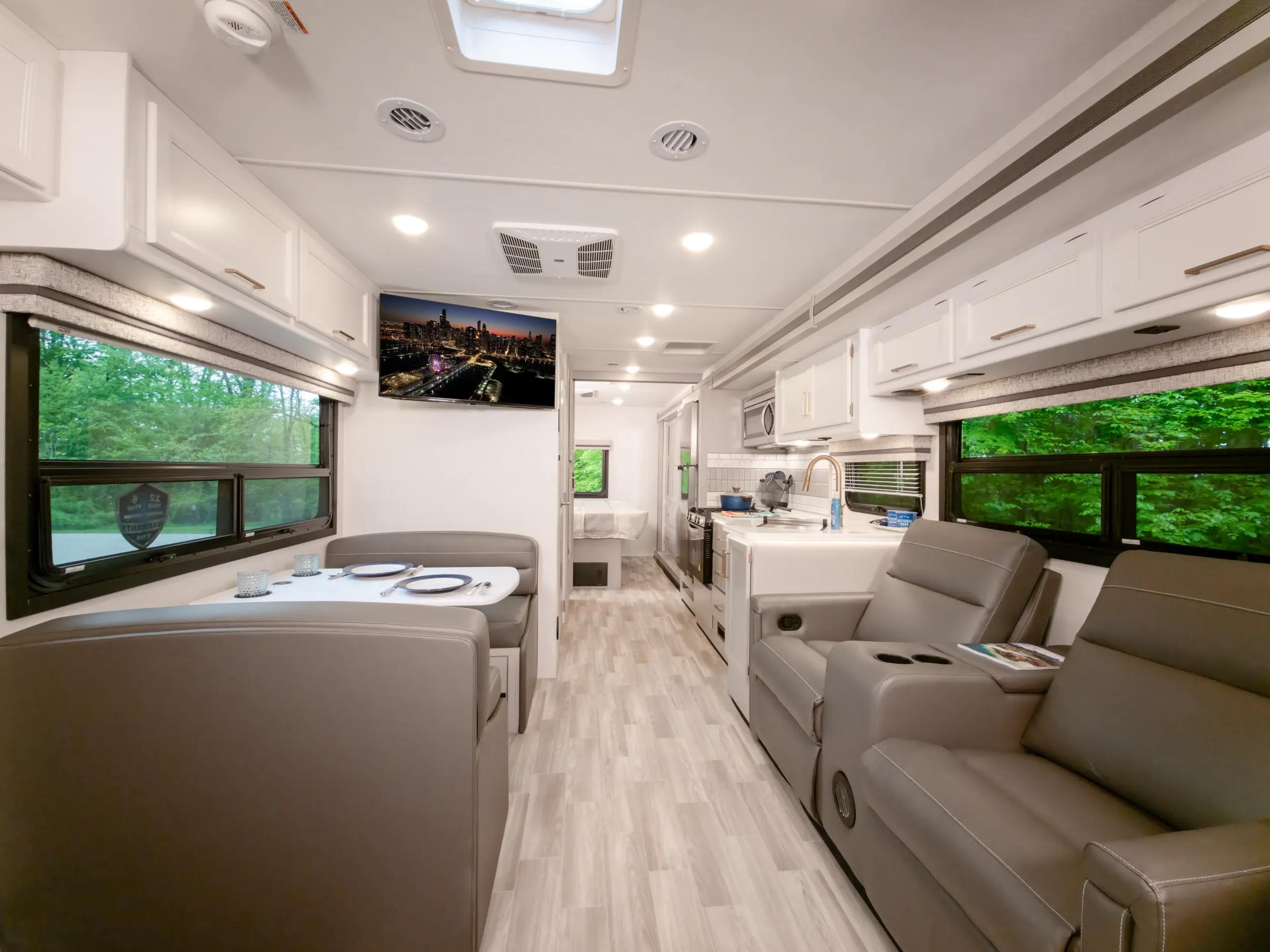
You enter through the rear of the living area, a layout that Thor refers to as “Rear Cabin Entry.” The base model is designated 18R. It features two longitudinal benches facing each other, separated by a removable center table. During the day, it serves as the dining area. At night, the table is removed, and the two benches convert into a double bed.
The dimensions of the unfolded bed are not listed in the manufacturer’s official technical specifications. Some authorized dealers estimate it to be approximately 52 × 82 inches, or roughly 132 × 208 cm. This figure has yet to be confirmed, but it would result in a sleeping area that is longer than it is wide, better suited to the length of the living area than its width.
A Kitchen for the Road
The kitchen is stripped down to the essentials. It features a portable single-burner induction cooktop, a single-door 12-volt refrigerator, and a wall-mounted microwave. The single-bowl stainless-steel sink is equipped with a pull-out spray faucet. The single, portable burner hints at its intended use: simple cooking, possibly outdoors, under the 10-foot (approximately 3.05 m) side awning.

The bathroom occupies the center of the vehicle. It is an enclosed wet bathroom that combines a shower and toilet in the same space, equipped with a 12-volt exhaust fan. In a six-meter vehicle, this is the expected compromise: a separate shower stall is omitted to save space elsewhere.

Autonomy in liters and watts
The tanks determine how long you can stay away from service areas. The Rize+ carries 20.5 US gallons of fresh water (about 77.6 liters), 24 gallons of gray water (about 90.8 liters), and 11 gallons of black water (about 41.6 liters). The 2.5-gallon water heater—about 9.5 liters—operates on both 12 V and 110 V. The tanks are equipped with antifreeze heating pads, a useful feature for those planning to travel outside the warmer months.
As for electricity, the system relies primarily on a 4.0 kW onboard generator. This is supplemented by a 1,000 W pure sine wave inverter, a detachable 30 A shore power connection, and a second auxiliary battery dedicated to the living area. The solar system requires more caution. The official documentation mentions an external solar port—in other words, a connection point designed for hooking up solar equipment. The configurations shown during the presentation reportedly included a 100 W panel and a 100 Ah battery, but there is no confirmation at this stage that this setup comes standard on every unit.
For temperature control, a 13,500 BTU roof-mounted air conditioner provides cooling. Heating is provided by a 3,400 BTU 110-volt electric heater. Everything therefore depends on having a sufficient power supply—either from the dock power outlet or a generator—which is something you’ll want to know before planning for cold nights out in the wilderness.
Price as the Main Selling Point
As of October 2026, the suggested starting price for the Rize+ is $130,340, or approximately 120,000 euros before taxes at that month’s exchange rate. This conversion is for reference only: the spec sheet indicates that the vehicle is intended solely for North American dealers, and no European launch has been announced.
The vehicle is positioned below the equivalent Class B motorhomes in the Thor lineup, including the classic Rize. It is also less expensive than its direct competitors from Winnebago, the Elora and the Resa. Buyers therefore pay less for a more spacious interior. In exchange, buyers give up the silhouette of a van and the discretion of a utility vehicle parked in the city, and they accept a 7.3-liter V8 where a van would make do with a more modest engine.
The model is being released for the 2027 model year, and it has a twin. The Thor Scope+ shares exactly the same technical specifications and layout. Only the styling differs: to choose between the two, you’ll have to look at the exterior design rather than the spec sheet.