
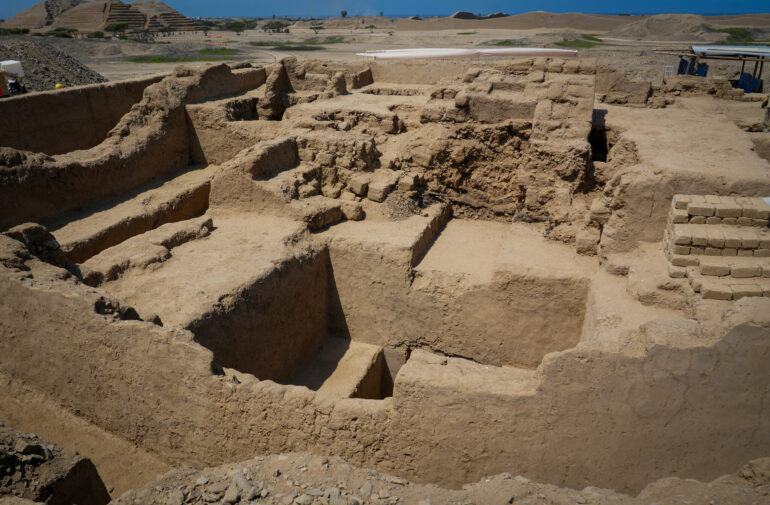
The silence that envelops the ruins of Chan Chan, on Peru’s northern coast, has just been broken by an announcement that will go down in the history of Andean archaeology. On September 8 and 9, 2026, Peru’s Ministry of Culture officially announced the discovery of an intact funerary platform within the Utzh An complex. This sector, formerly known as the “Great Chimú Palace,” is the largest of the ten monumental complexes in this earthen city, a UNESCO World Heritage Site. While the Chan Chan site has long been known as the capital of the pre-Inca Chimú kingdom, this discovery is exceptional: it is the first time that experts have unearthed an elite burial site that has escaped the systematic looting that has plagued the region since the colonial period.
An Earthen Citadel Preserved by Time
The project, led by the Proyecto Especial Complejo Arqueológico Chan Chan (PECACH), focused its efforts on a massive pyramidal structure built of adobe—the sun-dried earthen bricks typical of Peruvian coastal architecture. Measuring approximately 17 meters on each side and 5 meters in height, this platform is not merely a mound of earth, but a complex structure whose spiritual and physical integrity has remained intact for about six centuries. Initial estimates place the tomb’s sealing in the 14th or 15th centuries CE, a pivotal period shortly preceding the expansion of the Inca Empire into these territories.
The internal layout of the structure reveals a rigorous spatial hierarchy. Archaeologist Jorge Meneses Bartra, who is in charge of the site, describes a configuration centered around a central chamber flanked by an antechamber and two large side chambers. The main chamber, measuring 1.2 meters wide by 5 meters deep, is sunken into the ground. It is accessed via a staircase descending approximately 2.5 meters, leading to a wall niche that underscores the solemnity of the site. Although some media sources have mentioned the presence of five chambers, official reports from the Ministry and the surveys conducted by Jorge Meneses Bartra’s team confirm a predominantly tripartite structure on the platform.
The Thirty-Eight Occupants of Utzh An
The most fascinating aspect of this discovery is the presence of 38 individuals, arranged according to a strict funerary protocol. At the heart of the arrangement, in the central chamber, lies the principal figure—a high-ranking Chimú noble. His central position confirms his status as a figure of authority, surrounded in the afterlife by a large retinue. The first side chamber contained the remains of 20 individuals, while 17 to 18 other skeletons were found in the peripheral areas of the platform.
One anomaly, however, has caught the attention of anthropologists: while the burial traditions of this people typically favor the fetal, seated, or crouched positions, one of the skeletons was discovered lying fully extended. This unusual posture raises questions that the archaeological team is currently approaching with caution. The hypothesis of a human sacrifice or a very specific social status has been put forward to explain this anomaly, but it remains subject to more in-depth clinical analyses. Similarly, the kinship or vassalage ties linking the central dignitary to the 37 other deceased individuals are currently the subject of anthropometric and genetic studies to determine the social organization of this group.

The Armory and Ornaments of a Vanished Elite
The second side chamber offers a striking contrast to the rest of the structure: it contains no human remains. This space was reserved exclusively for the storage of metal weapons and emblems of power. It is here, and throughout the other chambers, that archaeologists have unearthed a collection of grave goods of rare density. There are approximately 200 black ceramic vessels—an aesthetic hallmark of the Chimú kingdom—whose dark luster attests to a high level of technical mastery.
The splendor of the Utzh An courtyard is also evident in the abundance of metal ornaments. Ear ornaments, known as orejeras, headdresses, and various objects made of copper and gold have been recovered. In addition to these pieces are necklaces made of Spondylus, orange-hued bivalve shells imported from the warm waters of present-day Ecuador, which the Chimú considered a material more precious than gold due to their sacred significance. Quartz pieces and carved wooden boxes inlaid with metal round out this archaeological treasure, whose historical value remains, to this day, inestimable.
The Mysteries of the Red Pigment
The preservation of the remains has also revealed complex ritual details. Several bodies were wrapped in fardos, funeral bundles consisting of multiple layers of textiles stacked on top of one another. On the skulls, bones, and even on the ceramic vessels, archaeologists have noted the presence of an intense red pigment. While initial observations suggest it is cinnabar—a rare and precious mercury sulfide—laboratory chemical analyses are underway to confirm its exact composition. The use of this pigment, associated with prestige and the divine, once again underscores the exceptional status of the platform’s occupants.
The scientific work has only just begun. While the estimated age of the structure is around 600 years—corresponding to the period between 1400 and 1470—only absolute carbon-14 dating will allow us to pinpoint the exact moment when this platform was sealed. Pending these results, the Utzh An site remains the most direct and best-preserved testament to the grandeur of Chan Chan before the Incas permanently altered its fate. Research continues under the auspices of PECACH, with the certainty that the adobe soils of the Chimú capital have not yet revealed all their secrets.