Make Texture a preferred source on Google to support us
Add Texture to GoogleCan a watch come with a “health certificate” as precise as a high-precision timepiece demands? Jaeger-LeCoultre now answers this question with an engraving: three letters—HPG—etched on the back of the new Master Control Chronometer models. Behind this acronym, “High Precision Guarantee,” lies an ambition that extends far beyond a mere precision certification. In the Vallée de Joux, the manufacture aims to monitor the timepiece at every stage of its life: when it leaves its workshops, when it returns for restoration, and even when a collector wishes to entrust it to the manufacture’s care.
Time, Tested in Real-World Conditions
The starting point for this new certification lies in a distinction that is essential for the connoisseur: a movement may perform excellently on a test bench, only to react differently once assembled, subjected to the stresses of the wrist, temperature fluctuations, and the minor mishaps of daily life. Jaeger-LeCoultre has chosen to test the finished watch, not just its movement.
The HPG protocol spans three days, using a device developed by the manufacture, for which a patent is pending. The program aims less to replicate a static laboratory environment than to simulate an ordinary week. During the first two days, the watch is placed in various orientations: dial up, crown down, and other positions where the effect of gravity alters the behavior of the regulating organ. At the same time, the watch is subjected to shocks ranging from 25G to 50G, comparable to those experienced when a wrist hits a door or a piece of furniture with force.
The active test sequences are conducted at 35 °C, then alternate with rest periods at 18 °C. On the third day, the watch remains motionless, as if left on a table over the weekend. The temperature range used here is narrower than that of the Swiss Official Chronometer Testing Institute (COSC): the COSC tests movements at 8 °C and 38 °C for fifteen days, in five positions. The HPG therefore does not claim to cover all the climates to which an owner might expose their watch, particularly the cold of the mountains.
This limitation is mitigated by the testing protocol used for the Master Control Chronometer: its movement first obtains independent COSC certification before undergoing Jaeger-LeCoultre’s own tests. On the one hand, a third-party organization validates the chronometric qualities of the bare movement; on the other, the manufacture observes its performance once it has been assembled into a complete watch.
A tradition reimagined rather than a break with the past
This innovation is part of a long-standing tradition. In 1992, with the first Master Control, Jaeger-LeCoultre launched its “1,000 Hours Control” program, designed to test the assembled watch. This initiative preceded by more than twenty years the introduction, in 2015, of METAS certification for Omega watches, followed by its extension to Tudor in 2021.

However, the landscape has become more complex. This year, the COSC introduced a second level, Excellence Chronometer, which also tests the assembled watch under conditions simulating its actual use. Its stated tolerance is -2 to +4 seconds per day; it also includes tests related to magnetism and power reserve. Jaeger-LeCoultre takes a different approach: the HPG certification specifically adds tests for shocks, altitude, and a requirement regarding the finish, but does not publish a daily rate tolerance.
Altitude, incidentally, is a geographical nod. The caliber alone is subjected to a theoretical ascent from sea level to 1,004 meters—the exact altitude of Le Sentier. It takes an hour by car from Geneva to reach this plateau in the Swiss Jura, after a climb through spruce forests. The valley, situated at over 1,000 meters, saw the watchmaking industry develop as an extension of local expertise in ironworking and gemstone cutting. The long winter seasons also contributed to concentrating work inside homes and workshops.
Founded locally in 1833, Jaeger-LeCoultre now comprises 82 workshops, 180 trades, and more than 800 people dedicated solely to production. This deep-rooted history gives the HPG a distinctive character: the certification does not seek to obscure its internal origins. Rather, it is based on the company’s self-regulation.
When Finishing Becomes a Matter of Mechanics
This is undoubtedly the label’s most distinctive feature. To earn the HPG seal, a movement must demonstrate at least six of the eight traditional finishing techniques: beveling, burnishing, circular satin finishing, linear satin finishing, jewel settings, Côtes de Genève, pearl finishing, and polished screw heads. Some of these operations can be mechanized, which is sure to fuel debates among advocates of strictly handcrafted work.
Jaeger-LeCoultre’s position is pragmatic. With an estimated annual production of around 100,000 watches, entirely manual finishing would be impractical. Above all, finishing is not viewed here as a mere aesthetic enhancement. Polishing can reduce friction; Côtes de Genève patterns are associated with dust retention; a carefully finished edge prevents a burr from releasing a particle into the movement. Ornamentation and reliability are thus treated as two sides of the same discipline.

In the restoration workshop, this idea takes on an almost elementary form. A steel hand is held over the flame of an alcohol lamp. The color shifts from brown to purple before reaching the desired deep blue. A few seconds too long means starting over: the needle must be polished—a process that takes about three hours—and then reheated. This minute task serves as a reminder that horological precision is not measured solely by the rate deviation. It also lies in the mastery of a gesture and the ability to reject approximation.
The Master Control Collection as a Showcase
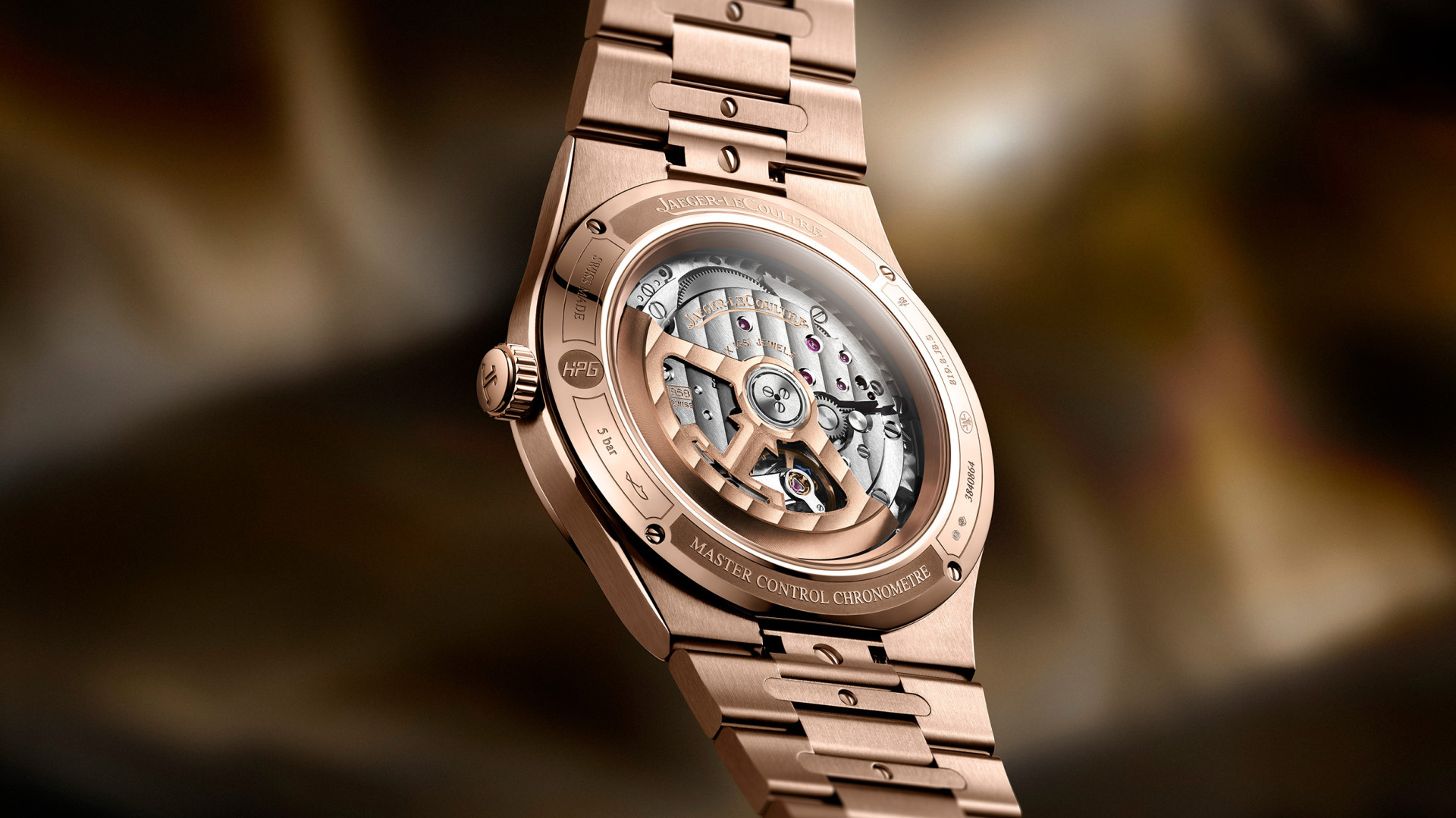
The HPG currently appears on three models in the Master Control Chronometer family: the Date, the Date Power Reserve, and the Perpetual Calendar. The first model starts at 12,700 pounds in stainless steel; the version with a power reserve is priced starting at 15,300 pounds; the Perpetual Calendar model reaches 41,000 pounds in stainless steel. The HPG designation does not have its own separate pricing tier. Proof of certification is visible on the case back in the form of an engraved emblem.
This discretion does not obscure the reality: the HPG is not an independent certification. Jaeger-LeCoultre makes no secret of this. It is a commitment by the manufacture, valid on a watch-by-watch basis and not based on a sample taken from a production run. Its coexistence with the COSC therefore seems logical: one provides an external institution’s assessment of the movement, while the other focuses on the finished product and the criteria defined at Le Sentier.
The brand plans to extend this seal to other collections starting in 2027. Future Reverso and Polaris models could thus benefit from a testing regime to which current models are not yet subject. The HPG designation is therefore not presented as a one-time edition, but as the new technical terminology for a growing portion of the catalog.
The Watch: Private Property Under Private Surveillance
The MasterCare program, launched on November 16, 2026, takes this logic to an extreme that is quite revealing of contemporary collector’s watchmaking. Jaeger-LeCoultre offers certain owners the option to deposit their watches in a secure facility located within the manufacture itself. The brand then takes charge of winding them, monitoring their operation throughout their entire power reserve, checking their complications, and sending a quarterly report on their condition.
The program remains deliberately selective. Access is granted upon application, with fees and a qualification process that take into account the customer’s history with the brand as well as proof of ownership. Each timepiece must have been previously serviced by Jaeger-LeCoultre; vintage watches are not accepted. Drop-off and pickup must be done in person, with the latter requiring forty-eight hours’ advance notice. Visits include a private tour of the manufactory and workshops, as well as lunch.
For some collectors, entrusting the care of their watches to those who designed them will naturally extend the concept of service. For others, a watch’s beauty lies precisely in its presence, its signs of wear, and the family box where it awaits its next owner. Between the “birth certificate,” the restoration of vintage timepieces, and this new preservation program, Jaeger-LeCoultre is forging a rare sense of continuity: that of a manufacturer committed to supporting its watches far beyond the point of sale.