
Make Texture a preferred source on Google to support us
Add Texture to GoogleTime Harvested: Straw Marquetry According to Bernardo d'Orey
In the understated world of fine watchmaking, innovation does not always lie in the complexity of an escapement or the hardness of a futuristic alloy. Sometimes, it springs from a single strand of straw. This material, humble by nature and tied to the cycles of the earth, finds unprecedented nobility under the guidance of the Louis Erard watchmaking house. By partnering with Portuguese artist Bernardo d’Orey, the brand explores a rare facet of the Métiers d’Art: straw marquetry. This collaboration has given rise to a limited edition of just twenty-five pieces, in which each dial tells a story of patience, light, and geometric precision.
The choice of straw is no accident. While marquetry is often associated with wood—as seen in other pieces from the brand’s Excellence collection—rye straw offers a natural luster and texture that few other organic materials can match. For Bernardo d’Orey, each dial represents a challenge requiring absolute concentration. More than twelve hours of manual labor are required to assemble a single piece, a process spread out over several days to maintain a fresh perspective and ensure precision in every movement. In this process, there is no room for error: each segment must fit together with micron-level precision to create a perfectly flat and continuous surface.
The Art of the Perfect Surface
Unlike mosaics, where joints and spacing often contribute to the final design, straw marquetry aims for total fusion. Here, the elements brush against one another without ever leaving a gap, creating a visual unity where the material seems to flow from one edge of the dial to the other. The secret lies in the orientation of the fibers. By varying the angles at which the pieces are placed, the artisan captures the light in ever-changing ways. Depending on the angle of the wrist, the dial comes to life, revealing deep contrasts or satiny reflections that transform the act of telling time into a kinetic experience.
This technique is part of the prestigious tradition of the Métiers d’Art, alongside enameling, micro-painting, and miniature sculpture. It requires an intimate understanding of the material. The straw is split, flattened, and then dyed before being cut with surgical precision. This work with a natural material offers an organic alternative to the more technological approaches found in the industry, such as the use of silicon by certain high-end designers. Here, it is the human hand that tames the plant fiber to give it an architectural structure.
An Aesthetic of Broken Ice
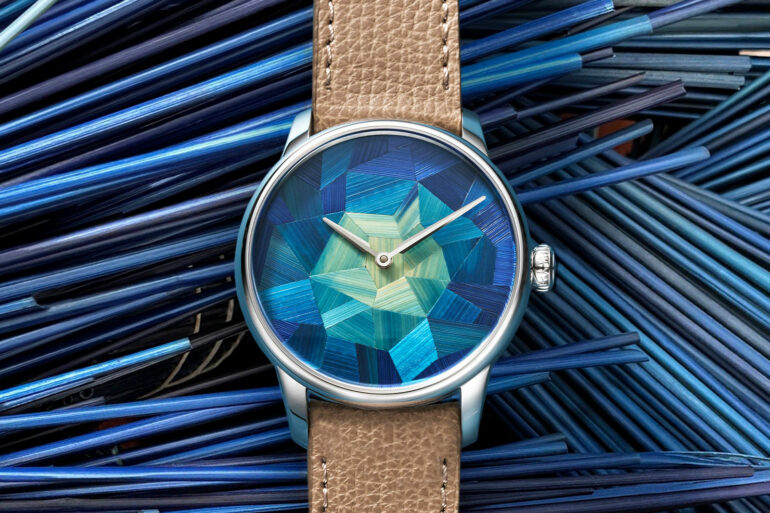
The design chosen for this edition moves away from traditional floral motifs to embrace contemporary geometry. Named “Broken Ice,” the composition evokes a frozen surface in the midst of shattering. The color palette reinforces this sensation of mineral freshness: shades of teal and azure blue blend with deeper sapphire highlights. The layout follows a smoky gradient, with the lightest shades at the center gradually darkening toward the edge of the dial.
The result is a visually rich object, yet devoid of superfluous embellishments. The dial features no hour markers or numerals, leaving the entire space to Bernardo d’Orey’s artwork. The slender hands glide over this abstract landscape without disrupting its balance. It’s an approach that could be described as “minimal but not minimalist”: while the lines are clean and simple, the complexity of the execution invites microscopic observation. Each fragment of straw has its own grain and direction, creating a chromatic puzzle of rare density.
The Balance Between Tradition and Everyday Life
To house this work of art, Louis Erard has chosen a 39-mm-diameter stainless steel case. This classic and versatile size allows the watch to maintain an elegant profile while making a bold statement. At 12.82 mm thick, the watch has a certain heft, reminding us that it is not merely a piece of jewelry, but a robust mechanical timepiece. The case features meticulous finishes that frame the dial without overshadowing it.

Inside beats the Sellita SW261-1 automatic caliber. This movement, renowned for its reliability, features an “élaboré” finish. Mechanical watch enthusiasts will appreciate the inner workings visible through a transparent case back made of gray-tinted sapphire crystal—a subtle touch that echoes the dark hues of the dial. The movement offers a 38-hour power reserve and beats at a frequency of 28,800 vibrations per hour, ensuring a level of precision that matches the watch’s aesthetic sophistication. The watch is mounted on a beige grained calfskin strap, whose softness and neutral hue subtly contrast with the cool metallic sheen of the steel and the electric blues of the dial.
A New Height of Exclusivity
This Marqueterie de Paille edition marks another step forward in the brand’s strategy of making craftsmanship—typically reserved for a very select few—accessible to a wider audience. However, the rarity is even more pronounced here: whereas the brand’s previous forays into wood marquetry were limited to 99 pieces, this edition is restricted to just 25 pieces. This decision underscores the extreme difficulty of the craftsmanship and the considerable time invested by the Portuguese artisan in each piece.
Priced at 4,500 CHF (approximately 4,095 £ before taxes), this piece is positioned as a collector’s item for those seeking artisanal watchmaking. This price reflects not only the quality of the components but, above all, the value of human time—time that is not measured in seconds but in hours of infinite patience. By blending the ancestral art of marquetry with a modern vision of design, this collaboration demonstrates that straw, when elevated to an art form, can rival the most precious materials in capturing the essence of time.
Water resistance is guaranteed up to 50 meters, ensuring sufficient protection for daily use, although this timepiece’s primary purpose is to shine on special occasions. This watch is a demonstration of quiet strength, a reminder that amid today’s technological clamor, the silence of the workshop and the precision of a scalpel on a strand of straw retain their undiminished power to fascinate.