Make Texture a preferred source on Google to support us
Add Texture to GoogleYou have to get very close to the Big Bang Soldier All Black to realize that it isn’t really meant to be read. From a distance, it looks like a typical black, massive watch in the Hublot style. Just a few centimeters from the wrist, the scene shifts: silhouettes of little soldiers invade the bezel and dial, disrupting the usual landmarks and transforming the timepiece into a field of observation. This 50-piece edition, born from the collaboration between Hublot and the London-based artist of Nigerian origin Leonard Iheagwam—known as Soldier—places an uncomfortable question at the heart of a luxury accessory: what remains of war when it becomes a motif, a toy, or camouflage?
A watch designed to obscure the display
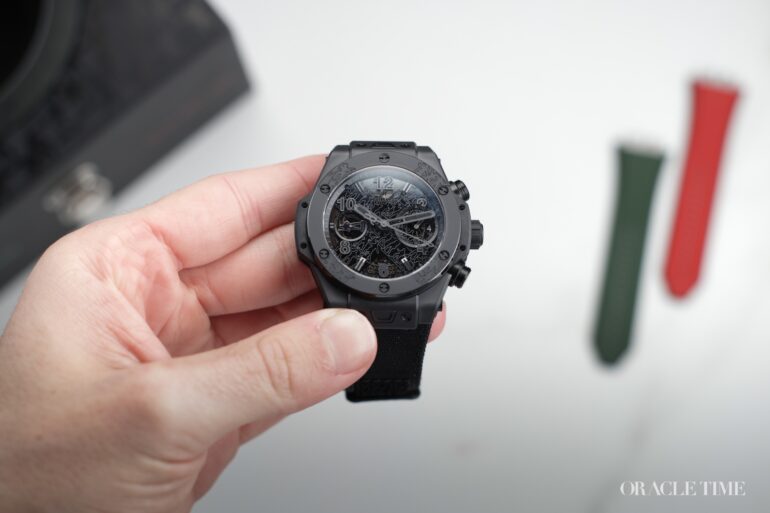
Hublot’s All Black collection has built its identity on a simple idea: eliminating color, reducing contrasts, and letting volumes take center stage. Here, this approach takes on an almost radical form. The case, dial, hands, and movement all feature the same dark palette. The 42-mm diameter and 14.5-mm thickness ensure a tangible presence, yet the watch defies the visual obviousness one typically expects from a chronograph.
The microbead-blasted and polished ceramic bezel features an X-shaped motif formed by a series of miniature soldiers in silhouette. These figurines are reminiscent of the small plastic characters found in children’s toys. They also appear across the semi-openwork dial, where certain openings reveal mechanical components, including the date disc. The shapes are neither regular nor symmetrical; they require a moment’s pause before the eye can make out the time indications.
This difficulty is not a flaw concealed behind an artistic statement. It constitutes the very mechanism of the piece. The soldiers form a sort of camouflage, while the black hands blend into their black background. Reading the time requires making the effort to separate the functions from the image. The watch thus treats camouflage not as a military decoration, but as a way to prevent immediate perception and delay interpretation.
One detail in particular highlights this ambiguity: the small seconds hand is indicated by a soldier. His silhouette serves as the hand, and the tip of his rifle points to the outer scale. This choice might seem playful were it not specifically imbued with the meaning of *Soldier*. Here, the armed man becomes a measuring instrument, trapped in a circular, repetitive motion.
The Military Motif: Between Constraint and Protest
Leonard Iheagwam grew up in Lagos before settling in London. His work addresses issues of migration, cultural diaspora, and the military imagination. In his home country, civilians are prohibited from wearing camouflage clothing. This restriction fuels his recurring use of military references, employed as a gesture in support of freedom of expression rather than as a mere aesthetic code.
The Big Bang Soldier All Black fits into this framework. It does not replicate a uniform nor does it claim a martial appearance. Instead, it features toy soldiers—figures immediately recognizable from childhood—to question the trivialization of war. In the form of a small green object traditionally molded from plastic, the soldier loses its gravity: it becomes an accessory, a prop, a collector’s item. It is this supposed lightness that the artist transposes onto a high-tech watch.
The contrast produces a more compelling effect than a message plastered onto a dial. A chronograph is designed to measure, organize, and quantify. Yet the motif chosen by Soldier evokes a human activity whose effects are, in fact, far from neutral. The piece does not resolve this tension; it makes it visible—and at times even difficult to look at, given how the elements on the dial overlap.
This approach distinguishes the collaboration from a mere exercise in personalization. Hublot thus continues its dialogue with artists, following a recent collaboration with Jeff Koons, but the result takes neither the path of decorative sculpture nor that of spectacular color. Instead, Soldier opts for subtlety, black, and optical confusion. His contribution is first and foremost perceptible in what the watch conceals.
The Mechanics Beneath the Camouflage
The construction retains the technical attributes expected of a Big Bang. The chronograph pushers and crown are made of black titanium. Their operation is designed to be particularly light: a gentle press is enough to start the central chronograph hand, while the reset to zero occurs without any perceptible delay. This ease of operation contrasts with the visually dense appearance of the watch as a whole.
On the back, a sapphire crystal offers a view of the HUB1280 Unico automatic caliber. It beats at a frequency of 28,800 vibrations per hour (4 Hz) and has a power reserve of 72 hours. The movement also adopts the watch’s monochromatic aesthetic, including the balance wheel. The decision not to reserve the black finish solely for the dial reinforces the watch’s cohesion: the mechanism does not appear as a bright or decorative interlude, but rather as a continuation of the watch’s darkened architecture.
The openings in the dial already offer glimpses of this mechanical work. This interplay between what appears and what disappears is one of the piece’s formal successes. The structure of the movement is hinted at, but never enough to allow for unimpeded reading. Even transparency is kept at a distance.

The watch is water-resistant to 100 meters, or 10 bars, and features hours, minutes, a small seconds hand, a date display, and a chronograph function. These concrete specifications serve as a reminder that, beyond its artistic intent, the watch is still meant to be worn. The artistic dimension has not eliminated its practical use; rather, it has complicated the relationship between the two.
Three straps, three degrees of departure from convention
The black fabric strap with a Velcro closure extends the watch’s overall understated look. Hublot also provides two rubber straps, one edged in red, the other in green. These two colors are the only distinct breaks in the appearance of the Big Bang Soldier All Black. They echo the hues that recur in the Soldier’s visual universe and are also featured on the front of the presentation box dedicated to this edition.
The strap-changing mechanism is integrated into the lugs: a trapezoidal button, located on the upper part, releases the strap with a simple press. This solution allows the watch’s look to be quickly changed without tools. Red and green do not alter the watch’s core concept, but they shift its tone: they bring to the surface elements that black seemed to have absorbed.
This set of straps prevents the watch from being confined to a single silhouette. On a black fabric strap, the watch embraces its ability to blend into the wrist. With the rubber versions accented with color, it takes on a more prominent presence, without losing the presence of the soldiers that structure its dial.
A limited edition for a specific audience
Referenced 441.CI.1140.NR.HBL26, the Hublot Big Bang Soldier All Black is limited to 50 pieces and priced at 22,900 pounds sterling. This pricing places it just above the ceramic Big Bang models, which start at 20,700 pounds—a relatively modest price for an edition resulting from an artistic collaboration.
Yet it does not seek universal approval. Its dial makes time-reading less immediate, its theme eschews the comfort of a purely decorative motif, and its all-black design demands a level of attention that many watches, on the contrary, seek to avoid. This is precisely what gives it its coherence. The Big Bang Soldier All Black does not put war on display; it transforms it into an image that disrupts the very function of the object. Details about this edition are available from Hublot.