Make Texture a preferred source on Google to support us
Add Texture to GoogleIn the early 1970s, as Diana Ross began her rise as a solo artist following her time with the Supremes, her quest for emancipation extended beyond the recording studio. It found its most intimate and daring expression within the walls of a unique Beverly Hills residence, located at 701 N. Maple Drive. This home, far more than just a California pied-à-terre, became the aesthetic laboratory of a woman who shaped her image with surgical precision. Amid soaring ceilings and reflective surfaces, the star orchestrates a daily life where family life and the staging of her own legend blend together, transforming her home into a natural extension of her creativity.
Architecture Designed for Art and Discretion
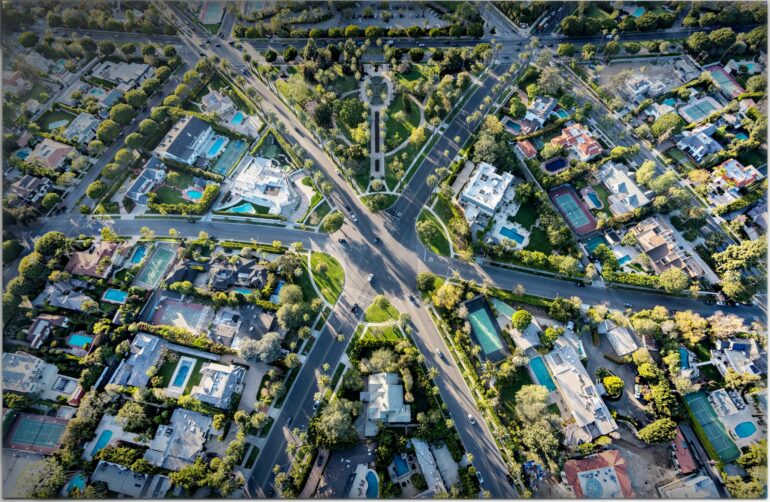
Built in 1964, the property already possessed a predisposition for the exceptional. It was originally designed for Donald Factor, grandson of the founder of the Max Factor cosmetics empire and a discerning art collector. This background explains the building’s radical architectural approach: facades that are almost windowless facing the street, limiting windows to the bare minimum in order to provide vast, uninterrupted wall surfaces inside. This design choice—often commented on by neighbors, who sometimes nicknamed the residence “the house without windows”—allowed for the display of large-scale works without fear of glare or direct light.
With a living area of approximately 635 square meters, the house features monumental ceiling heights of over 9 meters. This expansive space offered Diana Ross a rare sense of breathing room in the heart of Los Angeles. The structure, comprising five bedrooms and nine bathrooms, was centered around a central living area where light and materials created the atmosphere of a modern sanctuary. Outside, the California lifestyle took center stage with a swimming pool and a private tennis court—essential elements of Beverly Hills’ opulence.
The Ross Aesthetic: Mirrored Surfaces, Velvet, and the Conversation Pit
The interior design of Maple Drive reflects the stylistic transformations of the 1970s. The most iconic element of this layout is undoubtedly the “conversation pit”—a sunken living area that defined the social spaces of the era. In the early 1970s, this sunken area was covered with immaculate white shag carpet, creating an island of tactile softness amid the concrete structures. Later, toward the end of the decade, Diana Ross opted for a more theatrical look: a dark burgundy carpet paired with a navy blue sofa and white cushions, contrasting sharply with the sculptural, deep purple sofa that took center stage in the room.
The singer’s penchant for sparkle and light was evident in her lavish use of reflective surfaces. A grand piano entirely covered in mirrors took center stage, echoing a monumental fireplace that was also framed by mirrors. To create a sense of flow while maintaining a touch of glamour, curtains made of metallic beads served as ethereal dividers between the different living areas. On the walls, the star’s art collection underscored its pop aesthetic, notably with a large-scale Andy Warhol tapestry depicting Marilyn Monroe—a piece that engaged in a dialogue with the space’s modernity.
The Theater of Private Life
For Diana Ross, this house was the physical embodiment of her independence. The lyrics of her 1979 song, “It’s My House,” resonate particularly strongly in this setting: in it, she referred to that armchair placed exactly where she wanted it, asserting that every detail was the result of her care and love. The home bore witness to pivotal moments in her personal life, notably her marriage to producer Robert Ellis Silberstein from 1971 to 1977. It was here that her daughters—Rhonda Ross Kendrick, Tracee Ellis Ross, and Chudney Ross—grew up.

One of the most famous photographs from this period, taken in 1972, shows Diana Ross, eight months pregnant with Tracee, posing next to her mirrored piano. At that time, she was at the height of her critical acclaim, riding the success of the film *Lady Sings the Blues*, in which she portrayed Billie Holiday. The Maple Drive home thus served as a peaceful retreat from her whirlwind career. In 1978, she opened her home there for an extensive televised interview conducted by Barbara Walters, allowing the public a glimpse into this carefully staged intimacy.
The End of an Era in Beverly Hills
The year 1982 marked a sort of apotheosis for the Maple Drive resident. She celebrated her 38th birthday there amid a burst of creative energy—the very same year the album *Silk Electric* was released and her star was unveiled on the Hollywood Walk of Fame. However, the mid-1980s marked the end of this California chapter. In 1985, Diana Ross decided to sell the property at 701 N. Maple Drive.
The transaction, recorded at the time for $1.75 million (approximately 1.65 million euros at current exchange rates, without adjusting for inflation), marked a major turning point in the history of 1970s design in Los Angeles. The home designed by Donald Factor, which the diva lived in and transformed, remains in people’s memories as a perfect example of residential architecture designed for art, where the minimalism of the exterior facades concealed a sensory luxury and decorative boldness befitting one of pop culture’s greatest icons.