Make Texture a preferred source on Google to support us
Add Texture to GoogleOn the worn floor of a wood-paneled room, Kate Moss poses in a jacket with a Union Jack pattern. Mario Testino snaps the photo. It’s 2008, in Deptford, on the south bank of the Thames, in a house that has seen three centuries of shipwrights pass through its doors before turning its attention to fashion. The series is titled “Hope & Glory.” It will appear in the October issue of the British edition of Vogue, on page 320, and will eventually hang on the walls of a national museum and be auctioned off at major auction houses. The house, however, has remained where it was, at the end of Watergate Street. It is now looking for a new owner.
The Master Shipwright’s House
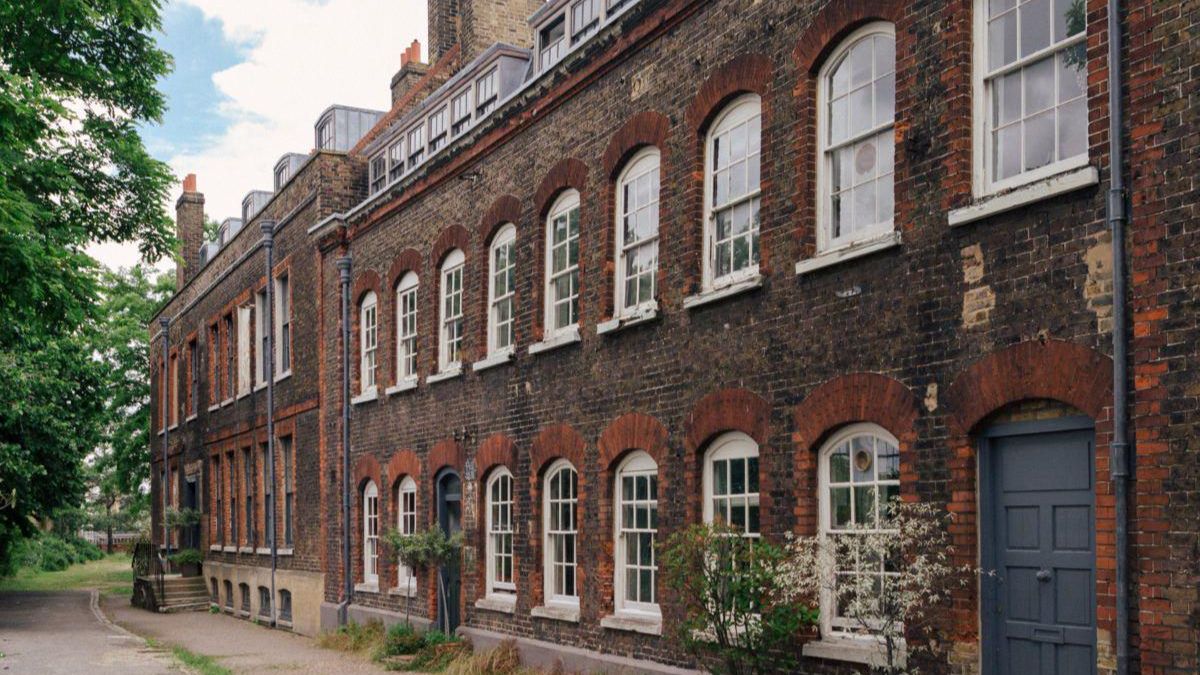
Its name reflects its original function: The Master Shipwright’s House was the official residence of the master shipwright, the man who oversaw shipbuilding at the royal shipyards in Deptford. These shipyards, known as the King’s Yard, were founded by Henry VIII in 1513. The current house dates from 1708. It was built—or rebuilt, depending on the source—for Master Shipwright Joseph Allin, under the supervision of Sir Christopher Wren’s office. The architecture reflects the transition from the Queen Anne style to the early Georgian period. The interior was subsequently remodeled around 1804.
Little remains of the former arsenal. The house is the oldest original building still standing on the Deptford shipyard site, which has earned it a Grade II* listing—the intermediate level of English heritage protection, reserved for buildings of special interest. The official listing dates back to February 3, 1993, under number 1213984. The future of this waterfront area—and in particular the neighboring brownfield site at Convoys Wharf—has, in fact, been the subject of debates in the British Parliament.
The landscape, however, has changed in character. From the garden, the view no longer looks out over ship hulls under construction but toward the skyline of Canary Wharf, across the river. Three hundred years of London’s economic history are captured in this frame: the former naval power in the foreground, finance in the background.
Thirty Years of Careful Stewardship
In June 1998, Willi Richards and Chris Mažeika purchased the property for a recorded price of between 195,000 and 200,000 pounds. This marked the beginning of a restoration spanning nearly three decades, carried out using a “light touch” approach. The principle involves making as few changes as possible to what is visible and as many as possible to what is not. The patinas, plasterwork, and period woodwork were preserved. The roofs, electrical system, plumbing, and heating were redone.

This decision largely explains the house’s second life. A space with walls that show their age and floors that no one has sanded to restore them—that’s exactly what photographers and set designers are looking for. An interior that’s been overly restored doesn’t photograph well; this one has retained its imperfections.
The main building offers approximately 731 square meters of living space (7,875 square feet), divided into six bedrooms, three bathrooms, and four reception rooms. Outside, an enclosed landscaped garden slopes down to the banks of the Thames. Private gardens of this kind, opening directly onto the river, have become rare downstream from central London. The entire lot covers approximately 0.75 acres, or nearly 3,000 square meters.
Kate Moss, page 320
The 2008 photo shoot took place in the house’s weathered rooms, on its antique floors. Two images from the series gained particular attention: the large-format portrait of Kate Moss in a Union Jack jacket, and a shot in which she appears seated in a circular armchair. The combination of the national emblem and an early 18th-century interior built for the Royal Navy is by no means coincidental in a series titled “Hope & Glory.”
These prints have made their way beyond the pages of the magazine. In 2016, they were featured in the Vogue 100: A Century of Style exhibition at the National Portrait Gallery in London, which traced a century of fashion photography. Prints from the series have also been auctioned at Christie’s, Sotheby’s, and Phillips. The amounts achieved are not disclosed here. What stands out most is this: part of the brand’s image now circulates on the art market, independent of its own walls.
A Setting That Plays Other Roles
Fashion photography was just one chapter. The house served as the main setting for John Luther’s apartment—the detective played by Idris Elba in the crime series *Luther*. The film industry has also made use of it, for David Cronenberg’s *Eastern Promises* and for *Sylvia*, starring Gwyneth Paltrow.

There is something paradoxical about this filmography. The oldest building on the former royal shipyard has often lent its rooms to characters who had no connection to its history: a tormented London cop, contemporary plots. It is precisely its state of preservation—this lack of restoration—that allows it to transition from one role to another.
Between 2020 and 2025, the house also welcomed the public under a different name. An independent theater and arts organization, The Shipwright, was run there by Joseph Winters with the support of the owners. For five years, the private residence thus functioned in part as a performance venue, extending its role as a setting while, this time, making it accessible to audiences.
What the house is worth, and what’s actually being sold
This is where you need to read the figures carefully. The main house is listed at an asking price of 4,500,000 pounds, marketed primarily by the Hamptons agency from its Greenwich office. This amounts to approximately 5.4 million euros. The figure of “$6 million” that accompanied the listing across the Atlantic is merely a conversion: at the November 2026 exchange rate, those 4.5 million pounds equate to roughly $5.8 to $6 million. The reference price remains denominated in sterling.
Most importantly, this price does not cover the entire estate. Depending on the listings and platforms, the property is presented in two ways: either the main house alone, priced at 4.5 million pounds, Or the entire property, which also includes an annex called the Back House and the entire lot, for a total of up to ten bedrooms, at an asking price of 8,000,000 pounds, or approximately 9.6 million euros. To say that the entire estate is “worth $6 million” would therefore be inaccurate.
One final point sheds light on the property’s history. In 2010, an initial attempt to put the property up for sale was made at 5,000,000 pounds. The asking price today for the main house alone is lower than that figure from sixteen years ago, while the price for the complete estate far exceeds it. As for the difference from the 1998 purchase price, it illustrates just how far the property has come: the main house is now listed at more than twenty times the amount paid by its current owners, before three decades of renovations.
It remains to be seen who will move into this house that so many people have already seen without ever knowing it: on a magazine page, in a room at the National Portrait Gallery, or in the background of a scene from *Luther*. The next occupant will inherit a residence built in 1708 for Joseph Allin, an enclosed garden on the banks of the Thames, and a view of Canary Wharf. It will also be up to them to decide whether cameras can still pass through the gate on Watergate Street.