Make Texture a preferred source on Google to support us
Add Texture to GoogleThe English Channel has a way all its own of swallowing up the light. Under the low skies of Normandy, the horizon often dissolves into shades of pearl gray and metallic blue, blurring the uncertain boundary between water and air. On this coast, subject to the whims of the ocean and westerly winds, Cabourg stretches out toward the open sea, firmly anchored to its foreshore. Yet walking its streets means immediately encountering a dual, almost spectral geography. This seaside resort in Calvados is not merely an elegant stack of glazed bricks and century-old woodwork; it remains the physical embodiment of one of the most famous settings in French literature. Here, the topographical reality constantly clashes with the memory of Balbec. By preserving these shores in the amber of his work, Marcel Proust forced his readers to superimpose fiction onto the town’s very real avenues. The salty air sweeping across the waterfront carries echoes of a vanished society, while the city’s very urban layout seems designed as the demanding backdrop for a play whose actors left the stage over a century ago.
The Illusion of a Seaside Geometry
Cabourg’s urban history is inextricably linked to the rise of sea bathing, that social and medical revolution that radically transformed the relationship with the coastline during the nineteenth century. Before the arrival of the railroad and the influx of Parisian capital, the site was nothing more than a ribbon of wild dunes. The creation of the resort from scratch stemmed from a fierce determination to tame nature, to stage it for the benefit of a bourgeoisie in search of new rituals. The street plan immediately reveals this rational ambition: a fan-shaped layout that unfolds with geometric precision from the Casino gardens, radiating inland in perfectly concentric avenues.
This grid, laid out with surgical precision, is now home to a dazzling array of architectural eclecticism. The villas, built to publicly assert their owners’ status, vie with one another in their uniqueness. Asymmetrical roofs covered with interlocking slate tiles interact with slender turrets and bow windows that open wide onto public spaces. The Neo-Norman style blends with Gothic pastiche, the precision of cut stone, and the exotic charm of Swiss-inspired chalets. The half-timbered facades are adorned with colorful ceramic finials, two-tone brick friezes, and wrought-ironwork featuring intricate botanical motifs. Each residence, whose name engraved in the lintel proclaims the identity of its founders, was part of a silent form of social competition. The walker who wanders through these linden-lined alleys physically senses the tension between the austerity of the urban plan and the exuberance of the private decor. It was in this shaded labyrinth that high society adapted its Parisian codes to withstand the sea spray.
The Palace’s Social Aquarium
At the absolute focal point of this vast complex stands an immaculate, stony structure. The Grand Hôtel, with its symmetrical façade and monumental roofs, functions as the central cog in the seaside resort’s machinery. Rebuilt at the very beginning of the twentieth century, the current hotel corresponds exactly to the one the writer knew, lived in, and scrutinized relentlessly. Between 1907 and 1914, the author made it his regular summer residence. Fleeing the pollen of Île-de-France and the violent asthma attacks that exhausted him, he discovered in this stationary ship an environment conducive to both clinical rest and sociological observation of his contemporaries.
His room, No. 414, perched on the fourth floor, quickly took on the character of a lookout post. Carefully sealed off and oriented to take in the horizon without being directly exposed to the sea breezes, it became the crucible of his novel-writing. From this refuge, he dictates, cross out, and annotate, before going downstairs to participate in the life of the ground floor when his strength allows. The grand dining room, encircled by monumental floor-to-ceiling windows, occupies a pivotal place in his mental architecture. He perceives and describes it as a marvelous aquarium. Inside, bathed in the warm light of the chandeliers, high society dines in formal attire, following a rigid choreography. Outside, pressed against the cold windows in the deepening darkness, onlookers and locals watch the spectacle. A simple glass wall separates two worlds that observe each other without mingling—a dividing line that the narrative will dissect to the extreme.
A vanishing point on the sand
The junction between this interior opulence and the raw brutality of the tides required a grand infrastructure. The pedestrian promenade that runs along the beach, stretching its long, clear line for several kilometers, structures the entire waterfront. This wooden and concrete seawall stands as the resort’s lifeline, the undisputed center of summer life. In the past, people would pass each other there with measured steps, hidden beneath beach umbrellas, strictly adhering to the protocol of greetings and appraising glances.
Yet it is precisely within this space of social conventions that the novel brings to life the dazzling energy of youth and the upheaval of an era. On this uncertain boundary between the solidity of the city and the shifting sands, the famous little gang appears. Young women marching side by side, defiant, in control of their bodies and their laughter, their very presence disrupting the constrained demeanor of the established bourgeoisie. Walking along this promenade today, with one’s face exposed to the gusts from the west, induces a slight sense of vertigo. The steady surf, the piercing cries of the seagulls, and the crunch of sand beneath one’s shoes compose an unspoiled soundscape, a direct channel to the memory of the place. The beach, vast and flat at low tide, offers an unobstructed view that contrasts sharply with the architectural density of the hinterland.

The embodiment of a vanished century
To grasp the historical depth of this setting requires going beyond a mere contemplation of the seaside facades. Set back from the hustle and bustle of the seaside resort, the Villa du Temps retrouvé has chosen to anchor this intangible heritage within the reality of a museum. Rather than displaying a multitude of isolated biographical relics, the museum strives to recreate the aesthetic and intellectual ecosystem of the entire Belle Époque. Visitors enter not a frozen writer’s home, but a reconstruction of a world teetering on the brink, torn between its unshakable faith in industrial progress and a latent melancholy.
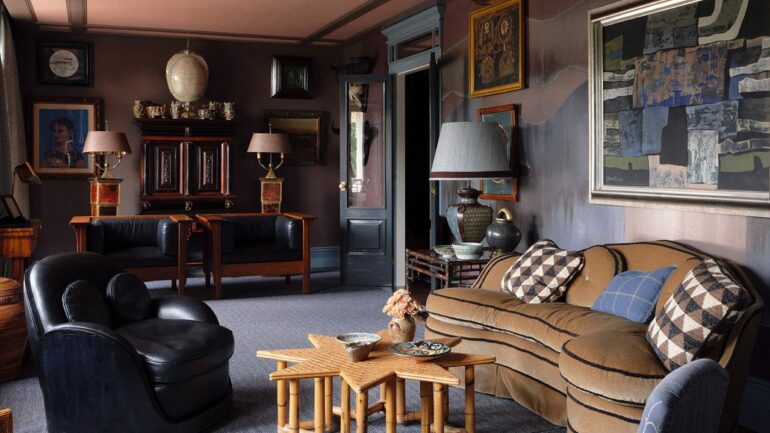
This immersion is achieved through the convergence of objects. The sinuous furniture, heavy fabrics, early photographs, and late-nineteenth-century paintings interact in rooms bathed in rich hues. The canvases hanging on the walls immediately evoke the fictional painter Elstir’s obsession with capturing optical phenomena and coastal mists. Behind glass cases, the evolution of the wardrobe silently narrates the gradual liberation of women’s bodies and the invention of leisure time. The exhibition skillfully restores volume and substance to the evanescent silhouettes that inhabit literature, documenting the very real roots of Proust’s imagination.
As night falls, when the crowd leaves the seawall and the mist envelops the villa balconies, the city sheds its seaside trappings. The terraces empty, the avenues grow dark, allowing the dark immensity of the English Channel to reclaim its dominance over the landscape. The sea then recedes hundreds of meters, leaving only a dull, steady rumble audible in the darkness. In this physical withdrawal, the anchorage of literature reveals itself with unprecedented depth. Footsteps on the promenade echo in a space that long ago ceased to be merely an expanse of sand and concrete, becoming instead a mental territory permanently fixed by the written word.