
Make Texture a preferred source on Google to support us
Add Texture to GoogleA harsh, almost metallic light bounces off the dark granite before shattering against walls of blue ceramic tiles. In Porto, geography rules. The city does not spread out; it clings, stacks itself up, and plunges toward the Douro estuary in a dizzying array of steep alleyways. The former capital of the North exudes an apparent ruggedness, a character carved in stone, immediately contradicted by the brilliance of its facades. Forget the melancholy often associated with the country as a whole. Here, the murmur of the Atlantic mingles with the clatter of historic trams and the buzz of a metropolis that has successfully woven its industrial heritage into a bold architectural modernity.
Travelers arriving in this labyrinth of stairways are first struck by a burst of color. Cobalt blue and milky white flood the public space, taking over train stations, churches, and ordinary homes. Far from being a mere ornament, this ceramic “skin” tells the story of a trading city that has always looked out to sea, blending Moorish, Flemish, and Brazilian influences to forge its own visual language.
The City as Seen Through Ceramic Tiles
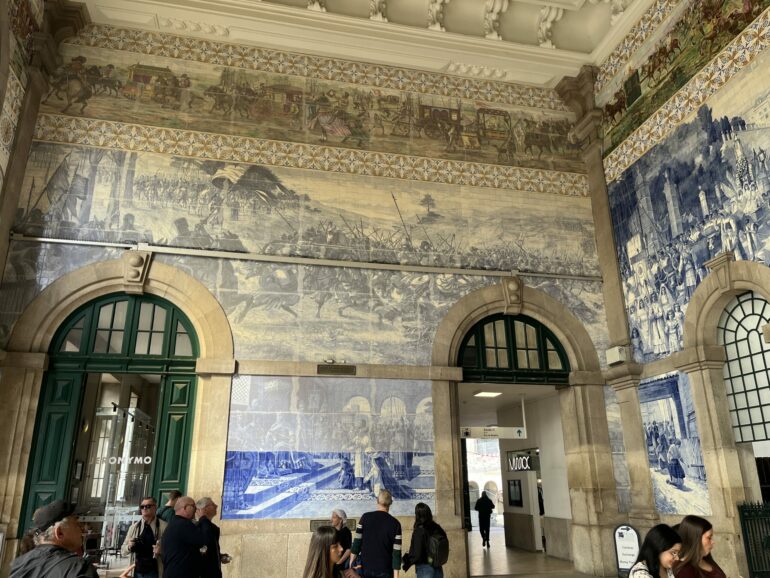
The anchor point of this mural narrative lies at the heart of the city’s nerve center, beneath the vaults of São Bento Station. Inaugurated in 1916, it does more than simply dispatch trains to the Douro Valley or the Minho region. Its waiting hall functions like an open history book. There, painter Jorge Colaço created a monumental mural composed of more than 20,000 tiles. Rather than hurrying to the platforms, travelers pause, craning their necks, to decipher the panels depicting the Battle of Valdevez or the conquest of Ceuta. Here, the azulejo becomes a tool of propaganda and memory, freezing Portugal’s founding myths in an unalterable glaze.
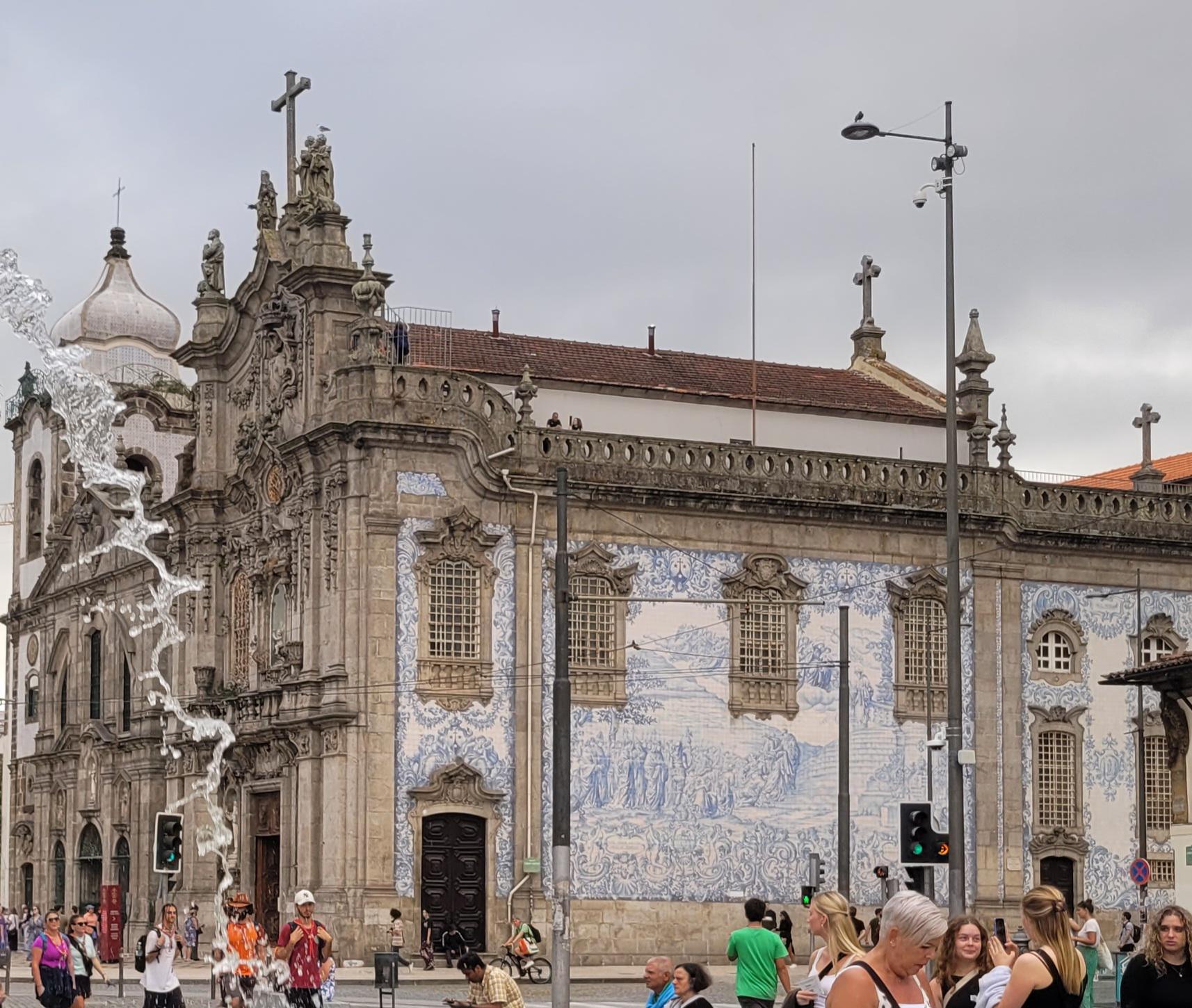
This visual language extends far beyond official buildings. On Rua de Santa Catarina, one of the busiest shopping streets, the Capela das Almas appears as if out of nowhere. Its exterior facades, covered in the early 20th century, depict the lives of Saint Francis of Assisi and Saint Catherine with a narrative density that borders on obsession. The contrast between the gray granite of the window frames and the vibrancy of the blue creates a rhythmic cadence unique to Porto’s architecture. Further west, the Igreja do Carmo pushes the boundaries of the art form even further with an immense side panel that seems to absorb all the light from Praça de Gomes Teixeira, offering a spectacular counterpoint to the adjacent university buildings.
Yet the azulejo is not confined to the monumental past. They adorn the bourgeois buildings of Foz do Douro, flake off the narrow facades of the Ribeira neighborhood, and are reinvented by contemporary designers who continue to explore the malleability of fired clay. It is a living material, whose glaze reflects the changing skies of a city subject to the whims of the ocean.
River Engineering and the Cult of Time
It’s impossible to truly understand Porto without confronting the Douro. The river is not merely a backdrop; it is the economic and symbolic backbone of the region. To span it, 19th-century engineering left an indelible mark. The Dom Luís I Bridge, completed in 1886 by Théophile Seyrig, a former associate of Gustave Eiffel, spans the river with a bold metallic presence that contrasts sharply with the surrounding rocky landscape. Its double deck superimposes two eras: above, the light rail glides silently, offering a bird’s-eye view of the rust-colored tiled rooftops; below, cars and pedestrians skim the dark waters.
On the south bank, you technically leave Porto and enter Vila Nova de Gaia. It is here, in the shade of the hills, that Port wine undergoes its slow transformation. For centuries, the rabelos—flat-bottomed boats with square sails—have carried the barrels down from the terraced vineyards of the Upper Douro, where the schist soils bake under the summer sun. In Gaia, the atmosphere changes abruptly. The air is thick with a calculated humidity and the sweet scent of evaporating alcohol—the famous “angels’ share.”

The urban landscape is dominated by the signs of the great British and Portuguese houses, veritable secular cathedrals dedicated to oxidation and blending. To step through the doors of institutions like Taylor’s or Graham’s is to enter an economy of patience. The oak casks rest there in a sacred twilight. The vocabulary itself requires an initiation. There, one learns to distinguish Ruby—which retains the vibrancy and dark fruit of a short period of bottle aging—from Tawny, whose prolonged contact with wood oxidizes the color to a mahogany hue and develops complex notes of nuts, caramel, and sweet spices. The cellars are not mere museums; they house the liquid wealth of an entire region, whose rarest bottles—the vintage port wines—sometimes lie dormant for a century before being opened.

Vanishing lines and faceted concrete
Reducing Porto to a 19th-century museum, however, would be a mistake in perspective. The city possesses a rough-hewn quality, an avant-garde spirit that finds expression in its recent architectural breakthroughs. Contemporary design makes no apologies; it asserts itself. In Mouzinho de Albuquerque Square, in the Boavista neighborhood, an asymmetrical white concrete monolith seems to have landed from outer space. The Casa da Música, designed by Dutch architect Rem Koolhaas in 2005, has upended the conventions of acoustics and urban aesthetics. Its undulating glass walls offer a glimpse into the main concert hall, blurring the line between the musical elite and the street, while its interior corridors, lined with contemporary azulejos, create a direct dialogue with the local heritage.
The other hub of this modernity is nestled amid the foliage of an eighteen-hectare park. The Serralves Foundation is a manifesto of the Porto School of Architecture. Álvaro Siza Vieira designed a contemporary art museum there, characterized by clean lines and immaculate stucco. The building stretches close to the ground, absorbing natural light through vast skylights, framing the park’s oaks and sweetgums as works of art in their own right. A few hundred meters away, the Casa de Serralves—a pastel-pink villa completed in the 1940s—offers a lesson in Art Deco style, reflecting the refinement of an industrial bourgeoisie that had made its fortune in textiles.
This shift westward, as you travel down the river, inevitably leads to the estuary. Line 1 of the tram, with its varnished wood paneling and brass controls, runs along the right bank to the Foz do Douro neighborhood. It is here that the river’s geography gives way to the vastness of the ocean. The granite seawalls, regularly battered by the Atlantic swell, protect the terraces where the local bourgeoisie comes to enjoy the crisp sea air.
The Felgueiras Lighthouse—a hexagonal tower perched at the end of a breakwater often submerged by winter waves—marks the city’s physical boundary. On stormy days, the foam lashes against the stone. On calmer days, the salt stings the eyes while the silhouettes of cargo ships take shape above the waterline. On a wrought-iron table facing the lighthouse, a glass of dry white port filled with ice cubes catches the sun’s last coppery glints. The wind picks up, suddenly cooling the air. The ocean imposes its rhythm, drowning out the noise of the city, leaving only the open horizon and the steady crash of the water against the granite.