
Make Texture a preferred source on Google to support us
Add Texture to GoogleContemporary watchmaking suffers from a form of visual hyperactivity. Extremely skeletonized dials, fluorescent materials, ostentatious case sizes: capturing a collector’s attention often feels like a contest of aesthetic decibels. The approach adopted by Franck Muller with its new Vanguard Ocean Drive turns this trend on its head. Known for its spectacular complications and boldly curved cases, the Geneva-based manufacturer offers here an exercise in subtlety. Designed for the summer season, this model eschews flashiness in favor of an intriguing restraint, thereby challenging our understanding of what defines exclusivity on the wrist today.
Mastering Aerospace Materials
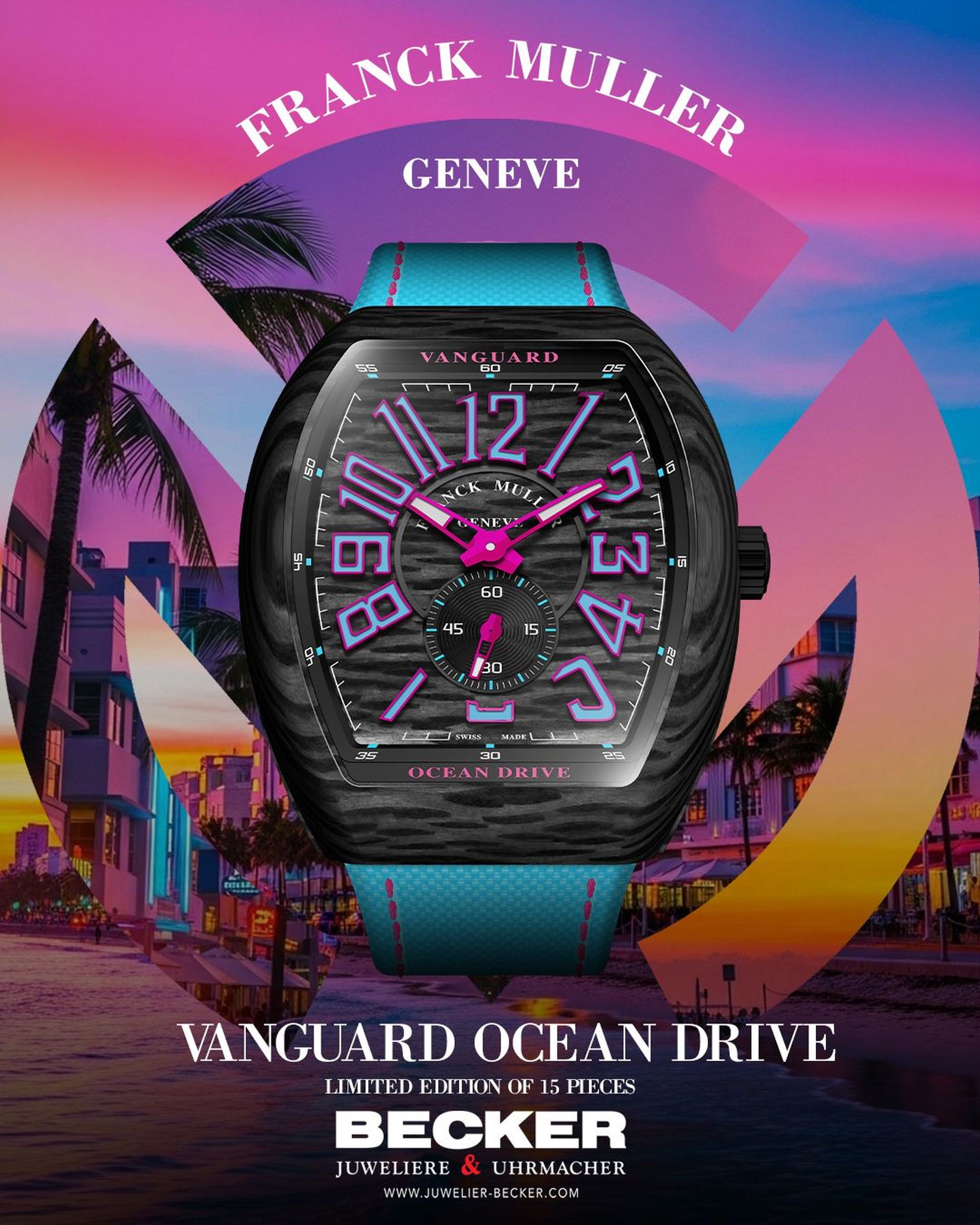
The choice of materials is the first step in this deliberate restraint. The watch industry has long used carbon as a selling point—a symbol of mechanical virility meant to showcase a timepiece’s high-tech credentials. On the Vanguard Ocean Drive, the treatment of this composite material takes a radically different approach. The case is machined from a solid block of 150 compressed layers of aerospace-grade carbon. This structural density, machined entirely within the brand’s workshops, requires heavy-duty machinery and millimeter-level precision, as the material proves particularly finicky under the CNC milling cutter.
But the real feat lies not in the complexity of the machining. It lies in the finish. By opting for a completely matte finish, Franck Muller eliminates the usual reflections of carbon. The watch does not catch the light to shine; it absorbs it. This matte finish gives the timepiece a subtle, almost industrial look, which sharply contrasts with the flashy effect found on other competing models. Here, carbon returns to its primary function: ensuring absolute lightness and extreme durability, prioritizing comfort while wearing it over a display of status.
Color as the Sole Focal Point
The design of the Vanguard collection has historically been rooted in a sporty aesthetic and a highly defined signature, playing on the delicate balance between bold lines and the refinement of the movement. The Ocean Drive tempers this equation. The case measures 41 mm in diameter—a surprisingly modest size for a watch collection that has often prioritized bold proportions. This compact design allows the watch to slip under a sleeve with surprising ease for a watch with such a distinctive shape.
The visual appeal relies exclusively on the use of color. The brand offers two distinct strap options: one in deep black, the other in a bright sky blue. The coherence of the design is evident in the details of the dial. The brand’s signature numerals, meticulously hand-brushed and polished, abandon gold or raw steel to adopt the exact shade of the chosen strap. This color-matching extends to the stitching, creating a visual unit of absolute continuity. By refusing to use multiple colors, the manufacturer forces the eye to focus on the textures: the grain of the bracelet, the matte finish of the case, and the relief of the hour markers. This apparent simplicity masks the painstaking work of harmonizing pigments across materials of different natures.
The Micro-Series Strategy
The question of this piece’s market positioning is resolved with mathematical precision. The Ocean Drive is priced at 15,000 euros, and its total production run is limited to just fifteen units. In the lexicon of luxury, this figure is an industrial footnote and borders on the confidential. The 41-mm case size, combined with such a limited production run, alters the perception of the piece: we are no longer dealing with a collection launch intended to boost sales volume, but rather with an engineer’s whim aimed at an ultra-niche audience.
This triad—compact size, exclusive pricing, and absolute rarity—indicates that Franck Muller is not seeking to attract new customers through a passing trend. The goal is to appeal to a very specific niche of collectors—those who are already well-versed in the brand’s history and aesthetic language. Offering a watch that is at once expensive, technically sophisticated, and visually understated is a bold gamble. Rarity creates initial desirability, but it does not guarantee a design’s longevity. The model relies entirely on the confidence that its limited production run will be sufficient to justify its status.
Narrative and Embodiment
Swiss watchmaking excels in the art of staging its launches, recognizing that the setting in which a watch is unveiled contributes to its value. The presentation of this model took place in the presence of Nicholas Rudaz, the manufacturer’s CEO. Instead of the usual high-profile social galas, the event took the form of an intimate gathering, bringing together a handful of clients, discerning collectors, and close associates of the house. The convivial atmosphere sought for this evening directly echoed the spirit of the watch.
The brand’s message centered on technology, design, and exclusivity, transforming the timepiece into a narrative of cutting-edge craftsmanship. This emphasis on personal connection has become a powerful tool for independent watchmakers. It binds the buyer to the product through a personal and direct experience with the company’s leaders. However, no amount of storytelling, however skillfully executed, can mask potential ergonomic shortcomings. Beyond the official narrative and the select circle of fifteen prospective buyers, the effectiveness of the carbon treatment, the choice of proportions, and the integration of colors will have to stand up to the test of the watch’s physical reality on the wrist.